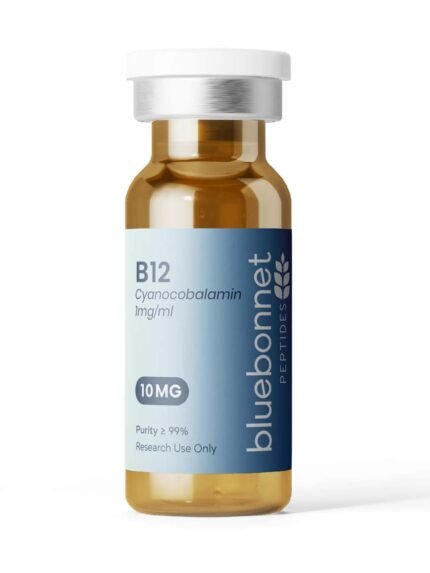
≥99% Purity
 Third-Party Tested
 COA Available
 U.S.-Based
 Research Use Only


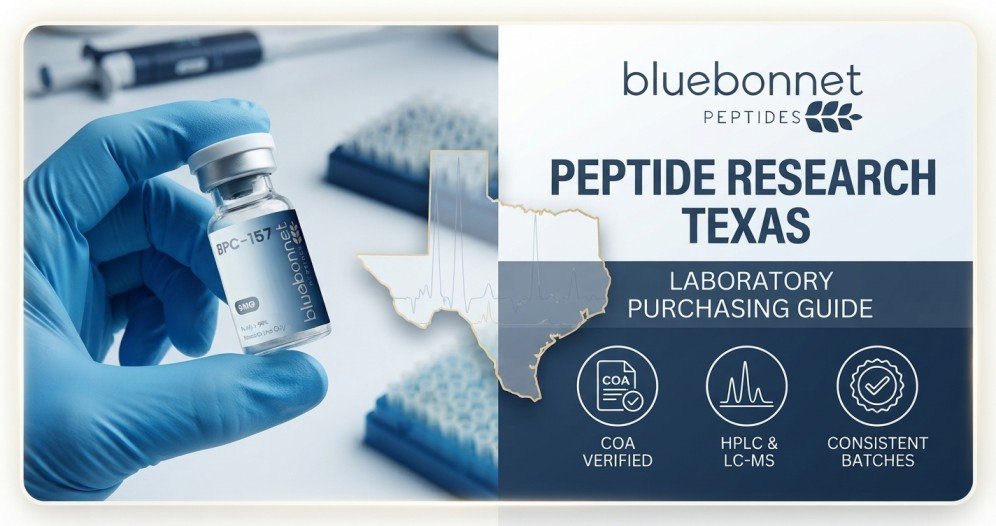
Last updated: August 2026 | 14-minute read
Buying Research Peptides in Texas: A Complete Laboratory Procurement Guide
Texas is not one research market.
It is several research ecosystems operating at once: academic laboratories in Austin, large-scale life sciences networks in Houston, biotechnology companies in Dallas-Fort Worth, biomedical research centers in San Antonio, agricultural and molecular science programs in College Station, and a rapidly growing Central Texas startup corridor.
But across all of these environments, one rule stays the same:
The quality of research materials determines the reliability of research data.
For laboratories purchasing Research Use Only (RUO) peptides in Texas, the decision should never come down to price alone. It should come down to verification, documentation, shipping control, supplier transparency, and batch consistency.
A peptide supplier might look credible online. A product page might claim “high purity.” A vial might arrive quickly. None of that proves the material is suitable for controlled laboratory investigation.
What matters is whether the supplier can document:
- What the peptide is
- How pure it is
- Which batch it came from
- How it was tested
- Who tested it
- How it was packaged and shipped
- How the laboratory should store it after receipt
This guide explains what Texas laboratories should know before purchasing research peptides, how procurement teams can evaluate suppliers, and why third-party testing, HPLC verification, LC-MS confirmation, and lot-specific Certificates of Analysis should be treated as baseline requirements—not optional features.
The Texas Research Environment: Why Procurement Standards Matter
Texas has become one of the most active life sciences regions in the United States.
Austin laboratories benefit from the research infrastructure around the University of Texas at Austin, the Dell Medical School, and a growing network of biotech companies throughout Central Texas. Houston is home to the Texas Medical Center, one of the largest life sciences and biomedical research environments in the world. Dallas-Fort Worth continues to expand in biotechnology, diagnostics, and analytical research. San Antonio and College Station contribute additional strengths in molecular research, laboratory science, and applied biotechnology.
This matters because Texas laboratories often operate under formal procurement systems. University purchasing departments, private research companies, contract laboratories, and institutional research groups may all require documentation before materials can be approved for use.
Common Texas Laboratory Procurement Requirements
- Vendor qualification
- Lot-specific Certificates of Analysis
- Safety Data Sheets
- Batch numbers on invoices and packing slips
- Independent third-party testing
- Storage and handling documentation
- Chain-of-custody records
- Internal receiving inspection logs
These requirements are not bureaucratic obstacles. They exist because reproducibility depends on traceability.
If a research result depends on a peptide, the laboratory must be able to show exactly which batch was used, how that batch was verified, and whether it was handled correctly after arrival.
Bluebonnet Insight
Texas laboratories should treat peptide procurement as part of the experimental workflow—not as a separate purchasing task. The decision made at the vendor selection stage affects purity, identity confirmation, storage stability, batch reproducibility, and the defensibility of downstream research data.
What Are Research Peptides?
Research peptides are short chains of amino acids produced for laboratory investigation, analytical testing, method development, and scientific research applications. They are commonly synthesized using controlled peptide chemistry, purified through chromatographic methods, and verified through analytical testing.
For compliant laboratory use, research peptides must be clearly labeled and handled as Research Use Only materials.
That means:
- They are intended for laboratory research
- They require proper handling and storage
- They should be accompanied by quality documentation
- They should not be marketed with non-research claims
- They should never be represented as consumer products
The RUO designation is important because it defines the appropriate context for the material. A responsible supplier should use clear compliance language and avoid claims that move the product outside laboratory research.
Learn more: Understanding what research peptides are and their role in laboratory science.
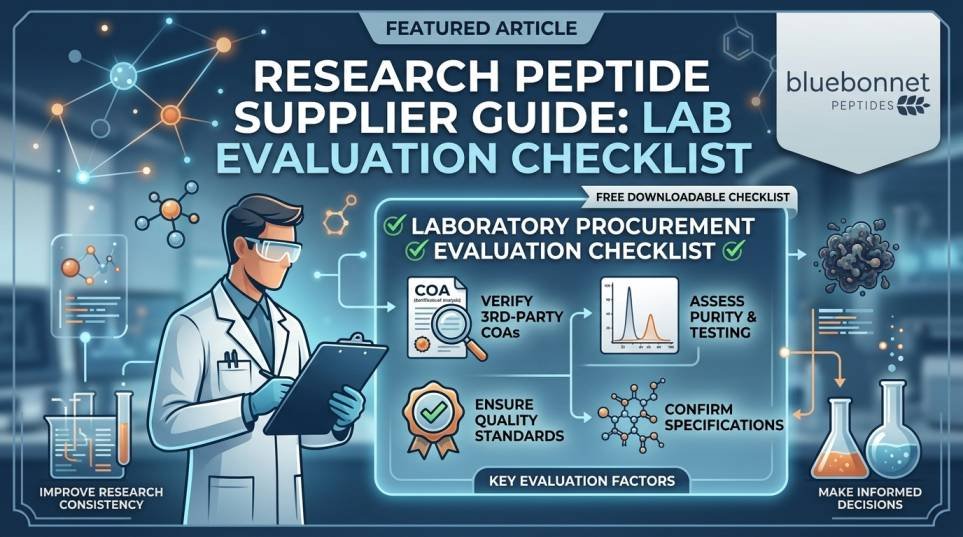
Why Texas Laboratories Need a Structured Procurement Process
Research peptide purchasing should follow a repeatable process.
Without a structured procurement system, laboratories risk approving suppliers based on convenience, price, incomplete documentation, or marketing claims. That creates problems later when data needs to be replicated, audited, or compared across multiple experiments.
Five Essential Pre-Purchase Questions
A strong procurement workflow helps laboratories answer five essential questions before placing an order:
- Is the supplier legitimate and transparent?
- Is the product independently tested?
- Is the COA lot-specific and complete?
- Can the supplier ship safely to Texas conditions?
- Can the laboratory store and document the material properly after receipt?
Each question reduces risk.
For example, independent testing reduces the risk of relying on self-reported purity claims. Lot-specific documentation reduces the risk of using the wrong batch data. Cold-chain shipping reduces the risk of temperature-related degradation. Storage planning reduces the risk of losing quality after the product arrives.
Procurement is not just about acquiring materials. It is about protecting the integrity of the research system.
Learn more: Complete supplier evaluation framework.

Step 1: Vendor Qualification Before Purchase
Vendor qualification is the first filter.
Before a Texas laboratory orders any peptide, the supplier should be evaluated for transparency, testing practices, documentation quality, and RUO compliance.
A Qualified Supplier Should Provide:
- A clear business identity
- Transparent contact information
- Research Use Only labeling
- Lot-specific Certificates of Analysis
- HPLC purity verification
- LC-MS identity confirmation
- Third-party laboratory testing
- Storage and handling guidance
- Shipping practices suitable for Texas temperatures
A supplier that cannot explain its testing process should not be approved.
Vendor qualification should also include reviewing how the supplier communicates. Technical questions should receive technical answers. If a supplier avoids discussing testing laboratories, manufacturing controls, COA details, or batch traceability, that lack of clarity should be treated as a red flag.
Good suppliers educate. Weak suppliers deflect.
Vendor Qualification Checklist
| Supplier Requirement | What to Verify | Why It Matters |
|---|---|---|
| Clear RUO positioning | Products labeled for laboratory research only | Supports compliance and proper use |
| Third-party testing | Independent lab named on COA | Reduces reliance on self-reported claims |
| HPLC data | Chromatogram and purity percentage provided | Confirms relative purity |
| LC-MS data | Observed molecular weight matches expected value | Confirms peptide identity |
| Lot-specific COA | Batch number matches vial label | Supports traceability |
| Cold-chain shipping | Insulated packaging and cold packs available | Protects material during Texas transit |
| Documentation support | SDS, storage guidance, packing records | Supports institutional procurement |
| Technical support | Answers scientific and documentation questions | Indicates supplier competence |
Bluebonnet Insight
A supplier should be evaluated before the first order, not after a problem occurs. Vendor qualification is the least expensive point in the procurement process to identify risk. Once a batch is already incorporated into research, unclear documentation becomes much harder to fix.
Step 2: Reviewing the Certificate of Analysis
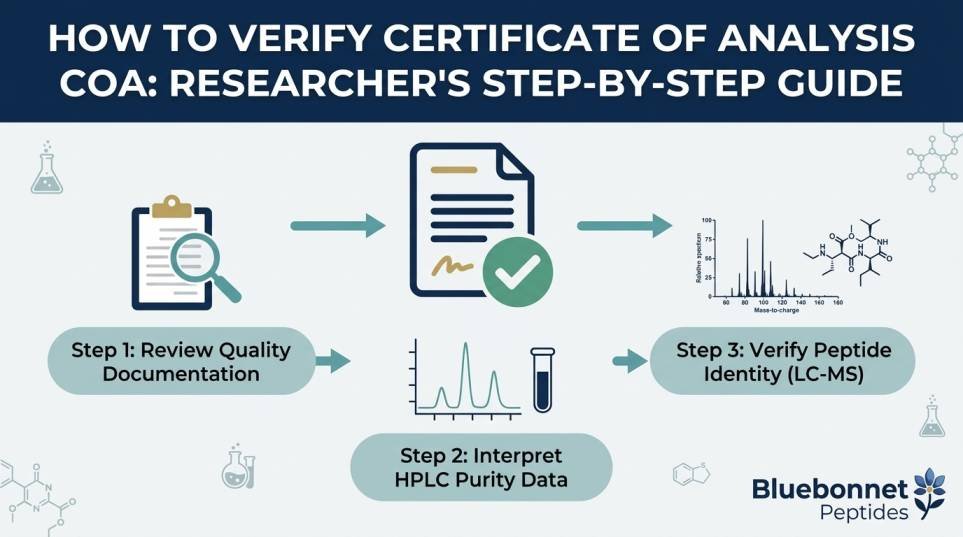
The Certificate of Analysis is the central quality document for a research peptide.
But not all COAs are equal.
A legitimate COA should be tied to a specific batch. It should not be a generic document used across multiple lots. It should include analytical results from the batch being shipped, not historical results from a different production run.
A Complete Peptide COA Should Include:
- Product name
- Lot or batch number
- Manufacturing date or batch date
- Analysis date
- Purity percentage
- HPLC chromatogram
- LC-MS or mass spectrometry identity confirmation
- Appearance description
- Testing laboratory name
- Testing laboratory credentials or accreditation
- Pass/fail criteria
- Authorized signature or digital verification
The most important detail is the lot number.
When the shipment arrives, the lot number on the vial must match the lot number on the COA. If those numbers do not match, the COA does not document the vial in your laboratory.
Learn more: Complete guide to understanding Certificates of Analysis.
Laboratory Best Practice: COA Verification
When a peptide shipment arrives at a Texas laboratory, receiving personnel should complete a COA verification process before placing the material into active inventory.
Recommended receiving checklist:
- Confirm the product name matches the purchase order
- Confirm the vial label includes a lot or batch number
- Match the lot number on the vial to the COA
- Review the HPLC purity result
- Confirm that a chromatogram is included
- Confirm LC-MS or mass spectrometry identity data is present
- Confirm the testing laboratory is independent
- Save the COA in a digital records folder
- Record the storage location in the inventory system
- Document any shipping or packaging concerns immediately
This process should take only a few minutes, but it creates a permanent quality record that protects the research team later.
Step 3: Understanding HPLC Purity Verification
High-Performance Liquid Chromatography, or HPLC, is one of the most important analytical methods used in peptide quality control.
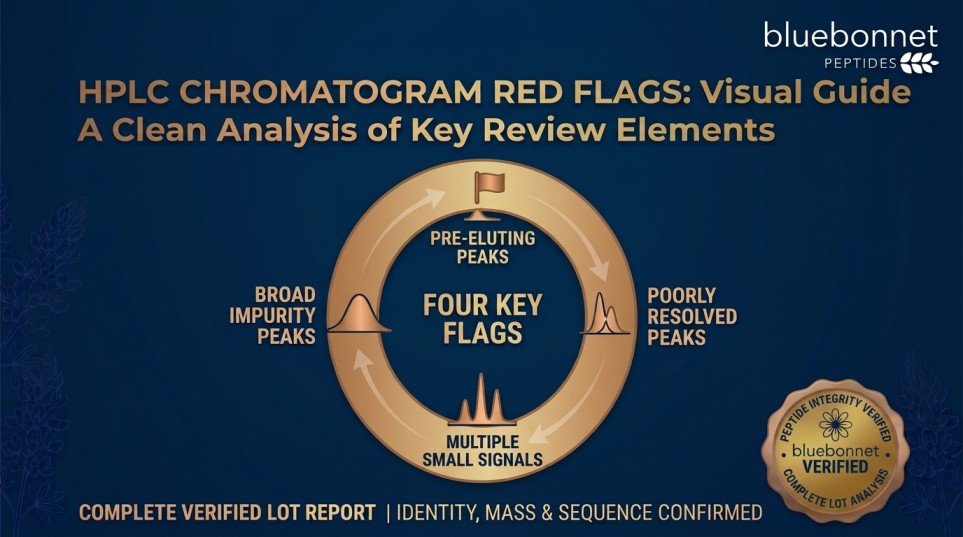
HPLC separates the components of a peptide sample based on chemical interactions with a column and mobile phase. The resulting chromatogram shows peaks corresponding to the target peptide and any detectable impurities.
For research peptide procurement, HPLC helps answer one question:
How much of the sample appears to be the intended peptide compared with detectable impurities?
A high-quality research peptide should show a dominant primary peak with minimal secondary peaks. If a chromatogram shows multiple significant peaks, broad shoulders, or a noisy baseline, those may indicate impurities, incomplete synthesis, degradation, or poor separation.
Why HPLC Matters for Texas Laboratories
- It provides measurable purity data
- It helps identify synthesis-related impurities
- It supports batch comparison
- It gives procurement teams objective quality evidence
- It reduces reliance on marketing claims
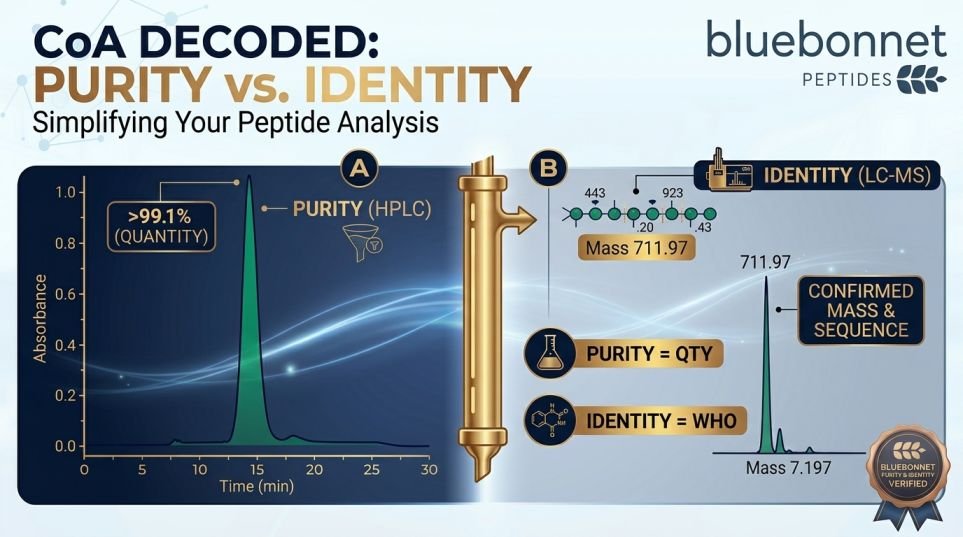
However, HPLC alone is not enough. It measures relative purity, but it does not confirm that the dominant peak is the correct peptide.
That is why LC-MS confirmation is also required.
Learn more: Understanding peptide purity and quality standards.
Step 4: Confirming Identity with LC-MS
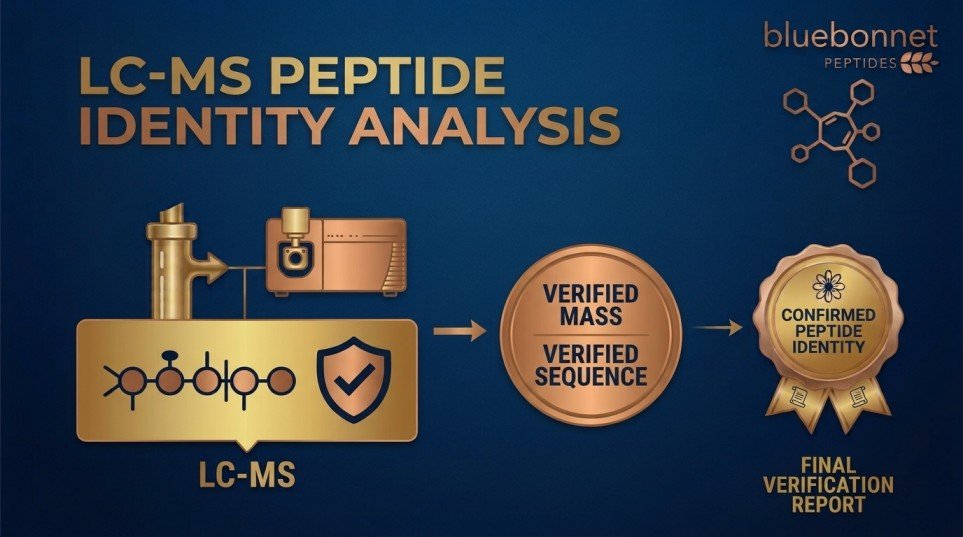
Liquid Chromatography-Mass Spectrometry, commonly called LC-MS, confirms peptide identity by measuring molecular mass.
This is critical because a sample can appear highly pure by HPLC and still be the wrong compound.
LC-MS helps confirm whether the peptide in the vial matches the expected molecular weight for the intended sequence. If the observed mass does not align with the expected value, the batch may contain the wrong material, an incomplete sequence, an unexpected modification, or another analytical issue that requires investigation.
HPLC and LC-MS Answer Different Questions
| Analytical Method | Primary Question | What It Verifies |
|---|---|---|
| HPLC | How pure is the sample? | Relative purity and impurity profile |
| LC-MS | Is the sample the correct compound? | Molecular identity |
| COA | Is the batch documented? | Traceability and quality record |
| Third-party testing | Who verified the data? | Independent confirmation |
A qualified research peptide supplier should provide both HPLC and LC-MS data. One without the other leaves an important quality gap.
Step 5: Third-Party Testing and Why Independence Matters
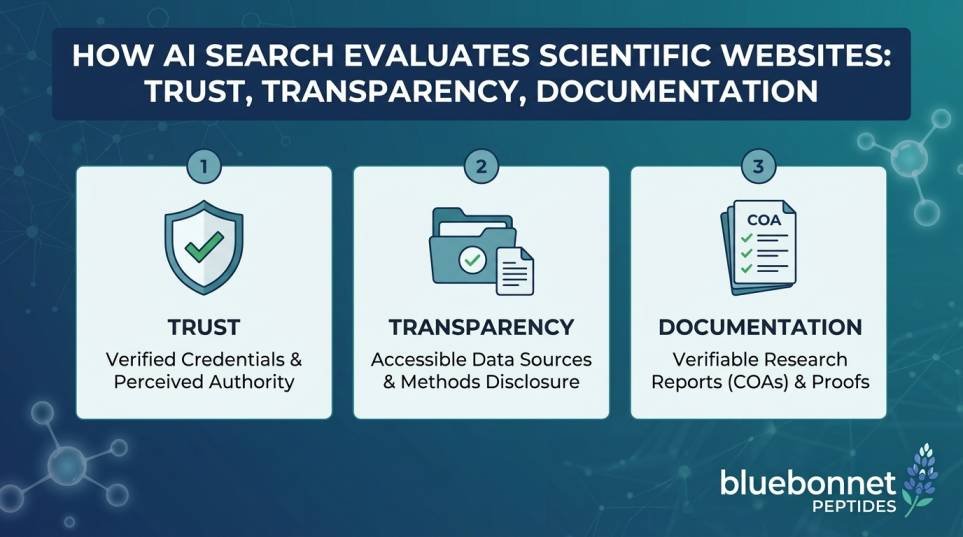
Third-party testing is one of the strongest trust signals in research peptide procurement.
Internal testing can be useful, but independent verification carries more weight because the testing laboratory is separate from the supplier or manufacturer. A third-party laboratory has no incentive to inflate results or overlook quality concerns.
For Texas Laboratories, Third-Party Testing Supports:
- Procurement review
- Internal quality assurance
- Audit readiness
- Experimental reproducibility
- Supplier accountability
- Scientific integrity
A strong third-party testing program should include independent HPLC purity testing and independent identity confirmation, ideally through LC-MS or an equivalent mass spectrometry method.
When Reviewing Third-Party Testing, Ask:
- Is the laboratory named?
- Is the laboratory independent?
- Is accreditation listed or verifiable?
- Does the report include batch-specific data?
- Can the supplier provide the full report if requested?
- Are results tied to the exact lot being sold?
If the COA simply says “third-party tested” but does not identify the laboratory or provide results, the claim is incomplete.
Learn more: Understanding third-party laboratory testing.
Bluebonnet Insight
The phrase “third-party tested” should never be accepted at face value. The testing laboratory should be named, the batch should be identified, and the results should be reviewable. Transparency is not a slogan—it is a document trail.
Manufacturing Standards: What Texas Laboratories Should Ask
Peptide quality begins before testing.
Testing can confirm quality, but manufacturing creates it.
Most research peptides are produced using Solid Phase Peptide Synthesis (SPPS), a widely used method in which amino acids are added step-by-step to a growing peptide chain anchored to a solid resin. After synthesis, the peptide is cleaved from the resin, purified, lyophilized, tested, and packaged.
Key Manufacturing Stages Include:
- Raw material sourcing
- Amino acid coupling
- Cleavage from resin
- Crude peptide analysis
- Preparative HPLC purification
- Lyophilization
- Post-lyophilization quality control
- Third-party verification
- Packaging and shipping
Each step introduces potential quality risks if not controlled.
For example, incomplete amino acid coupling can create deletion sequences. Poor purification can leave residual impurities. Inadequate lyophilization can leave excess moisture. Weak packaging can expose the peptide to humidity or oxygen.
A supplier does not need to reveal proprietary manufacturing details, but it should be able to explain the general quality process.
Strong Supplier Answers Include:
- SPPS synthesis under controlled conditions
- Preparative HPLC purification
- Analytical HPLC verification
- Mass spectrometry confirmation
- Lyophilization to improve storage stability
- Batch-level documentation
- Independent third-party testing before release
Weak Supplier Answers Include Vague Phrases Like:
- “High-quality manufacturing”
- “Lab tested”
- “Industry standard purity”
- “Trusted source”
- “Premium grade”
Those phrases are not documentation.
Learn more:
The complete journey of a research peptide from manufacturing to laboratory.
Why freeze-drying matters for peptide stability.
Batch Consistency and Reproducibility
Batch consistency matters because research rarely depends on a single vial.
A laboratory may begin with one batch during method development, order another batch for a follow-up experiment, and use a third batch during a larger research program. If purity, identity, moisture content, or impurity profile varies significantly between lots, the laboratory may introduce a hidden variable into the data.
Batch-to-Batch Consistency Supports:
- Reproducible experimental conditions
- Valid comparison across timepoints
- Multi-phase project continuity
- More reliable troubleshooting
- Better documentation for publication or internal review
To Evaluate Batch Consistency, Laboratories Should Review Whether the Supplier:
- Tests every batch individually
- Uses consistent specifications across lots
- Provides lot-specific COAs
- Maintains batch records
- Offers access to historical COAs
- Can identify the batch before fulfillment when needed
A single COA from one batch does not prove consistency. It only proves that one batch was tested.
For ongoing research programs, Texas laboratories should consider documenting all batch numbers used in the project and retaining COAs for each lot.
Learn more: Understanding batch-to-batch consistency in peptide research.
Bluebonnet Insight
For multi-month or multi-site research projects, request batch information before ordering. If the same lot is still available, the supplier may be able to reserve material for continuity. If a new lot is required, compare the new COA against the previous lot before integrating it into the project.
Documentation and Traceability for Texas Procurement Teams
Traceability is the ability to connect every vial in the laboratory to its documentation history.
A Traceable Peptide Inventory Should Answer:
- Who supplied the material?
- What product was ordered?
- What lot number was received?
- What COA corresponds to that lot?
- When did the laboratory receive it?
- Who inspected it?
- Where was it stored?
- When was it opened or reconstituted?
- Which project used it?
- Were there any deviations during shipping or storage?
This level of documentation may feel detailed, but it is normal in professional laboratories. It allows research teams to reconstruct exactly what happened if an experiment produces unexpected results.
Recommended Documents to Retain:
- Purchase order
- Supplier invoice
- Packing slip
- Lot-specific Certificate of Analysis
- Safety Data Sheet
- Shipping tracking record
- Receiving inspection form
- Temperature record, if available
- Storage location record
- Reconstitution or preparation record, if applicable to the protocol
- Internal usage log
For Texas laboratories operating within universities, biotech companies, or contract research environments, these records support procurement review and internal quality systems.
Laboratory Best Practice: Digital COA Archive
Create a shared digital folder or laboratory information system entry for every peptide lot.
Recommended folder structure:
Supplier Name > Peptide Name > Lot Number > COA / SDS / Invoice / Receiving Inspection / Storage Record
This structure makes it easy to retrieve documents months later when a researcher, procurement officer, quality manager, or collaborator asks which batch was used.
Shipping and Handling in Texas
Shipping is not an afterthought in Texas.
It is a quality-control step.
Texas Weather Creates Several Challenges for Research Peptide Shipments:
- High summer temperatures
- Humidity in regions such as Houston and the Gulf Coast
- Long ground transit routes across the state
- Warehouse heat during carrier transfers
- Weekend delays
- Delivery trucks without continuous temperature control
Even lyophilized peptides can degrade when exposed to excessive heat or moisture for extended periods. Reconstituted or solution-based materials are generally more sensitive.
A supplier serving Texas laboratories should use shipping protocols appropriate for the destination and season.
Recommended Shipping Standards:
- Insulated shipping containers
- Frozen gel packs or cold packs
- Desiccant for moisture control
- Expedited shipping service
- Early-week shipping schedule
- Secure vial cushioning
- Clear packing documentation
- Shipment tracking
- Temperature indicator or data logger for sensitive shipments, when needed
Monday through Wednesday shipping is especially important. Packages shipped late in the week can become trapped in carrier facilities over the weekend, increasing the risk of temperature exposure.
Receiving Inspection for Texas Laboratories
When a shipment arrives:
- Inspect the outer package for damage
- Open the insulated shipper promptly
- Check whether cold packs are still cold or partially frozen
- Confirm desiccant is present
- Inspect vials for cracks, seal issues, or label damage
- Confirm the peptide appearance matches expectations
- Match the lot number to the COA
- Photograph any damage or temperature concerns
- Place material into recommended storage quickly
If the package arrives warm, damaged, wet, or delayed, the laboratory should document the issue before using the material.
Learn more: Peptide storage guidelines for maintaining research quality.
Storage Planning Before the Order Arrives
Storage should be planned before placing the order.
Many laboratories focus heavily on choosing a supplier but fail to prepare receiving and storage systems. That creates unnecessary risk. A verified peptide can still degrade if it is stored improperly after delivery.
Lyophilized peptides are generally more stable than reconstituted materials, but they still require protection from heat, light, moisture, and repeated temperature cycling.
General Storage Framework
| Material State | Typical Storage Approach | Key Risk |
|---|---|---|
| Lyophilized peptide | -20°C for standard storage; -80°C for long-term storage | Moisture, heat, light |
| Reconstituted peptide | Follow peptide-specific laboratory protocol | Reduced stability after preparation |
| Working aliquots | Store according to validated project workflow | Repeated freeze-thaw cycles |
| Archive material | -80°C in monitored freezer | Temperature excursions |
Laboratories should also consider freezer quality.
Frost-free freezers are not ideal for long-term peptide storage because they cycle temperature to prevent ice buildup. Manual-defrost or laboratory-grade freezers with temperature monitoring provide more stable conditions.
Storage Best Practices:
- Store lyophilized peptides promptly after receipt
- Keep vials sealed until use
- Protect from light
- Use desiccant where appropriate
- Avoid repeated temperature fluctuations
- Do not store near freezer doors
- Maintain a freezer temperature log
- Label storage boxes clearly
- Record exact storage location
Learn more:
Peptide storage guidelines for optimal stability.
Peptide reconstitution best practices.
Bluebonnet Insight
Do not wait until a shipment arrives to decide where it will be stored. The receiving team should know the freezer location, inventory entry format, and documentation requirements before the carrier delivers the package. Prepared laboratories protect peptide quality from the first minute of receipt.
Inventory Management for Peptide Research in Texas
Inventory management is often overlooked until a problem occurs.
A peptide vial without clear labeling, location tracking, or usage records becomes a weak point in the research record. Texas laboratories should manage research peptide inventory with the same care used for other controlled laboratory reagents.
Recommended Inventory Fields:
- Peptide name
- Lot number
- Supplier
- Receipt date
- COA file location
- Storage temperature
- Freezer and box location
- Quantity received
- Quantity remaining
- Date opened
- Preparation date, if applicable
- Project or study code
- Responsible researcher
- Expiration or retest date, if assigned
Inventory can be managed through spreadsheets, electronic laboratory notebooks, laboratory information management systems, or barcode systems. The system matters less than consistency.
Laboratory Best Practice: FIFO and Lot Segregation
Use a First-In-First-Out system for routine inventory, but keep lots segregated.
Older material should generally be used first if it remains within quality expectations. However, different lots should not be casually mixed within a single experiment unless the protocol is designed to account for batch differences.
For research reproducibility, always document which lot was used.
Supplier Transparency and RUO Compliance
A supplier’s language tells you a lot about its operating standards.
Responsible RUO suppliers communicate in laboratory terms. Their materials, product pages, labels, and educational content should emphasize research, analytical verification, quality documentation, storage, and laboratory handling.
Warning Signs Include:
- Claims outside laboratory research
- Product descriptions that imply non-research use
- No RUO designation
- No COA access
- No testing details
- No physical business information
- No explanation of shipping conditions
- No response to documentation requests
For Texas institutions, supplier transparency is not only a quality issue. It is a compliance issue. Purchasing departments may reject vendors whose language or documentation does not align with laboratory research standards.
A Transparent Supplier Should Make It Easy to Find:
- COAs
- Testing methodology
- Storage information
- RUO labeling
- Contact information
- Shipping policies
- Batch documentation
- Educational resources
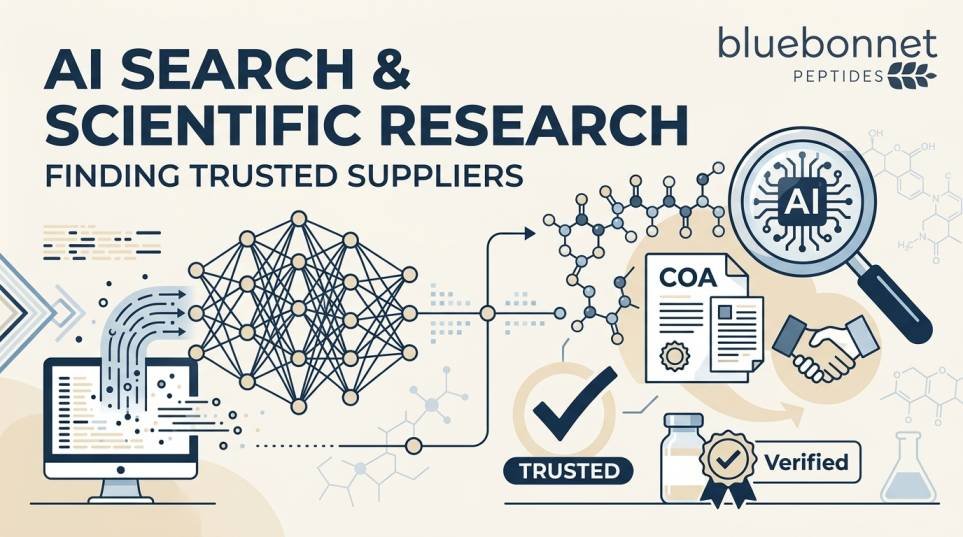
Bluebonnet Peptides emphasizes scientific transparency by providing third-party testing, HPLC verification, LC-MS verification, batch-level COAs, and educational guidance designed for laboratory researchers. The goal is not to replace a laboratory’s internal protocols, but to support informed procurement and responsible handling.
How Bluebonnet Supports Texas Laboratory Procurement
Bluebonnet Peptides serves laboratories across Texas through a US-based Research Use Only supply model built around documentation and verification.
For Texas researchers, the most important supplier qualities are not marketing language or geographic proximity. They are verifiable quality systems.
Bluebonnet’s Educational Standards Emphasize:
- Research Use Only compliance
- Independent third-party testing
- HPLC purity verification
- LC-MS identity confirmation
- Lot-specific Certificates of Analysis
- Batch traceability
- Cold-chain shipping practices
- Storage and handling education
- Supplier transparency
- Scientific integrity
This is especially important for laboratories in Austin, Houston, Dallas, San Antonio, College Station, and other Texas research markets where procurement teams may need documentation before approving materials for use.
Bluebonnet’s position is simple:
Researchers should not have to rely on promises. They should be able to review evidence.
That evidence begins with the COA and continues through manufacturing documentation, analytical testing, shipping practices, and educational resources.
Learn more:
Understanding peptide purity and quality standards.
Third-party laboratory testing explained.
Pre-Purchase Checklist for Texas Laboratories
Before purchasing research peptides in Texas, laboratories should confirm the following:
Supplier Verification
- Is the supplier US-based or able to ship reliably within the US?
- Does the supplier clearly identify products as Research Use Only?
- Does the supplier avoid non-research claims?
- Is technical support available?
Quality Documentation
- Is a lot-specific COA available?
- Does the COA include HPLC purity data?
- Does the COA include LC-MS identity confirmation?
- Is the third-party laboratory named?
- Does the lot number match the product being shipped?
Manufacturing and Quality
- Is the peptide purified by HPLC?
- Are purity specifications clearly stated?
- Is each batch tested independently?
- Are batch records maintained?
Shipping and Storage
- Does the supplier use insulated packaging?
- Are cold packs included when appropriate?
- Is expedited shipping available to Texas?
- Does the supplier ship early in the week?
- Is the laboratory prepared for immediate storage?
Internal Documentation
- Will the COA be archived?
- Will the lot number be recorded?
- Will receiving inspection be documented?
- Will storage location be logged?
- Will usage be traceable by project?
If the answer is “no” to several of these questions, the supplier may not be suitable for controlled laboratory procurement.
Common Procurement Mistakes to Avoid
Mistake 1: Buying Based on Price Alone
Lower prices may reflect lower purity, limited testing, incomplete documentation, or inadequate handling. The true cost of poor-quality research material is not the purchase price. It is failed experiments, repeated work, and questionable data.
Mistake 2: Accepting Generic COAs
A COA must match the lot number on the vial. A generic COA is not sufficient for traceability.
Mistake 3: Relying on HPLC Alone
HPLC measures purity. LC-MS confirms identity. Both are necessary.
Mistake 4: Ignoring Shipping Conditions
Texas heat can compromise improperly packaged materials. Shipping practices should be evaluated before purchase.
Mistake 5: Storing Without Documentation
If the storage location, receipt date, and lot number are not recorded, the laboratory loses traceability.
Mistake 6: Mixing Lots Without Documentation
Different batches should not be treated as interchangeable unless the protocol allows it and the quality data supports it.
Mistake 7: Waiting to Review Documents Until After Use
COAs and testing data should be reviewed before material enters active research workflows.
Frequently Asked Questions
A: Texas laboratories should look for Research Use Only labeling, lot-specific Certificates of Analysis, HPLC purity verification, LC-MS identity confirmation, independent third-party testing, clear storage guidance, and shipping practices suitable for Texas temperatures. Supplier transparency is more important than low pricing or geographic proximity.
A: A lot-specific COA connects the vial in your laboratory to the analytical testing performed on that exact batch. Without matching lot numbers, the COA may document a different batch. For procurement, audit readiness, and reproducibility, the lot number on the vial must match the lot number on the COA.
A: HPLC is essential for measuring peptide purity, but it does not fully confirm identity. A peptide can appear highly pure by HPLC and still be the wrong compound. LC-MS or mass spectrometry confirmation is needed to verify that the molecular weight matches the intended sequence.
A: Third-party testing provides independent verification. Internal testing may be useful, but independent laboratories reduce reliance on supplier self-reporting. For Texas laboratories, third-party testing strengthens quality assurance, procurement review, and research documentation.
A: Research peptides shipped to Texas should be packaged in insulated containers with cold packs when appropriate, desiccant for moisture control, secure vial cushioning, and expedited transit. Early-week shipping helps prevent weekend delays that may expose materials to heat in carrier facilities.
A: Most lyophilized research peptides should be stored frozen, commonly at -20°C for working stock or -80°C for long-term storage. Laboratories should use temperature-monitored freezers, protect vials from light and moisture, and record storage location immediately upon receipt.
A: Yes. For Austin laboratories, supplier quality is determined by documentation, testing, and shipping reliability—not whether the supplier has a local storefront. A US-based RUO supplier with verified COAs, HPLC, LC-MS, third-party testing, and cold-chain shipping can support Austin biotechnology companies and university laboratories effectively. Learn more in our Austin-specific laboratory guide.
A: Purity describes how much of the sample appears to be the target compound compared with detectable impurities. Identity confirms whether the compound is actually the intended peptide. HPLC supports purity assessment. LC-MS supports identity confirmation. Both are important.
A: Laboratories should record lot numbers for every experiment, retain COAs for each batch, compare new COAs against previous lots, and avoid mixing lots without documentation. For longer projects, researchers may ask suppliers whether material from the same batch can be reserved.
A: Major red flags include no third-party testing, generic COAs, missing lot numbers, no HPLC chromatogram, no LC-MS data, vague supplier information, unclear shipping methods, non-research claims, and product language that does not align with Research Use Only standards.
- Understanding what peptides are
- How to choose a research peptide supplier
- Understanding Certificates of Analysis
- Understanding peptide purity
- How to read a Certificate of Analysis
- Third-party peptide testing explained
- The journey of a research peptide from manufacturing to laboratory
- Why freeze-drying matters for peptide stability
- Peptide storage best practices
- Peptide reconstitution guide
- Batch-to-batch consistency in peptide research
- Research peptides in Austin, Texas
External References
- University of Texas at Austin
- Texas Medical Center
- Texas A&M University
- National Institutes of Health
- PubMed
- OSHA Laboratory Standard
- U.S. Food and Drug Administration
Final Thoughts
Purchasing research peptides in Texas is a quality decision before it is a purchasing decision.
Texas laboratories operate in a research environment that values documentation, reproducibility, and scientific accountability. Whether the work is happening in Austin, Houston, Dallas, San Antonio, College Station, or another Texas research market, the procurement principles remain the same.
Key Takeaways:
- Choose suppliers based on verification, not marketing language
- Require lot-specific COAs for every batch
- Review both HPLC purity and LC-MS identity data
- Confirm third-party testing is truly independent
- Prepare cold storage before shipments arrive
- Document lot numbers, storage conditions, and usage
- Avoid suppliers that make non-research claims
- Treat shipping to Texas as a quality-control step
Bluebonnet Peptides supports Texas laboratories through educational resources, transparent documentation, independent testing, HPLC verification, LC-MS confirmation, and Research Use Only standards designed to protect scientific integrity.
Your research materials should be traceable, testable, and documented from supplier to storage.
Quality is not a label.
It is a process.
Research Use Only · Not for Human Consumption · Educational Purposes Only
Bluebonnet Peptides provides research-grade peptides to qualified investigators and institutions. All products are for laboratory research use only and are not intended for human consumption, veterinary use, or therapeutic applications. Nothing in this article constitutes medical advice, and no product referenced herein is intended to diagnose, treat, cure, or prevent any disease.