Last updated: August 2026
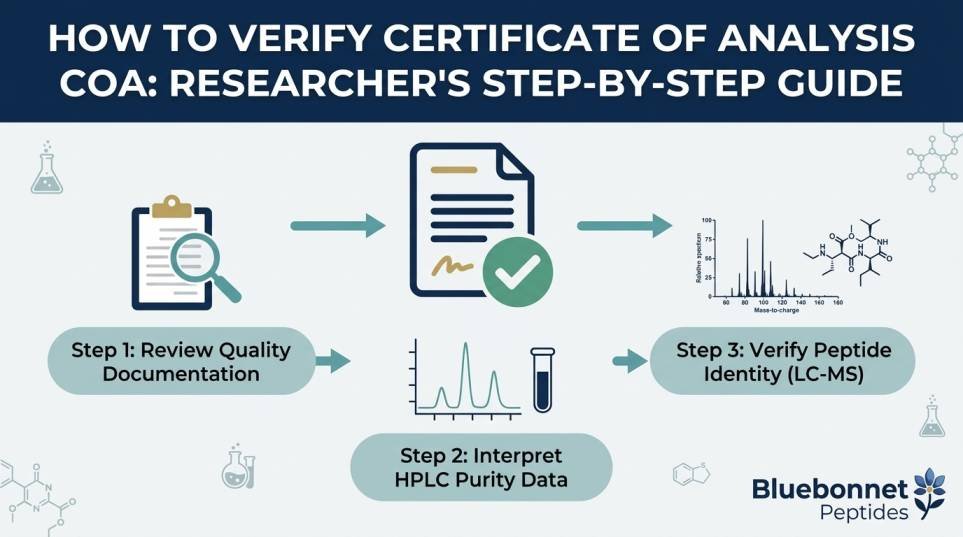
HPLC tells you how pure a sample appears. It does not tell you what the sample is.
That distinction is why LC-MS appears alongside HPLC in research peptide analytical documentation. The two techniques answer different questions, and together they provide a more complete picture than either can alone.
This guide explains what LC-MS is, how the combined technique works, and how LC-MS information may appear on a peptide Certificate of Analysis.
What Does LC-MS Mean?
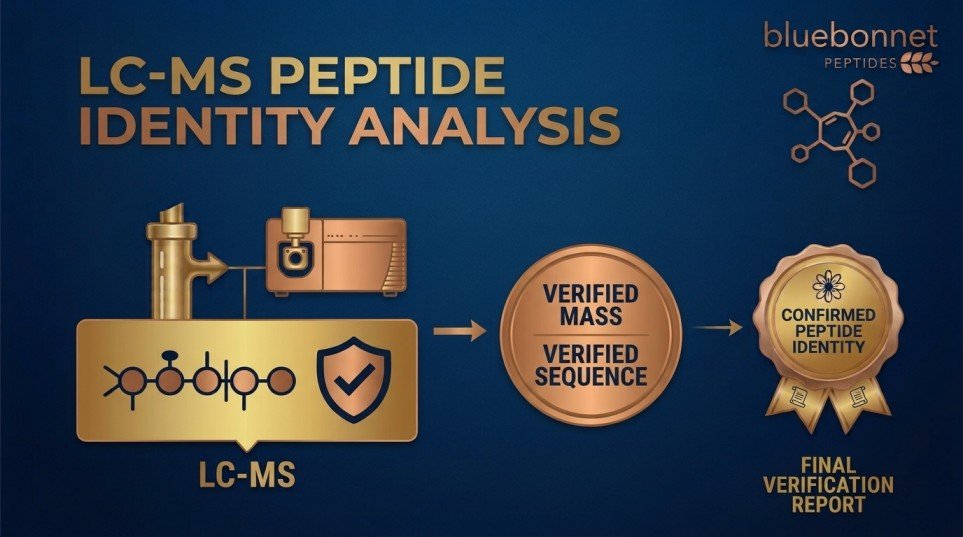
LC-MS stands for Liquid Chromatography-Mass Spectrometry.
It is a hyphenated analytical technique — two instruments coupled together so that the output of the first becomes the input of the second.
Liquid chromatography separates the components of a mixture.
Mass spectrometry measures the mass-to-charge ratio of those components.
The result: components are separated in time, and each is then measured for molecular mass as it elutes.
Liquid Chromatography: The Separation Step
Liquid chromatography separates compounds in a mixture based on how they interact with two phases.
The stationary phase is the packing material inside the chromatography column.
The mobile phase is the solvent system flowing through the column.
A sample is injected into the flowing mobile phase and carried through the column. Compounds that interact more strongly with the stationary phase move more slowly. Compounds that interact less strongly move faster. This difference in travel speed separates the mixture.
The time it takes a compound to travel through the column and reach the detector is its retention time.
For peptides, reverse-phase chromatography is common. In this configuration, the stationary phase is nonpolar and separation is driven largely by hydrophobicity — a property that often differs between a target peptide and its synthesis-related impurities.
Mass Spectrometry: The Measurement Step
Mass spectrometry measures the mass-to-charge ratio (m/z) of ionized molecules.
The process involves three stages:
- Ionization
Molecules are converted into charged ions. For peptides, electrospray ionization (ESI) is widely used because it is gentle enough to keep peptide molecules intact while producing multiply charged ions. - Mass Analysis
Ions are separated according to their mass-to-charge ratio using electric or magnetic fields. - Detection
The abundance of ions at each m/z value is recorded, producing a mass spectrum.
The output is a plot of ion intensity against m/z. From this spectrum, the molecular weight of the analyte can be calculated.
How the Two Techniques Work Together
Coupling LC to MS produces capabilities neither technique has independently.
Mass spectrometry alone struggles with complex mixtures. Many components entering the ion source simultaneously produce overlapping spectra that are difficult to interpret.
Liquid chromatography alone confirms separation but provides no direct structural or mass information. A UV detector registers that something eluted — not what that something is.
Combined, the workflow becomes:
- The sample is injected onto the LC column
- Components separate and elute at different retention times
- Each eluting component enters the mass spectrometer sequentially
- Molecular weight is measured for each separated component
This means mass information can be assigned to specific chromatographic peaks. The main peak can be measured. Impurity peaks can be measured. Each is analyzed individually rather than as a mixture.
Molecular Weight and Peptide Identity
Every peptide has a theoretical molecular weight calculable from its amino acid sequence.
LC-MS measures the observed molecular weight of the analyte. Comparing observed against expected is the basis of peptide identity verification.
When the observed molecular weight matches the theoretical value within the expected tolerance of the instrument and method, the data are consistent with the intended peptide.
When the observed value does not match, the discrepancy itself is informative:
- A mass lower than expected may suggest a truncated or deletion sequence
- A mass higher than expected may suggest an unexpected modification or adduct
- A mass differing by a small, specific increment may indicate oxidation or another defined chemical change
- An entirely different mass suggests the compound is not the intended peptide
Because peptides commonly ionize to form multiply charged species, a single peptide may produce several signals in the spectrum at different m/z values. These are mathematically deconvoluted to calculate the neutral molecular weight.
Chromatographic Separation vs. Mass Analysis
Understanding what each technique measures clarifies why both appear in analytical documentation.
Chromatographic Separation (LC / HPLC)
- Measures: retention time and relative peak area
- Answers: How many detectable components are present, and in what proportion?
- Provides: purity percentage
- Limitation: does not identify what any peak is
Mass Analysis (MS)
- Measures: mass-to-charge ratio and calculated molecular weight
- Answers: What is the molecular mass of this component?
- Provides: identity confirmation data
- Limitation: does not quantify purity in the way chromatographic peak area does
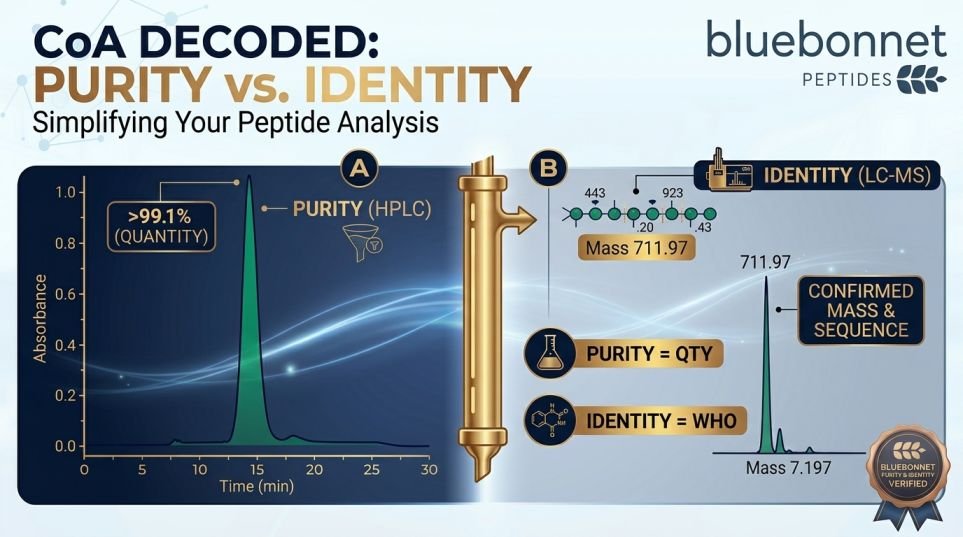
A sample can produce a single, sharp, well-resolved chromatographic peak and still be the wrong compound. Purity and identity are independent questions.
Related Reading:
https://bluebonnetpeptides.com/blog/peptide-purity-explained/
How LC-MS Information Appears on a Peptide COA
On a research peptide Certificate of Analysis, mass spectrometry data typically appear in a dedicated identity section.
Commonly reported elements:
- Expected molecular weight. The theoretical value calculated from the peptide sequence.
- Observed molecular weight. The value measured by the instrument.
- Molecular formula. Sometimes included alongside the expected mass.
- Mass spectrum. Some COAs include the spectrum image; others report only the numerical result.
- Method notation. The ionization mode or instrument type may be listed.
- Pass/fail conclusion. Whether the observed value falls within the acceptance criteria.
What to check:
- The observed and expected values correspond
- The result is tied to the specific lot number on your vial
- Identity data appear alongside purity data, not in place of it
- The testing date is documented
Related Reading:
https://bluebonnetpeptides.com/blog/how-to-read-certificate-of-analysis-peptides/
Why LC-MS Matters in Analytical Verification
LC-MS closes a specific gap in peptide characterization.
Purity testing detects the presence of impurities. It does not detect substitution — a situation in which the material is uniform and pure but is not the compound named on the label. Only mass measurement catches that.
For research applications, this matters because:
- Experimental interpretation depends on knowing what compound was used
- Methods documentation should reference verified material
- Unexpected results can be investigated against confirmed starting material
- Comparisons across lots require confirmed identity in each lot
Purity without identity is incomplete. Identity without purity is also incomplete. Analytical verification is stronger when both are documented for the same lot.
Related Reading:
https://bluebonnetpeptides.com/blog/peptide-sequences-explained/
Frequently Asked Questions
Q: What is the difference between LC-MS and HPLC?
A: HPLC separates components and quantifies relative abundance by peak area, producing a purity percentage. LC-MS adds a mass spectrometer after the chromatography step, so each separated component is also measured for molecular weight. HPLC addresses purity; LC-MS addresses identity.
Q: Does LC-MS confirm the complete amino acid sequence?
A: Standard LC-MS confirms the intact molecular weight, which is consistent with the expected sequence but does not independently establish the order of residues. Sequence-level confirmation requires additional approaches such as tandem MS (MS/MS) or peptide mapping.
Q: Why might observed and expected molecular weights differ slightly?
A: Small deviations can reflect instrument calibration, measurement tolerance, or whether monoisotopic versus average mass is being reported. Methods generally define an acceptable tolerance. Larger deviations may indicate a modification, truncation, or a different compound.
Q: Why do peptides produce multiple peaks in a mass spectrum?
A: Peptides frequently form multiply charged ions during electrospray ionization. A single peptide may appear at several m/z values corresponding to different charge states. These signals are deconvoluted to determine the neutral molecular weight.
Q: Should a peptide COA include both HPLC and LC-MS data?
A: Analytical documentation is more complete when both are present, because they answer different questions. Purity data without identity data leaves the compound unconfirmed; identity data without purity data leaves the impurity profile undescribed.
Research Use Only
All information presented here is for educational purposes. Bluebonnet Peptides supplies research peptides for laboratory research use only. These materials are not for human consumption, veterinary use, or therapeutic application, and are not intended to diagnose, treat, cure, or prevent any disease.
 ≥99% Purity
 Third-Party Tested
 COA Available
 U.S.-Based
 Research Use Only