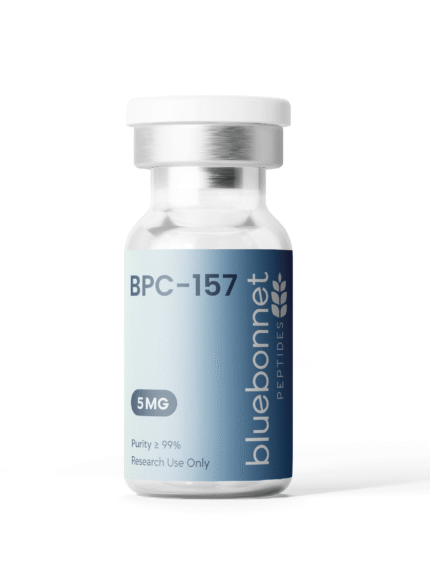
≥99% Purity
 Third-Party Tested
 COA Available
 U.S.-Based
 Research Use Only

Last updated: August 2026 | 12-minute read
You’ve purchased a research peptide. The supplier sends you a certificate of analysis for peptides.
You open the PDF and see a wall of technical data, graphs, numbers, lab jargon, and testing methods you’ve never heard of.
What does any of this actually mean?
Most researchers glance at the purity percentage, see “99%,” and assume the product is verified. However, a COA contains far more information than a single number — and knowing how to read it can mean the difference between trusting your research results and questioning them.
This guide, therefore, walks you through every section of a peptide certificate of analysis, line by line, so you can verify quality with confidence.
What Is a Certificate of Analysis for Peptides?
A certificate of analysis (COA) is a laboratory document that reports the results of quality testing performed on a specific batch of product.
Purpose of a COA:
- ✅ Confirms identity: Is this actually the peptide it claims to be?
- ✅ Verifies purity: What percentage of the sample is the target peptide?
- ✅ Documents contamination testing: Are harmful substances present?
- ✅ Provides traceability: Which batch was tested, when, and by whom?
- ✅ Establishes accountability: Can you verify the testing was done by an independent lab?
A certificate of analysis is your proof of quality. Without it, you’re trusting marketing claims. With it, you have verifiable data.
Anatomy of a Certificate of Analysis for Peptides
Every legitimate COA follows a similar structure. Here’s what each section means.
Section 1: Header Information
The top of the COA identifies the document and the laboratory. What to look for:
Document Title: Should clearly state “Certificate of Analysis” or “COA.”
Laboratory Name: Name of the testing facility. Should be an independent, accredited lab (not the manufacturer).
Laboratory Logo: Professional labs include their logo and branding.
Contact Information: Lab address, phone number, website. You should be able to verify the lab exists.
Accreditation Logos:
- A2LA (American Association for Laboratory Accreditation)
- ISO 17025 (International standard for testing laboratories)
- Other relevant certifications
✅ Example (Good):
═══════════════════════════════════════════════
    ANALYTICAL TESTING LABORATORY, INC.
    123 Science Drive, Boston, MA 02134
    Phone: (555) 123-4567 | www.analyticallab.com

    [A2LA Logo]  [ISO 17025 Logo]

    CERTIFICATE OF ANALYSIS
═══════════════════════════════════════════════
Why this is good: lab name is specific and verifiable, contact information is provided, and accreditation logos are displayed.
❌ Example (Red Flag):
═══════════════════════════════════════════════
    QUALITY TESTING LAB

    Certificate of Analysis
═══════════════════════════════════════════════
Why this is questionable: vague lab name, no contact information, no accreditation logos, and no way to verify lab independence.
Section 2: Product Information
This section identifies what was tested. What to look for:
- Product Name: e.g., “BPC-157 (Pentadecapeptide)” — should match the product you purchased
- CAS Number: Chemical Abstracts Service registry number — e.g., BPC-157 CAS: 137525-51-0
- Molecular Formula: e.g., C₆₂H₉₈N₁₆O₂₂ — confirms the expected chemical structure
- Molecular Weight: e.g., ~1,419 Da (Daltons) — used for mass spectrometry verification
- Appearance: e.g., “White to off-white lyophilized powder” — visual description of the sample
✅ Example:
PRODUCT INFORMATION
───────────────────────────────────────────────
Product Name:       BPC-157 (Body Protection Compound)
CAS Number:         137525-51-0
Molecular Formula:  C₆₂H₉₈N₁₆O₂₂
Molecular Weight:   1,419.55 g/mol
Appearance:         White lyophilized powder
Storage:            -20°C, protect from light
Section 3: Sample Information
This section identifies the specific batch that was tested. What to look for:
- Lot Number / Batch Number: CRITICAL — this must match the lot number on your vial
- Manufacturing Date: When the batch was produced
- Expiration Date (if provided): When the product should be used by
- Sample Received Date: When the lab received the sample for testing
- Testing Date / Report Date: When testing was performed and COA was issued
✅ Example:
SAMPLE INFORMATION
───────────────────────────────────────────────
Lot Number:         BB-BPC157-2026-001
Manufactured:       January 15, 2026
Sample Received:    January 20, 2026
Testing Completed:  January 25, 2026
Report Date:        January 26, 2026
Why this matters: lot number traceability (you can match this to your vial), recent testing (confirms current batch quality), and timeline makes sense (sample received → testing → report issued).
❌ Red Flag Example:
SAMPLE INFORMATION
───────────────────────────────────────────────
Product:            BPC-157
Testing Date:       June 2024
Why this is a problem: no lot number (can’t match to your specific batch), old testing date (doesn’t prove current batch quality), and no manufacturing date.
Section 4: Testing Methods
This section lists the analytical methods used to test the sample. What to look for:
| Test Type | Method | Purpose |
|---|---|---|
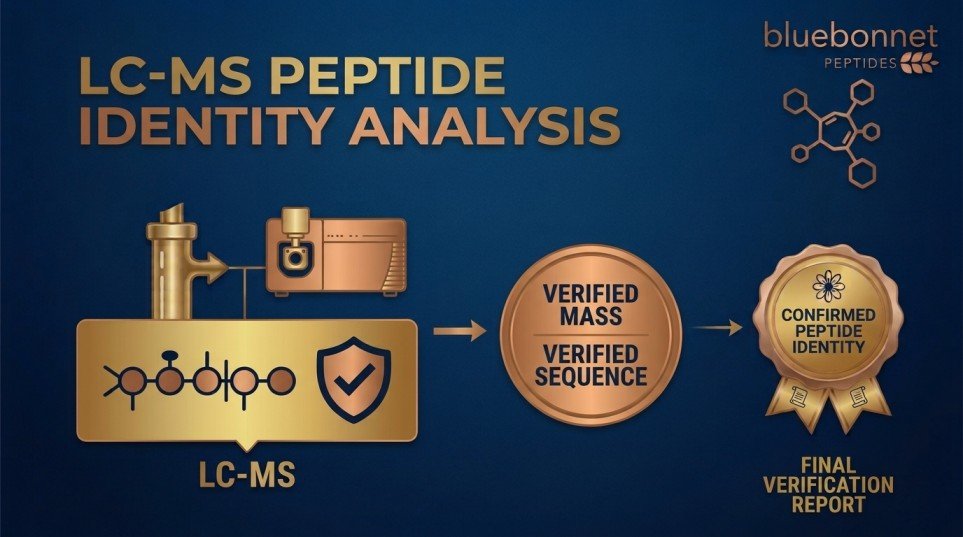
| Identity Testing | Mass Spectrometry (MS), MALDI-TOF, or ESI-MS | Confirms the peptide is the correct compound |
| Purity Testing | RP-HPLC (Reverse-Phase HPLC) | Measures purity percentage |
| Fentanyl | Immunoassay or LC-MS | Screens for fentanyl contamination |
| Heavy Metals | ICP-MS | Detects heavy metal contamination |
| Bacterial Endotoxins | LAL (Limulus Amebocyte Lysate) test | Screens for bacterial contamination |
| Water Content | Karl Fischer titration | Measures moisture content |
✅ Example:
TESTING METHODS
───────────────────────────────────────────────
Identity:           Mass Spectrometry (ESI-MS)
Purity:             RP-HPLC (Reverse-Phase HPLC)
                    Gradient: 10-90% Acetonitrile over 30 min
                    Detection: UV 220nm
Appearance:         Visual Inspection
Water Content:      Karl Fischer Titration
Fentanyl:           Immunoassay Screening
Heavy Metals:       ICP-MS
Bacterial Endotoxin: LAL Test (USP <85>)
Why this is good: specific methods listed (not vague “testing performed”), industry-standard techniques (HPLC, MS), and comprehensive testing (identity + purity + contamination).
Section 5: Test Results
This is the core of the certificate of analysis — the actual data.
Identity Testing Results:
IDENTITY TESTING (Mass Spectrometry)
───────────────────────────────────────────────
Expected MW:        1,419.55 Da
Observed MW:        1,419.60 Da
Difference:         +0.05 Da
Conclusion:         Identity Confirmed ✓
Why this is good: observed weight matches expected weight, small difference (+0.05 Da) is within acceptable variance, and clear “pass” conclusion.
Purity Testing Results:
PURITY TESTING (RP-HPLC)
───────────────────────────────────────────────
Method:             RP-HPLC (UV 220nm)
Retention Time:     18.3 minutes
Purity:             99.2% (by peak area)
Major Impurities:   <0.5%
Conclusion:         Pass (≥99% specification) ✓
Why this is good: purity exceeds 99%, retention time documented, impurities are minimal (less than 0.5%), and clear pass/fail conclusion.
Contamination Testing Results:
FENTANYL SCREENING
───────────────────────────────────────────────
Method:             Immunoassay
Result:             Not Detected
LOD:                1.0 ng/mL
Conclusion:         Pass ✓

HEAVY METALS (ICP-MS)
───────────────────────────────────────────────
Lead (Pb):          <0.5 ppm (LOQ)
Mercury (Hg):       <0.1 ppm (LOQ)
Arsenic (As):       <0.5 ppm (LOQ)
Cadmium (Cd):       <0.2 ppm (LOQ)
Conclusion:         Pass (all below limits) ✓

BACTERIAL ENDOTOXIN (LAL Test)
───────────────────────────────────────────────
Method:             LAL (USP <85>)
Result:             <5.0 EU/mg
Specification:      <10.0 EU/mg
Conclusion:         Pass ✓
Why this is good: all contaminants tested, results below acceptable limits, and clear pass/fail for each test.
Section 6: HPLC Chromatogram
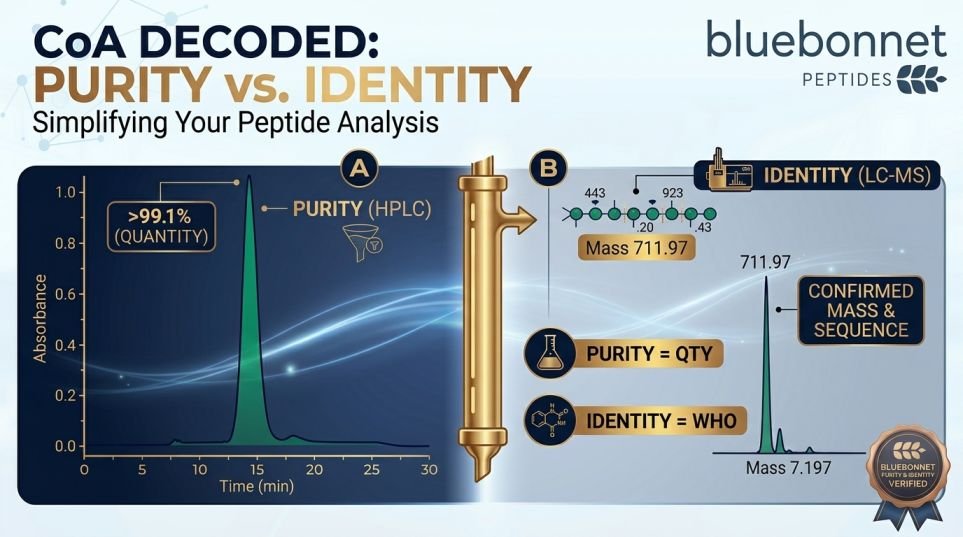
This is the visual representation of the purity test on your certificate of analysis peptides document.
How to read an HPLC chromatogram:
- X-Axis (Horizontal): Time (minutes) — shows when compounds exited the HPLC column
- Y-Axis (Vertical): Signal Intensity (mAU) — shows how much of each compound was detected
- Peaks: each peak represents a compound; main peak = target peptide (should be dominant); small peaks = impurities (should be minimal)
✅ Example Chromatogram Interpretation:

✅ What to look for:
- ✅ One dominant peak (the target peptide)
- ✅ Peak area ≥99% (research-grade standard)
- ✅ Minimal secondary peaks (low impurity levels)
- ✅ Sharp, well-defined peak (good separation)
- ✅ Baseline is flat (no noise or drift)
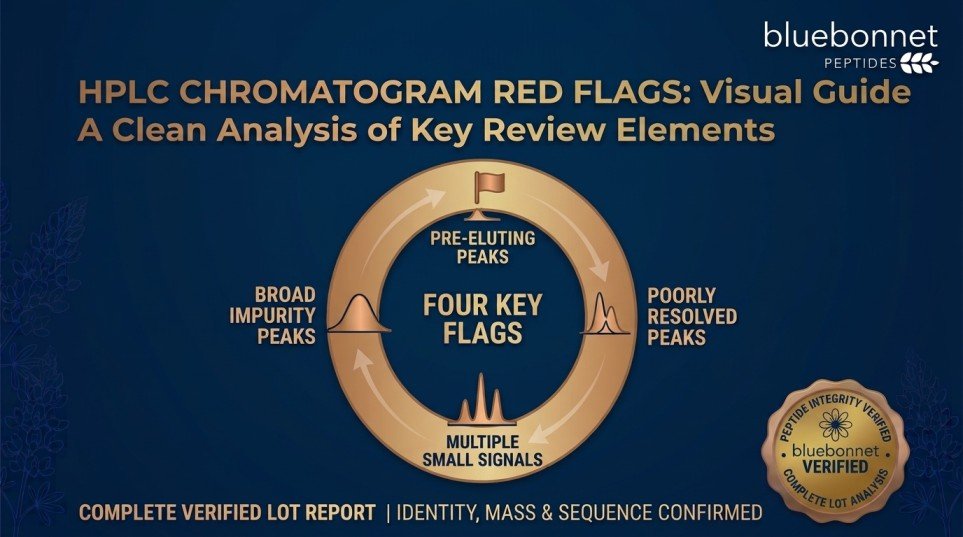
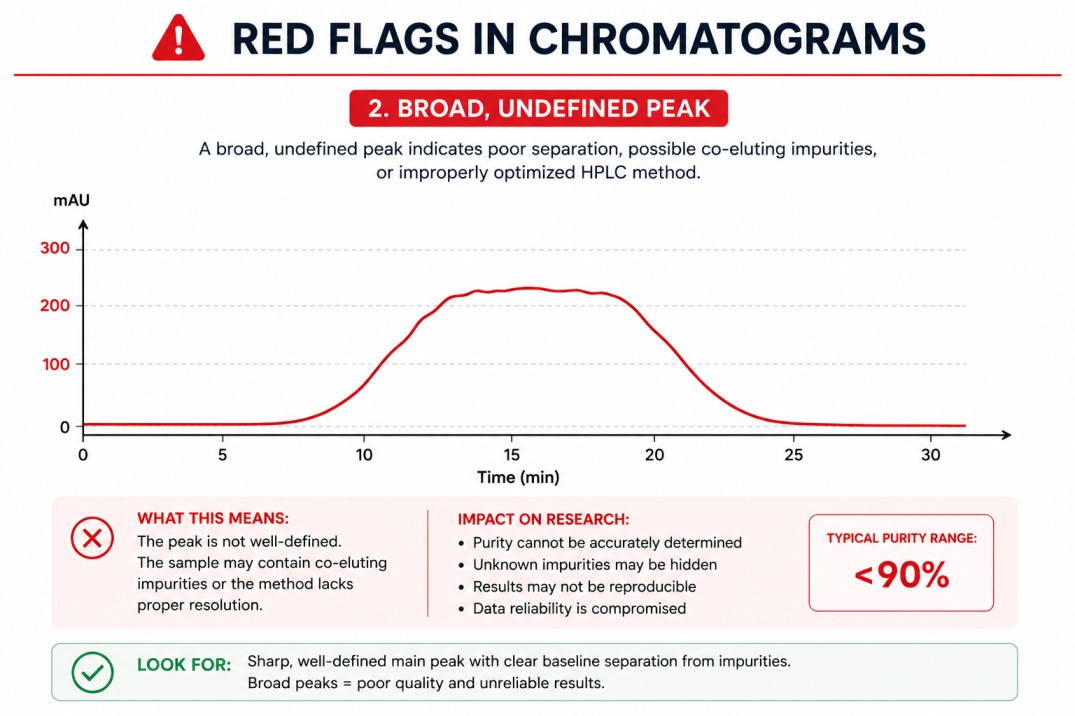
❌ Red flags in chromatograms:
- Multiple large peaks — high impurity levels (multiple compounds present)
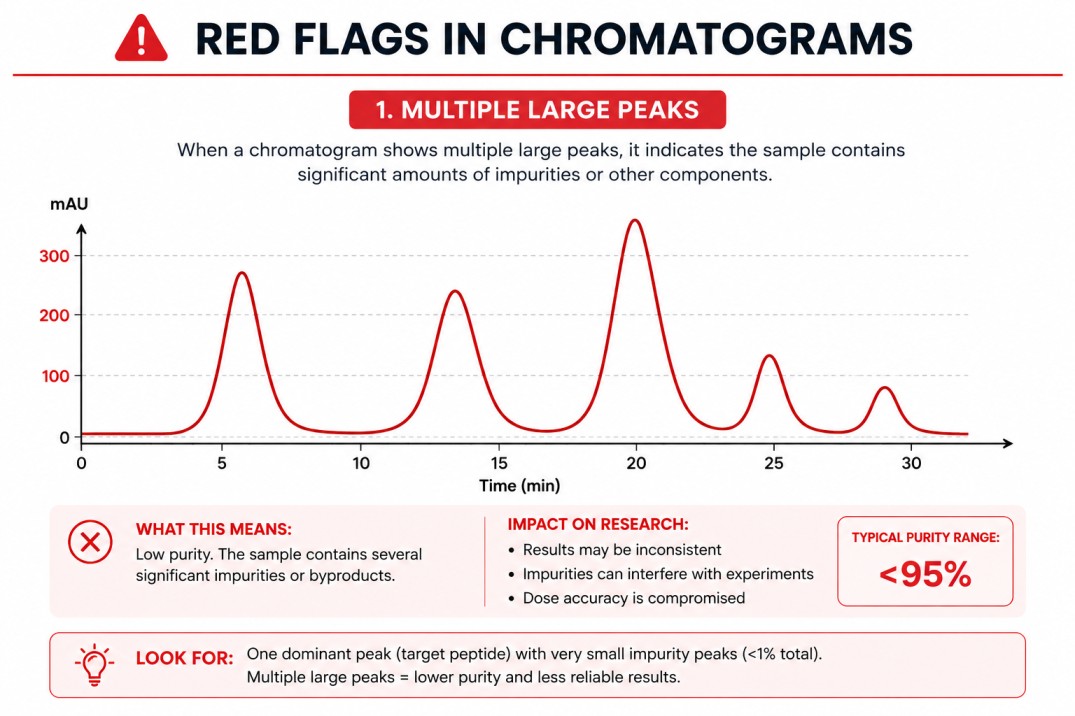
- Broad, undefined peak — poor separation, degradation, or low-quality sample
No Chromatogram Provided:
If the COA lists purity but doesn’t include a chromatogram, you can’t visually verify the claim.
Red flag: Supplier might be hiding poor-quality data.
Section 7: Batch Number Verification
CRITICAL: The lot number (or batch number) on the COA must match the lot number printed on your vial.
How to verify:
- Check your vial label for the lot number (e.g., “LOT: BB-BPC157-2026-001”)
- Check the COA for the lot number (listed in the “Sample Information” section)
- Confirm they match exactly
| Without Lot Number Matching | With Lot Number Matching |
|---|---|
| COA could be from a different batch | You know the testing corresponds to your specific batch |
| COA could be old (recycled) | You have full traceability |
| COA could be fabricated | You can verify authenticity |
Section 8: QR Code Verification (If Available)
Some advanced COAs include QR codes for digital verification. What QR codes provide:
- ✅ Direct link to lab’s verification portal
- ✅ Instant authentication (scan to confirm COA is real)
- ✅ Tamper-proof verification (can’t be easily faked)
- ✅ Access to full testing data (some labs provide more detail online)
How to use: scan the QR code with your smartphone, you’ll be directed to the lab’s website, and confirm the COA details match.
Section 9: Laboratory Signature and Certification
The COA should be signed by authorized laboratory personnel. What to look for:
- Signature: Signed by lab technician, quality manager, or authorized signatory
- Printed Name and Title: e.g., “Dr. Sarah Johnson, PhD, Quality Assurance Manager”
- Date Signed: Should match the report date
- Lab Certification Statement: e.g., “This Certificate of Analysis is issued in accordance with ISO 17025 standards and A2LA accreditation scope.”
Section 10: Disclaimer and Notes
The bottom of the COA typically includes legal disclaimers and usage notes. Common disclaimers include:
- Research Use Only (RUO): This product is for Research Use Only. Not for human consumption, veterinary use, or diagnostic purposes.
- Test Scope: This certificate of analysis applies only to the tested sample and the specified lot number.
- Storage Recommendations: Store at -20°C, protected from light. Use within 30 days of reconstitution.
- Expiration: Product stability is subject to proper storage conditions.
Complete Example: Full Certificate of Analysis Walkthrough
Let’s walk through a complete certificate of analysis for peptides from start to finish.
═══════════════════════════════════════════════
    ANALYTICAL TESTING LABORATORY, INC.
    123 Science Drive, Boston, MA 02134
    Phone: (555) 123-4567
    www.analyticallab.com

    [A2LA Logo]  [ISO 17025 Logo]

    CERTIFICATE OF ANALYSIS
═══════════════════════════════════════════════

CLIENT INFORMATION
───────────────────────────────────────────────
Client:             Bluebonnet Peptides LLC
Address:            456 Research Blvd, Austin, TX
Contact:            quality@bluebonnetpeptides.com

PRODUCT INFORMATION
───────────────────────────────────────────────
Product Name:       BPC-157 (Pentadecapeptide)
CAS Number:         137525-51-0
Molecular Formula:  C₆₂H₉₈N₁₆O₂₂
Molecular Weight:   1,419.55 g/mol
Appearance:         White to off-white lyophilized powder

SAMPLE INFORMATION
───────────────────────────────────────────────
Lot Number:         BB-BPC157-2026-001
Manufactured:       January 15, 2026
Sample Received:    January 20, 2026
Testing Completed:  January 25, 2026
Report Date:        January 26, 2026

TESTING METHODS
───────────────────────────────────────────────
Identity:           Mass Spectrometry (ESI-MS)
Purity:             RP-HPLC (UV 220nm)
Appearance:         Visual Inspection
Water Content:      Karl Fischer Titration
Fentanyl:           Immunoassay Screening
Heavy Metals:       ICP-MS
Bacterial Endotoxin: LAL Test (USP <85>)

TEST RESULTS
───────────────────────────────────────────────

IDENTITY (Mass Spectrometry)
Expected MW:        1,419.55 Da
Observed MW:        1,419.60 Da
Difference:         +0.05 Da
Conclusion:         Identity Confirmed ✓

PURITY (RP-HPLC)
Retention Time:     18.3 minutes
Purity:             99.2% (by peak area)
Major Impurities:   <0.5%
Specification:      ≥99.0%
Conclusion:         Pass ✓

APPEARANCE
Observation:        White lyophilized powder
Conclusion:         Pass ✓

WATER CONTENT
Result:             3.2%
Specification:      ≤5.0%
Conclusion:         Pass ✓

FENTANYL SCREENING
Result:             Not Detected
LOD:                1.0 ng/mL
Conclusion:         Pass ✓

HEAVY METALS (ICP-MS)
Lead (Pb):          <0.5 ppm
Mercury (Hg):       <0.1 ppm
Arsenic (As):       <0.5 ppm
Cadmium (Cd):       <0.2 ppm
Conclusion:         Pass (all below limits) ✓

BACTERIAL ENDOTOXIN (LAL Test)
Result:             <5.0 EU/mg
Specification:      <10.0 EU/mg
Conclusion:         Pass ✓

═══════════════════════════════════════════════

HPLC CHROMATOGRAM

Peak Summary:
Peak  Retention  Area      % Area
  1     10.2      125       0.3%
  2     18.3    40,850     99.2%  ← BPC-157
  3     22.1      205       0.5%
Total           41,180    100.0%

═══════════════════════════════════════════════

OVERALL CONCLUSION

All tests meet or exceed specifications.
This batch is approved for release.

═══════════════════════════════════════════════

DIGITAL VERIFICATION

Or visit: www.analyticallab.com/verify
Enter: BB-BPC157-2026-001-COA

═══════════════════════════════════════════════

CERTIFICATION

Dr. Sarah Johnson, PhD
Quality Assurance Manager
Date: January 26, 2026

This laboratory is accredited by A2LA
(Certificate #12345) and operates under
ISO/IEC 17025:2017 standards.

═══════════════════════════════════════════════

DISCLAIMER

This product is for Research Use Only (RUO).
Not for human consumption, veterinary use, or
diagnostic purposes.

This COA applies only to the tested sample
(Lot BB-BPC157-2026-001). Store at -20°C,
protected from light.

═══════════════════════════════════════════════
What makes this COA legitimate:
- ✅ Independent lab (not manufacturer self-testing)
- ✅ Lab accreditation (A2LA, ISO 17025)
- ✅ Batch-specific (lot number clearly listed)
- ✅ Comprehensive testing (identity, purity, contamination)
- ✅ Visual data (HPLC chromatogram included)
- ✅ Clear results (pass/fail for each test)
- ✅ Professional signature (authorized personnel)
- ✅ Verifiable (QR code, lab contact info)
- ✅ Recent (testing date matches batch timeline)
- ✅ Transparent (all methods and results disclosed)
Red Flags: Fake or Questionable Certificate of Analysis Peptides Documents
🚩 No Lab Name or Contact Information
Problem: Can’t verify lab independence or accreditation. What it looks like: a document that simply states “Certificate of Analysis, Product: BPC-157, Purity: 99%” with no way to verify who performed the testing.
🚩 Generic or Recycled COA
Problem: Same COA used for multiple batches. What it looks like: no lot number listed, testing date is 6+ months old, says “Sample Batch” instead of a specific lot number. Consequently, this doesn’t prove your specific batch was tested.
🚩 Manufacturer Self-Testing
Problem: Lab is owned by the manufacturer. What it looks like: lab name matches manufacturer name, lab address is the same as manufacturing facility. This is a conflict of interest — grading their own work.
🚩 Missing Testing Methods
Problem: Doesn’t specify how purity was measured. What it looks like: “Purity: 99%, Method: Internal Testing.” There’s no way to verify methodology or accuracy.
🚩 No Chromatogram or Visual Data
Problem: Can’t visually verify purity claim. Suppliers could list any purity percentage without proof.
🚩 Purity Below 95%
Problem: Not research-grade quality. What it looks like: “Purity: 90.5% by HPLC, Specification: ≥85%, Conclusion: Pass.” While it “passes” their internal spec, 90% is not research-grade and should be ≥99%.
🚩 Can’t Verify Lab Accreditation
Problem: Lab isn’t listed in A2LA or ISO directories. How to check: visit a2la.org/directory, search for the lab name, and if not found, accreditation is questionable.
How to Verify Certificate of Analysis Peptides Authenticity
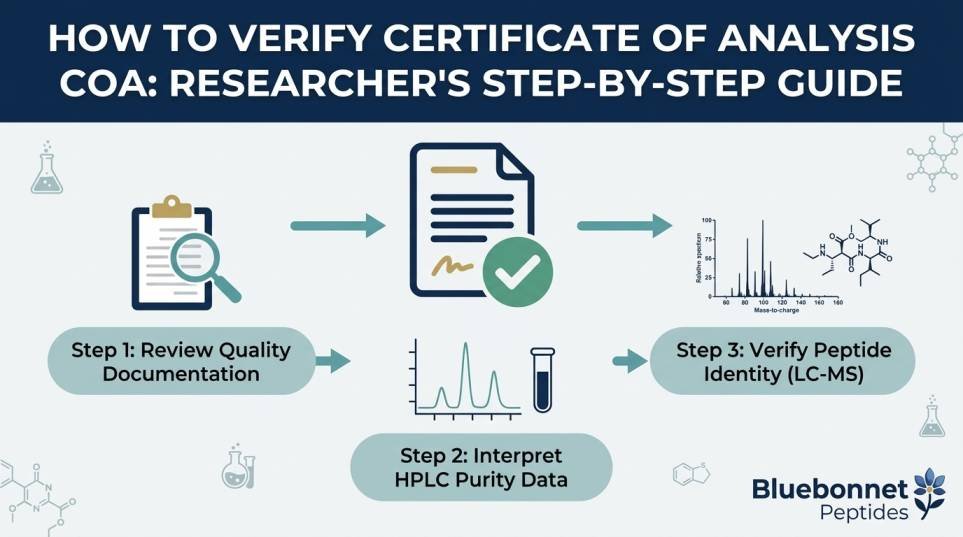
If you receive a COA and want to verify it’s legitimate, follow these steps.
Step 1: Look Up the Lab
Google the lab name. Confirm their website exists, that they offer peptide testing services, and that contact information is available.
Step 2: Check Accreditation
Visit the A2LA directory, search for the lab, confirm accreditation is active, and verify scope covers peptide testing.
Step 3: Match Lot Numbers
Compare the lot number on your vial label to the lot number on the COA. They must match exactly.
Step 4: Verify Testing Date
Check the timeline: manufacturing date → sample received date → testing date → report date. The timeline should make sense (manufacturing to reporting within days or weeks, not months or years).
Step 5: Contact the Lab If Necessary
If you have doubts, email or call the lab directly. Provide the lot number and COA date and ask: “Can you confirm this COA was issued by your facility?” Legitimate labs will verify or deny authenticity.
Step 6: Scan QR Code If Available
If the COA includes QR verification, scan it with your smartphone, confirm details match, and verify on the lab’s official website.
Bluebonnet’s Certificate of Analysis Peptides Transparency
At Bluebonnet Peptides, we believe COAs should be accessible, verifiable, and comprehensive. What you’ll find in every Bluebonnet COA:
- ✅ Independent third-party lab (accredited by A2LA, ISO 17025)
- ✅ Batch-specific lot numbers (matches your vial)
- ✅ Complete testing methods (HPLC, mass spec, contamination screening)
- ✅ Visual chromatograms (see the purity data yourself)
- ✅ Recent testing dates (current batch verification)
- ✅ Lab contact information (verify authenticity anytime)
- ✅ Digital verification (QR codes where available)
- ✅ Professional certification (signed by authorized lab personnel)
- ✅ Public accessibility (COAs published and linked from every product page)
We don’t ask you to trust us. We provide the data so you can verify independently.
Every product page links directly to batch-specific COAs. No “request required.” No hidden documentation. Transparency is our standard, not our exception.
Explore verified COAs for BPC-157, GHK-Cu, and our complete Research Peptides range.
Frequently Asked Questions About Certificate of Analysis Peptides
A: Verify the lab name is searchable online, the lab is accredited (check A2LA directory), the lot number matches your vial, and contact the lab directly to confirm issuance.
A: Yes. If you have concerns, contact the testing lab directly and ask them to confirm the COA was issued by their facility for the specified lot number.
A: Request one. Legitimate suppliers should provide visual HPLC data. If they refuse or say it’s “proprietary,” that’s a red flag.
A: COAs should correspond to current batches. If the testing date is 6+ months old, ask if it applies to the current lot or if it’s been recycled from an older batch.
A: LOD (Limit of Detection) is the smallest amount the test can detect. LOQ (Limit of Quantification) is the smallest amount the test can accurately measure. “<LOD” or “<LOQ” means below detectable/quantifiable levels, which is good for contamination tests.
A: Manufacturer COAs involve a conflict of interest (they’re grading their own