≥99% Purity
 Third-Party Tested
 COA Available
 U.S.-Based
 Research Use Only


Last updated: September 2026 | 14-minute read
You reconstitute a peptide that’s been stored properly in your -80°C freezer. The lyophilized powder dissolves, but the solution isn’t perfectly clear. There’s a slight cloudiness, maybe some visible particles if you look closely. You use it in your experiment anyway—the COA showed 99% purity, so the material must be fine, right?
Maybe. Or maybe you’re observing peptide aggregation.
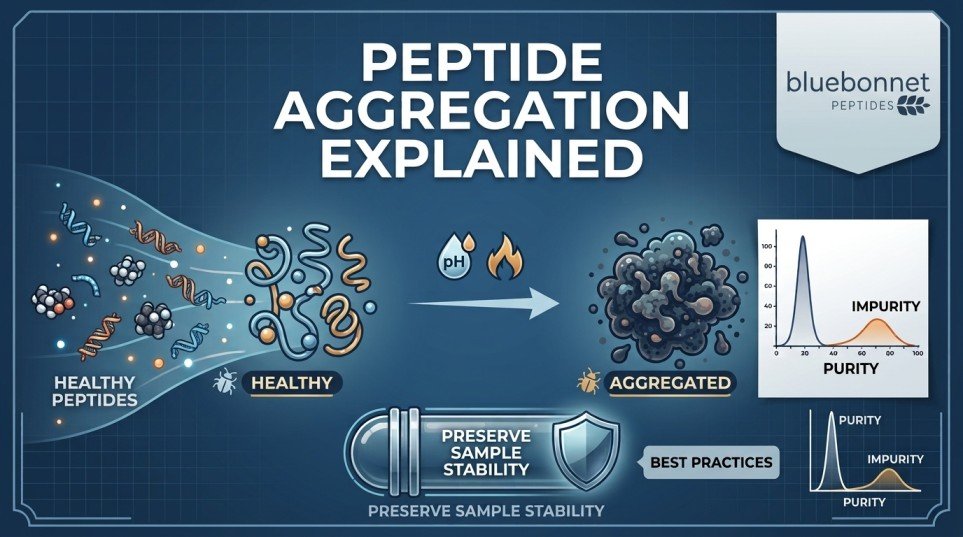
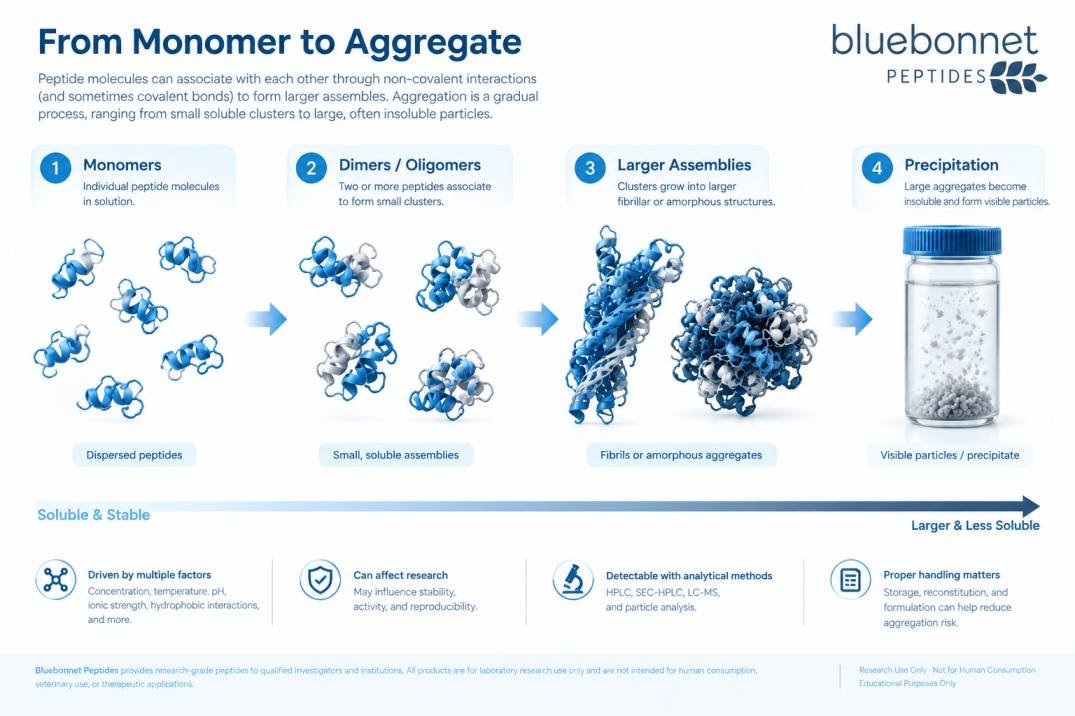
Aggregation is one of the most common but least understood peptide quality issues affecting research. It’s not contamination. It’s not necessarily degradation. It’s a physical phenomenon where individual peptide molecules associate with each other, forming larger assemblies that can range from small soluble clusters to large insoluble particles.
Aggregation matters because it can affect research outcomes. Aggregates may have different biological activity than monomers, different pharmacokinetic behavior in animal models, and different physical properties affecting experimental reproducibility. Yet aggregation often goes undetected because it’s not always visible and isn’t revealed by standard purity testing.
Understanding aggregation—what causes it, how it’s detected, what it looks like, and what it means for research quality—enables better material handling, more informed quality assessment, and clearer interpretation of experimental results.
This comprehensive guide explains peptide aggregation from mechanistic and practical perspectives. You’ll learn what aggregation is at the molecular level, what factors promote or prevent it, how analytical methods detect aggregates, what researchers observe when aggregation occurs, and how to minimize aggregation risk through proper handling and storage.
Whether you’re troubleshooting unexpected experimental variability, evaluating peptide quality documentation, or optimizing reconstitution protocols, this article provides the framework for understanding aggregation as a critical quality parameter beyond purity percentage.
What Is Peptide Aggregation?
Peptide aggregation is the association of individual peptide molecules into larger assemblies.
Monomers Versus Aggregates
Monomer:
A single peptide molecule in solution, not associated with other peptide molecules.
Aggregate:
Multiple peptide molecules associated together through non-covalent interactions (hydrogen bonding, hydrophobic interactions, electrostatic forces) or occasionally covalent bonds (disulfide linkages for cysteine-containing peptides).
Aggregation continuum:
Monomer → Dimer → Oligomer → Larger assemblies → Precipitate
Aggregation can range from small, reversible associations (dimers, trimers) to large, irreversible formations (insoluble precipitates).
Types of Aggregates
Soluble aggregates:
Small peptide assemblies that remain dissolved in solution. They may not be visible but can be detected by analytical methods.
Characteristics:
- Remain in solution (don’t settle or precipitate)
- May cause slight turbidity or cloudiness
- Often reversible under certain conditions
- Can still be biologically active (though potentially altered)
Insoluble aggregates:
Large peptide assemblies that precipitate out of solution.
Characteristics:
- Visible particles, cloudiness, or precipitation
- Settle to bottom of container over time
- Generally irreversible once formed
- Likely to have significantly altered or absent activity
Aggregation Versus Degradation
Important distinction:
Aggregation:
Physical association of intact peptide molecules. The peptide sequence remains unchanged; molecules are simply clustering together.
Degradation:
Chemical modification of the peptide itself through oxidation, hydrolysis, deamidation, or other reactions that change the molecular structure.
Why the difference matters:
- Aggregation may be reversible; degradation typically is not
- Analytical detection methods differ
- Implications for research differ
- Prevention strategies differ
Peptides can undergo both aggregation and degradation, sometimes simultaneously. Understanding which phenomenon you’re dealing with requires appropriate analytical characterization.
Why Aggregation Occurs
Peptides aggregate because the aggregated state can be thermodynamically favorable under certain conditions.
Driving forces:
Hydrophobic interactions:
Hydrophobic amino acids (Leu, Ile, Val, Phe, Trp) tend to associate with each other to minimize contact with water, driving aggregation especially for peptides with hydrophobic sequences.
Electrostatic attractions:
Oppositely charged regions can attract, promoting aggregation.
Hydrogen bonding:
Peptide backbones and polar side chains can form intermolecular hydrogen bonds, stabilizing aggregates.
Van der Waals forces:
Weak attractions between molecules can contribute to aggregation, especially in concentrated solutions.
Disulfide bond formation:
For cysteine-containing peptides, intermolecular disulfide bonds can covalently link peptides into aggregates.
Aggregation tendency depends on:
- Peptide sequence (particularly hydrophobicity and charge distribution)
- Solution conditions (pH, ionic strength, concentration)
- Temperature
- Time
- Mechanical stress
- Freeze-thaw cycles
Factors That Influence Peptide Aggregation
Understanding what promotes or inhibits aggregation enables better handling strategies.
Peptide Concentration
Higher concentrations increase aggregation tendency.
Why:
Aggregation requires peptide molecules to encounter each other. Higher concentrations increase encounter frequency, promoting aggregation.
Practical implications:
Stock solutions:
Concentrated stock solutions (>1 mg/mL) have higher aggregation risk than dilute working solutions.
Storage:
Lyophilized peptides (very high local concentration in solid form) can undergo aggregation during storage if moisture is present.
Reconstitution:
Gradual addition of solvent with gentle mixing helps prevent local high-concentration zones that promote aggregation.
Recommendation:
Prepare peptide solutions at the lowest concentration practical for your application. Dilute concentrated stocks shortly before use.
Temperature
Temperature affects aggregation through multiple mechanisms.
Higher temperatures generally increase aggregation rate:
- Increased molecular motion and collision frequency
- Some aggregates form through temperature-dependent conformational changes
- Hydrophobic interactions often strengthen at higher temperatures
Lower temperatures can prevent some aggregation:
- Reduced molecular motion slows aggregation kinetics
- Some aggregates are less stable at lower temperatures
However:
Freezing can promote aggregation through freeze-concentration effects (peptide concentration increases in unfrozen liquid pockets during freezing process).
Practical implications:
Storage temperature:
Frozen storage (-20°C or -80°C) minimizes aggregation for lyophilized peptides. Reconstituted peptides refrigerated (2-8°C) experience slower aggregation than room temperature storage, but aggregation still occurs over time.
Freeze-thaw cycles:
Repeated freezing and thawing promotes aggregation. Aliquot reconstituted peptides into single-use portions to avoid multiple freeze-thaw cycles.
Room temperature exposure:
Minimize time peptides spend at room temperature, particularly after reconstitution.
- Peptide Storage Best Practices: Maximizing Stability Before and After Reconstitution
- Lyophilization Explained: Why Freeze-Dried Peptides Improve Research Stability
pH and Ionic Strength
Solution pH affects peptide charge state, influencing aggregation.
At pH extremes:
Peptides may be highly charged (all positive or all negative), creating electrostatic repulsion that inhibits aggregation.
Near isoelectric point (pI):
Peptides have minimal net charge, reducing electrostatic repulsion and often promoting aggregation.
Practical consideration:
Each peptide has sequence-dependent optimal pH. Some peptides are more soluble and less prone to aggregation at acidic pH; others prefer neutral or slightly basic conditions.
Ionic strength:
Low ionic strength:
Can promote aggregation for some peptides through electrostatic attractions.
High ionic strength:
Can shield charges, either promoting or inhibiting aggregation depending on peptide characteristics.
Recommendation:
Use reconstitution solvents and buffers appropriate for the specific peptide. Supplier recommendations (when available) reflect sequence-specific solubility characteristics.
Sequence Characteristics
Peptide sequence strongly influences aggregation propensity.
Aggregation-prone sequences:
High hydrophobicity:
Peptides rich in Leu, Ile, Val, Phe, Trp have greater aggregation tendency due to hydrophobic interactions.
Beta-sheet forming tendency:
Sequences with high beta-sheet propensity can form intermolecular beta-sheet structures that drive aggregation (relevant for amyloidogenic sequences).
Aromatic residues:
Phe, Tyr, Trp can promote aggregation through pi-pi stacking interactions.
Cysteine residues:
Can form intermolecular disulfide bonds, creating covalently linked aggregates.
Aggregation-resistant sequences:
High charge density:
Peptides with many charged residues (Asp, Glu, Lys, Arg) experience electrostatic repulsion inhibiting aggregation.
Proline residues:
Proline disrupts beta-sheet formation, often reducing aggregation.
Hydrophilic sequences:
Peptides rich in Ser, Thr, Asn, Gln generally have lower aggregation tendency.
Implication:
Aggregation propensity is intrinsic to sequence. Some peptides are inherently more challenging to keep soluble and monomeric than others.
Time
Aggregation is often time-dependent.
Fresh solutions:
Immediately after reconstitution, peptides may be primarily monomeric.
Over time:
Aggregates gradually form as peptides associate, particularly if storage conditions promote aggregation.
Kinetics:
Aggregation rate varies by peptide and conditions—some peptides aggregate within hours, others remain stable for weeks.
Practical implication:
Age of reconstituted peptide solution affects aggregation state. Using fresh solutions improves consistency. Old solutions may contain significant aggregates even if initially prepared correctly.
Mechanical Stress
Physical agitation can promote aggregation.
Mechanisms:
- Vortexing creates air-liquid interfaces where peptides can denature and aggregate
- Shaking introduces mechanical energy promoting molecular associations
- Pipetting creates shear forces
Best practices:
- Mix by gentle inversion or swirling, not vigorous vortexing
- Avoid repeated pipetting
- Minimize introduction of air bubbles
- Use gentle techniques throughout handling
Freeze-Thaw Cycles
Repeated freezing and thawing strongly promotes aggregation.
Why:
During freezing:
- Peptide concentration increases in unfrozen regions (freeze-concentration)
- Ice crystal formation creates physical stress
- pH and ionic strength change in unfrozen pockets
During thawing:
- Localized high-concentration zones persist temporarily
- Refreezing can exacerbate concentration effects
Multiple cycles compound damage:
Each freeze-thaw cycle provides additional opportunities for aggregation.
Prevention:
Aliquot reconstituted peptides into single-use portions. Freeze once, thaw once, use completely. Never refreeze thawed aliquots.
What Does Aggregation Look Like?
Visible signs may indicate aggregation, but appearance alone cannot definitively establish aggregation extent.
Observable Signs
Visual appearance changes that may suggest aggregation:
Cloudiness or turbidity:
Solution appears hazy or cloudy rather than perfectly clear.
Visible particles:
Small particles visible to naked eye, especially when viewing against light.
Precipitation:
Material settles to bottom of vial or container.
Gel formation:
Solution becomes viscous or gel-like (typically only at very high concentrations).
Film formation:
Thin film appears on vial walls or at air-liquid interface.
Color changes:
Some peptides may show slight color changes upon aggregation (not universal).
Important caveat:
Visible appearance alone cannot:
- Confirm aggregation is occurring (cloudiness could have other causes)
- Quantify extent of aggregation
- Distinguish aggregation from degradation
- Determine whether aggregates are soluble or insoluble
- Establish molecular identity of material
Visual inspection is preliminary assessment, not definitive characterization.
When Aggregation May Not Be Visible
Not all aggregation produces obvious visual changes.
Soluble aggregates:
Small oligomers (dimers, trimers, small assemblies) may remain in clear solution without visible cloudiness, yet analytical methods detect their presence.
Low aggregate concentration:
If only small percentage of peptide forms aggregates, visual appearance may seem normal while analytical testing reveals aggregation.
Early-stage aggregation:
Initial stages may not produce visible changes.
Implication:
Clear appearance doesn’t guarantee absence of aggregation. Analytical characterization provides quantitative assessment visual inspection cannot.
Distinguishing Aggregation from Contamination
Cloudiness or particles could indicate:
- Aggregation: Peptide molecules associating
- Particulate contamination: Dust, fibers, foreign particles
- Microbial contamination: Bacterial or fungal growth
- Chemical precipitation: Incompatible solvent causing precipitation
- Container leachables: Material from vial or container
How to investigate:
Microscopy:
Examine particles under microscope to assess morphology.
Sterility testing:
Rule out microbial contamination if material will be used in cell culture or in vivo.
Analytical methods:
HPLC, SEC-HPLC, LC-MS help characterize whether material is peptide aggregate versus contaminant.
Reconstitution in alternative solvent:
If peptide dissolves clearly in different solvent, may indicate solvent incompatibility rather than aggregation.
Don’t assume cloudiness automatically means aggregation—investigate the cause.
Laboratory Best Practice: Visual Inspection Protocol
Systematic visual assessment:
Upon reconstitution:
Immediately after adding solvent, observe:
- ☐ Does powder dissolve completely?
- ☐ Is solution clear or cloudy?
- ☐ Are particles visible?
- ☐ Does material settle quickly?
After storage:
Before each use of stored reconstituted peptide:
- ☐ Examine for cloudiness development
- ☐ Check for precipitation or settling
- ☐ Look for film formation on walls
- ☐ Note any color changes
Documentation:
Record observations in laboratory notebook:
- Date/time
- Visual appearance
- Any changes from previous observations
- Actions taken (used as-is, filtered, discarded, investigated further)
Decision criteria:
Establish institutional standards for when visual appearance triggers:
- Additional analytical testing
- Material rejection
- Protocol adjustment
- Supplier contact
Visual inspection is preliminary quality check, not substitute for analytical characterization, but it provides early warning of potential issues.
Analytical Detection of Aggregation
Appropriate analytical methods quantitatively characterize aggregation.
HPLC for Aggregation Detection
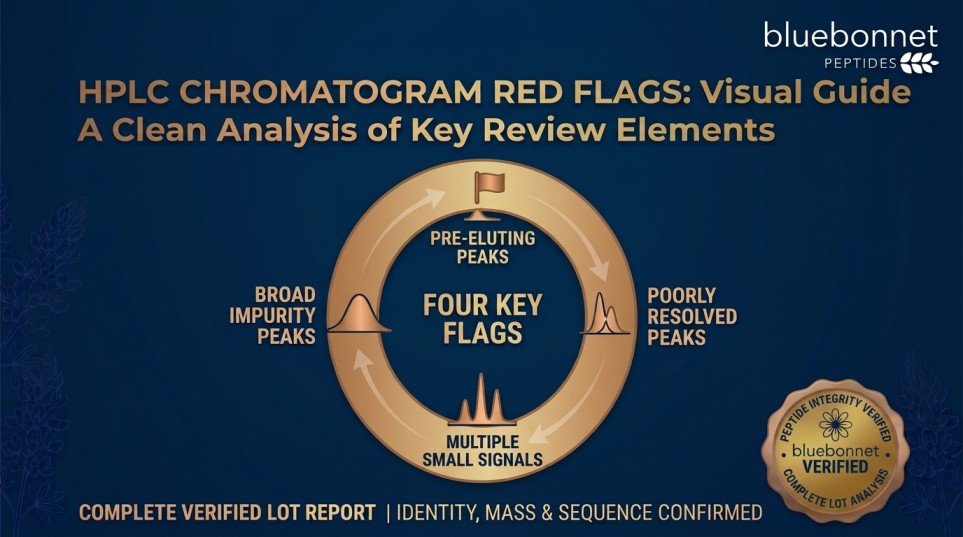
Standard reverse-phase HPLC primarily detects impurities, not aggregates.
Why:
RP-HPLC separates based on hydrophobicity. Aggregates often dissociate under the conditions used (organic solvent gradients, acidic pH), so they appear as monomer peak rather than separate aggregate peak.
What RP-HPLC shows:
- Purity: Percentage of desired peptide versus synthesis-related impurities (deletion sequences, truncations, synthesis byproducts)
What it typically doesn’t show:
- Non-covalent aggregates that dissociate during analysis
Limitation:
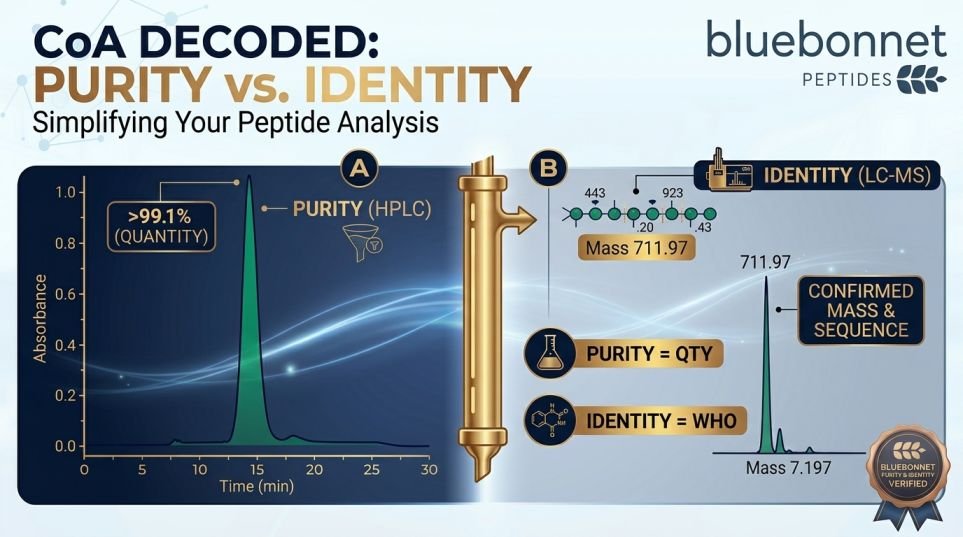
A peptide can show 99% purity by RP-HPLC but still contain significant aggregates not detected by this method.
Implication:
RP-HPLC purity percentage doesn’t guarantee absence of aggregation. Additional methods needed for aggregation characterization.
Size-Exclusion Chromatography (SEC-HPLC)
SEC-HPLC separates molecules by size, enabling aggregate detection.
How it works:
Column contains porous beads. Smaller molecules enter pores and take longer to elute. Larger molecules (aggregates) cannot enter pores and elute first.
Elution order:
Large aggregates → Smaller aggregates → Monomer → Small molecules/fragments
What SEC-HPLC reveals:
Aggregate content:
Percentage of material present as aggregates versus monomer
Aggregate size distribution:
Whether aggregates are small (dimers, trimers) or large (higher-order assemblies)
Monomer content:
Percentage present as single molecules (desired form for most applications)
Advantages:
- Directly detects aggregates under native-like conditions
- Quantifies aggregate percentage
- Characterizes aggregate size distribution
- Non-destructive to sample
Limitations:
- Requires specialized column
- May not detect very small aggregates (dimers)
- Less common than RP-HPLC in routine quality control
Interpretation:
- High monomer peak, low aggregate peaks: Well-behaved peptide with minimal aggregation
- Significant aggregate peaks: Peptide has aggregation issues requiring investigation
Example SEC-HPLC result:
- Monomer: 92%
- Dimer: 5%
- Higher aggregates: 3%
This reveals aggregation not detected by standard purity (RP-HPLC) testing.
Dynamic Light Scattering (DLS)
DLS measures particle size distribution in solution.
How it works:
Laser light scattered by particles in solution. Analysis of scattering fluctuations reveals particle size.
What DLS shows:
- Average particle size (hydrodynamic diameter)
- Size distribution (monodisperse vs. polydisperse)
- Presence of aggregates
Advantages:
- Rapid measurement
- Non-destructive
- Requires small sample volume
- Detects aggregation in solution conditions
Limitations:
- Doesn’t provide molecular-level detail
- Sensitive to dust/contamination (can give false positives)
- Interpretation requires expertise
Application:
DLS useful for formulation development and stability studies to monitor aggregation over time.
Analytical Ultracentrifugation (AUC)
AUC characterizes size, shape, and interactions of molecules in solution.
Capabilities:
- Determines molecular weight
- Detects aggregates and quantifies distribution
- Assesses reversibility of aggregation
- No molecular weight upper limit
Advantages:
- High precision
- Quantitative
- Solution-based (native conditions)
Limitations:
- Specialized equipment
- Requires expertise
- Time-intensive
- Not routine quality control method
Application:
Research-grade characterization when detailed aggregation information needed.
LC-MS for Covalent Aggregates
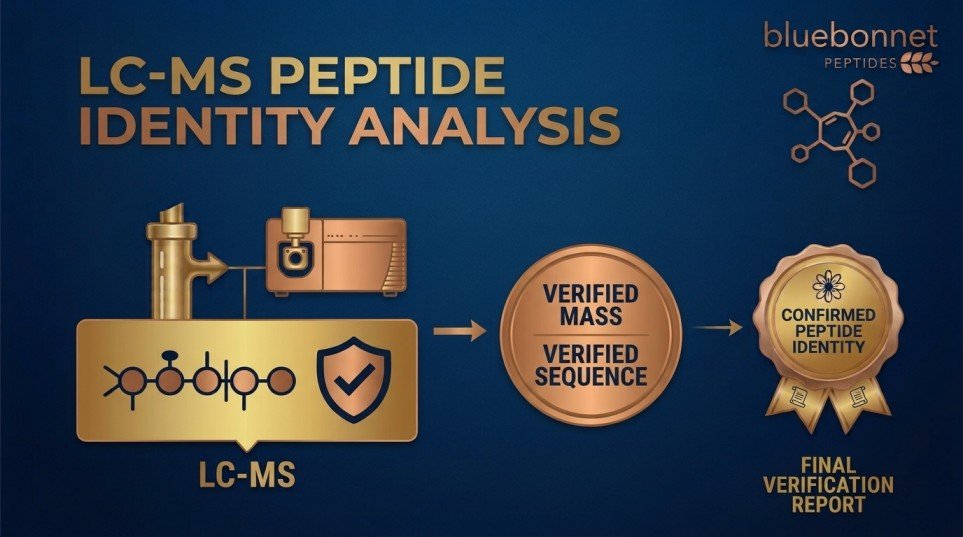
LC-MS detects covalent aggregates (especially disulfide-linked).
How:
Covalent aggregates have different molecular weight than monomer. LC-MS separates and detects based on mass.
What LC-MS shows:
For disulfide-linked aggregates:
Peaks at multiples of monomer molecular weight (dimer = 2× monomer MW, trimer = 3× MW, etc.)
Advantages:
- Detects covalent aggregates definitively
- Provides molecular weight information
- Complements other methods
Limitations:
- Primarily detects covalent aggregates
- Non-covalent aggregates may dissociate during ionization
Application:
Essential for cysteine-containing peptides where disulfide-mediated aggregation is concern.
Analytical Method Comparison
Different methods detect different aspects:
| Method | Detects | Best For | Limitations |
|---|---|---|---|
| RP-HPLC | Sequence-related impurities | Purity assessment | Often misses non-covalent aggregates |
| SEC-HPLC | Size-based separation | Aggregate quantification | Requires specialized column |
| DLS | Particle size | Rapid screening | Sensitive to contamination |
| AUC | Molecular weight, interactions | Detailed characterization | Specialized, time-intensive |
| LC-MS | Molecular weight | Covalent aggregates, identity | May miss non-covalent aggregates |
Comprehensive characterization often requires multiple complementary methods.
What COAs Typically Include
Standard peptide COAs usually provide:
- RP-HPLC purity (detects synthesis impurities)
- LC-MS identity confirmation (detects molecular weight)
What’s typically not included:
- SEC-HPLC aggregate analysis
- DLS particle size
- Detailed aggregation characterization
Implication:
Standard COA documentation may not reveal aggregation issues. For critical applications or aggregation-prone peptides, researchers may need to request additional characterization or perform in-house testing.

Implications for Research Quality
Aggregation affects experimental reproducibility and outcomes.
How Aggregation Affects Research
Biological activity:
Aggregates may have different activity than monomers—potentially reduced activity, altered potency, or different pharmacological profiles.
Concentration accuracy:
If significant fraction exists as aggregates, actual monomer concentration differs from calculated concentration, affecting dose-response relationships.
Pharmacokinetics:
In animal models, aggregates may have different absorption, distribution, metabolism, and clearance than monomers.
Cell culture studies:
Aggregates may interact differently with cells, confounding receptor binding studies or signaling pathway analysis.
Immunogenicity:
Protein/peptide aggregates can be immunogenic, potentially triggering immune responses in in vivo studies.
Physical properties:
Aggregates affect solution viscosity, filterability, and handling characteristics.
Analytical variability:
Aggregation state affects results of biological assays, binding studies, and activity measurements.
Reproducibility Concerns
Aggregation introduces experimental variability:
Batch-to-batch:
If aggregation tendency varies between batches due to manufacturing differences, experimental results may not reproduce.
Handling-dependent:
If researchers handle materials differently (mixing intensity, storage time, freeze-thaw frequency), aggregation state varies, causing result variability.
Time-dependent:
If experiments use fresh versus aged peptide solutions, aggregation differences affect outcomes.
Lab-to-lab:
Different storage, handling, and reconstitution practices create aggregation differences, contributing to reproducibility challenges across laboratories.
Minimizing variability:
Standardize handling:
Consistent reconstitution protocols, storage conditions, and usage timelines
Use fresh solutions:
Reconstitute shortly before use, minimize storage time
Document age:
Record reconstitution date, note solution age in experimental records
Characterize aggregation:
When possible, assess aggregation state of material used in key experiments
When to Be Particularly Concerned About Aggregation
Aggregation is especially important consideration for:
Quantitative dose-response studies:
Aggregation affects actual monomer concentration, skewing concentration-response relationships.
Receptor binding assays:
Aggregates may have altered binding characteristics.
In vivo pharmacology:
Aggregation affects absorption, distribution, and clearance.
Long-term stability studies:
Aggregation increases over time, affecting results if not monitored.
Cell culture at low concentrations:
Surface adsorption and aggregation can significantly deplete active monomer concentration.
Comparative studies:
If comparing materials from different sources or batches, aggregation differences confound comparisons.
Structure-activity relationships:
Aggregation obscures true structure-activity relationships by introducing heterogeneous species.
Bluebonnet Insight
Purity percentage alone doesn’t tell the aggregation story. A peptide can be 99% pure by RP-HPLC (meaning minimal synthesis-related impurities) yet contain significant aggregates not detected by standard purity testing. Comprehensive quality assessment considers both purity (synthesis-related impurities) and aggregation state.
For critical research applications, consider:
- Whether supplier can provide aggregation characterization (SEC-HPLC, DLS, or equivalent)
- Requesting aggregate content data for aggregation-prone sequences
- Performing in-house aggregation assessment for key experiments
- Documenting handling and storage practices that affect aggregation
- Using analytical methods appropriate for detecting aggregates when needed
Quality suppliers transparent about analytical methods used understand that different techniques answer different questions. Standard COAs answer purity questions; aggregation questions may require additional characterization.
Researchers who understand the distinction between purity and aggregation can make more informed quality assessments and better interpret experimental results.
Minimizing Aggregation Risk
Proper handling and storage practices reduce aggregation.
Reconstitution Best Practices
Solvent selection:
Follow supplier recommendations when available:
Suppliers may provide sequence-specific solvent guidance based on solubility testing.
Common solvents:
- Sterile water (many peptides)
- Dilute acetic acid (0.1-1%, for basic peptides)
- Dilute ammonia or buffer (for acidic peptides)
- DMSO (for very hydrophobic peptides, though may affect some applications)
Avoid incompatible solvents:
Some solvents precipitate peptides rather than dissolving them.
Reconstitution technique:
Add solvent gradually:
Don’t dump entire volume at once.
Mix gently:
Swirl or invert gently. Avoid vigorous vortexing.
Allow time to dissolve:
Some peptides dissolve slowly. Allow 5-10 minutes with gentle periodic mixing.
Avoid air bubbles:
Don’t introduce excessive air during mixing.
Use appropriate concentration:
Don’t exceed solubility limits. If peptide won’t fully dissolve, it may be too concentrated.
Temperature during reconstitution:
Some peptides dissolve better at room temperature, others may benefit from slight warming (but check stability data—don’t heat peptides that degrade at elevated temperature).
Storage Strategies
Lyophilized peptides:
Temperature:
-20°C or -80°C (colder is generally better for long-term storage)
Desiccation:
Store with desiccant to minimize moisture exposure
Protection from light:
Amber vials or aluminum foil wrapping for light-sensitive peptides
Minimize temperature fluctuations:
Avoid repeated removal from freezer
Seal integrity:
Ensure vials properly sealed to prevent moisture ingress
Reconstituted peptides:
Aliquot immediately:
Divide into single-use portions before freezing to avoid freeze-thaw cycles
Minimize storage time:
Use within days to weeks (peptide-dependent)
Refrigerate (2-8°C) for short-term:
If using within 1-2 weeks and peptide is stable
Freeze (-20°C or -80°C) for longer storage:
But accept that some aggregation may occur upon thawing
Never refreeze:
Once thawed, use completely and discard remainder
Protect from light:
Use amber tubes or wrap in foil if light-sensitive
Handling Practices
Minimize mechanical stress:
Gentle mixing:
Invert or swirl rather than vortex
Careful pipetting:
Avoid repeated aspiration/dispensing
Limit air exposure:
Don’t introduce air bubbles unnecessarily
Temperature control:
Minimize time at room temperature:
Keep cold during preparation and handling
Avoid temperature swings:
Don’t alternate between freezer and room temperature multiple times
Thaw gently:
Let thaw at refrigerator temperature or room temperature, not in warm water
Usage practices:
Fresh solutions when possible:
Reconstitute close to time of use
Use quickly after thawing:
Don’t let thawed aliquot sit for days
Don’t mix old and new:
Use each aliquot completely
Document conditions:
Record storage time, freeze-thaw history, observed appearance
Formulation Considerations
Some additives can reduce aggregation:
Carrier proteins:
BSA (0.1%) or other carrier proteins can reduce surface adsorption and sometimes aggregation (but may not be compatible with all applications)
Polyols:
Glycerol (5-10%) or other polyols may stabilize some peptides
Surfactants:
Non-ionic detergents (very low concentration) can reduce aggregation for some sequences
Buffering agents:
Appropriate buffers maintain pH, preventing pH-dependent aggregation
Caution:
Additives must be compatible with your experimental application. They may affect biological activity assays, cell culture studies, or in vivo experiments. Validate compatibility before use.
Laboratory Best Practice: Aggregation Mitigation Protocol
Establish standard practices to minimize aggregation:
Pre-reconstitution:
- ☐ Store lyophilized peptides at -20°C or -80°C with desiccant
- ☐ Minimize freeze-thaw cycles of lyophilized material
- ☐ Allow vial to warm to room temperature before opening (prevents condensation)
During reconstitution:
- ☐ Use appropriate solvent for specific peptide
- ☐ Add solvent gradually with gentle mixing
- ☐ Allow adequate time for complete dissolution
- ☐ Avoid vigorous vortexing
Post-reconstitution:
- ☐ Aliquot immediately into single-use portions
- ☐ Freeze aliquots if not using same day
- ☐ Label with reconstitution date
- ☐ Use fresh (recently reconstituted) solutions when possible
Usage:
- ☐ Thaw frozen aliquot gently
- ☐ Use completely and discard remainder (never refreeze)
- ☐ Minimize time at room temperature
- ☐ Mix gently before use
- ☐ Note solution age in experimental records
Documentation:
- ☐ Record reconstitution date
- ☐ Track freeze-thaw history
- ☐ Document observed appearance
- ☐ Note any deviations from protocol
This systematic approach minimizes aggregation-related experimental variability.
Frequently Asked Questions
A: Peptide aggregation is the association of individual peptide molecules (monomers) into larger assemblies held together by non-covalent interactions (hydrogen bonding, hydrophobic interactions, electrostatic forces) or occasionally covalent bonds (disulfide linkages). Aggregates can range from small soluble clusters (dimers, trimers) to large insoluble precipitates. Aggregation is a physical phenomenon where intact peptide molecules cluster together—it’s distinct from chemical degradation where the peptide sequence itself is chemically modified.
A: Peptides aggregate because the aggregated state can be thermodynamically favorable under certain conditions. Driving forces include:
* Hydrophobic interactions: Hydrophobic amino acids cluster to minimize water contact
* Electrostatic attractions: Oppositely charged regions attract
* Hydrogen bonding: Intermolecular hydrogen bonds stabilize aggregates
* Disulfide bonds: Cysteine-containing peptides can form covalent intermolecular disulfides
Factors promoting aggregation include high concentration, temperature stress, inappropriate pH, freeze-thaw cycles, mechanical agitation, time, and sequence characteristics (hydrophobic or aggregation-prone sequences). Each peptide has intrinsic aggregation propensity based on its sequence.
A: No. Aggregation and degradation are distinct phenomena:
Aggregation: Physical association of intact peptide molecules. The amino acid sequence remains unchanged; molecules are simply clustering together. May be reversible under some conditions.
Degradation: Chemical modification of the peptide itself through oxidation, hydrolysis, deamidation, or other reactions that alter the molecular structure. Typically irreversible.
Peptides can undergo both aggregation and degradation, sometimes simultaneously. Visual cloudiness could indicate aggregation, degradation products precipitating, or contamination. Analytical methods (HPLC, SEC-HPLC, LC-MS) help distinguish between these possibilities.
A: Standard reverse-phase HPLC primarily detects sequence-related impurities (deletion sequences, synthesis byproducts), not aggregation. RP-HPLC uses organic solvent gradients and acidic pH that often dissociate non-covalent aggregates, so they appear as monomer peak rather than separate aggregate peaks. This means a peptide can show 99% purity by RP-HPLC yet still contain significant aggregates.
Size-exclusion HPLC (SEC-HPLC) specifically detects aggregates by separating based on molecular size. Aggregates (larger) elute before monomers (smaller), enabling quantification of aggregate content. SEC-HPLC is the preferred HPLC method for aggregation detection, but it’s less commonly included in standard COAs than RP-HPLC.
A: LC-MS can detect covalent aggregates (especially disulfide-linked) because they have different molecular weights than monomers. Dimers appear at approximately 2× monomer molecular weight, trimers at 3×, etc. This makes LC-MS valuable for cysteine-containing peptides where disulfide-mediated aggregation is a concern.
However, non-covalent aggregates (held together by hydrogen bonds, hydrophobic interactions, electrostatic forces) often dissociate during the ionization process in mass spectrometry, appearing as monomers. LC-MS may miss these reversible aggregates.
Comprehensive aggregation characterization often requires multiple complementary methods: SEC-HPLC for non-covalent aggregates, LC-MS for covalent aggregates, DLS for particle size, etc.
A: Cloudiness can indicate aggregation, but it’s not definitive without further investigation. Cloudy or turbid peptide solutions may result from:
* Peptide aggregation (soluble or insoluble aggregates)
* Precipitation due to concentration exceeding solubility
* Particulate contamination (dust, fibers)
* Microbial contamination (bacterial/fungal growth)
* Incompatible solvent causing precipitation rather than dissolution
* Container leachables or other chemical contamination
Visual inspection alone cannot determine the cause. Investigation requires analytical methods (HPLC, SEC-HPLC, LC-MS, microscopy) to characterize what’s actually present. Don’t assume cloudiness automatically means aggregation—but do investigate before using material in experiments.
A: Investigating aggregation requires analytical characterization:
Analytical methods:
* SEC-HPLC: Quantifies aggregate content and size distribution
* Dynamic Light Scattering (DLS): Measures particle size in solution
* LC-MS: Detects covalent (disulfide-linked) aggregates
* Analytical ultracentrifugation: Detailed characterization (specialized)
Practical assessments:
* Visual inspection: Note cloudiness, particles, precipitation (preliminary only)
* Filtration test: Does material pass through appropriate filter size?
* Solubility test: Try reconstituting in alternative compatible solvent
* Concentration dependency: Does cloudiness decrease at lower concentration?
For most research laboratories:
Request SEC-HPLC data from supplier if available, or consider DLS measurement if equipment accessible. For critical applications, specialized aggregation characterization may warrant sending material to analytical laboratory.
A: Aggregation affects reproducibility in multiple ways:
Activity differences: Aggregates may have different biological activity than monomers, affecting experimental outcomes.
Concentration variability: If significant material exists as aggregates, actual active monomer concentration differs from calculated concentration, affecting dose-response curves and quantitative comparisons.
Handling sensitivity: Aggregation is influenced by storage time, freeze-thaw cycles, mixing techniques, temperature exposure—variables that may differ between experiments or laboratories, creating reproducibility challenges.
Batch differences: If aggregation tendency varies between peptide batches, results may not reproduce even when using nominally “same” peptide.
Time-dependence: Aggregation increases over time in solution. Experiments using fresh versus aged solutions may yield different results.
Controlling aggregation through standardized handling, fresh solutions, consistent storage practices, and when possible analytical characterization improves experimental consistency and cross-laboratory reproducibility.
Final Thoughts
Peptide aggregation occupies a curious space in research quality assessment—simultaneously common and frequently overlooked. It’s not contamination. It’s not impurity in the traditional sense. It’s a physical phenomenon intrinsic to peptide behavior that can significantly affect research outcomes yet often escapes detection by standard quality control methods.
Understanding aggregation transforms how you think about peptide quality. Purity percentages—while important—tell only part of the story. A 99% pure peptide could be predominantly monomeric and well-behaved, or it could contain significant aggregates that standard purity testing doesn’t detect. The difference matters profoundly for experimental reproducibility and result interpretation.
Key principles for aggregation awareness:
Aggregation is distinct from purity. RP-HPLC purity measures synthesis-related impurities. Aggregation characterization requires different methods (SEC-HPLC, DLS, AUC). Both matter; neither tells complete quality story alone.
Sequence matters. Some peptides are intrinsically aggregation-prone due to hydrophobic or β-sheet-forming sequences. Others are inherently more stable. Know your peptide’s characteristics.
Handling affects aggregation. Concentration, temperature, pH, mechanical stress, freeze-thaw cycles, and storage time all influence aggregation. Standardized practices minimize variability.
Visual appearance provides clues, not conclusions. Cloudiness may indicate aggregation—or contamination, precipitation, or other issues. Clear solutions don’t guarantee absence of soluble aggregates. Analytical characterization provides definitive assessment.
Fresh solutions are best. Aggregation is often time-dependent. Using freshly reconstituted peptide solutions improves consistency. Aliquoting prevents repeated freeze-thaw cycles that promote aggregation.
Documentation matters. Recording reconstitution dates, storage conditions, solution age, and observed appearance creates traceability that helps explain experimental variability when it occurs.
For critical applications, consider specialized testing. When aggregation could significantly affect results—dose-response studies, receptor binding assays, in vivo pharmacology, comparative studies—consider requesting or performing aggregation characterization beyond standard COA documentation.
The research landscape increasingly demands comprehensive materials characterization. Reviewers question experimental rigor. Reproducibility concerns intensify scrutiny. Understanding aggregation positions you to assess quality more completely, handle materials more appropriately, and interpret results more accurately.
Suppliers who understand aggregation as quality parameter—distinct from but equally important as purity—demonstrate sophisticated quality thinking. Those who can provide or discuss aggregation data when requested show commitment to comprehensive characterization.
Researchers who understand aggregation can:
- Make more informed quality assessments
- Implement handling practices that minimize aggregation
- Troubleshoot experimental variability more effectively
- Design protocols accounting for aggregation potential
- Communicate materials characterization more completely in publications
Aggregation awareness is materials science literacy. It’s recognition that peptide quality is multifaceted—purity, identity, aggregation state, degradation status—and comprehensive characterization considers all dimensions.
You don’t need to become an aggregation specialist. But you do need to recognize that the clear solution in your vial might contain aggregates, that the standard purity percentage doesn’t tell you about them, and that they could affect your research.
Ask questions. Request appropriate documentation. Handle materials to minimize aggregation. Use fresh solutions. Understand your peptide’s characteristics.
Your experimental reproducibility may depend on it.
- Understanding peptide purity
- Understanding Certificates of Analysis
- How to read a Certificate of Analysis
- Peptide storage best practices
- Why freeze-dried peptides improve stability
- Peptide reconstitution guide
- Understanding batch-to-batch consistency
Research Use Only Disclaimer
IMPORTANT: Research Use Only (RUO)
All peptides discussed in this article are Research Use Only (RUO) materials intended exclusively for laboratory research applications conducted by qualified researchers in appropriate institutional settings.
These peptides are NOT:
- Intended for human consumption or use
- Approved for medical diagnosis, treatment, cure, or prevention of any disease
- Suitable for veterinary applications
- Dietary supplements or food additives
- Cosmetic ingredients
- For self-administration or personal use
Appropriate use includes ONLY:
- Controlled laboratory research by qualified personnel
- In vitro studies in institutional research settings
- In vivo research in approved animal model studies under IACUC oversight
- Educational purposes in academic institutions
- Method development and validation in research laboratories
- Analytical method development including aggregation characterization studies
Legal and Safety Obligations:
Peptide procurement, handling, and use must comply with all applicable federal, state, and local regulations. Researchers are responsible for:
- Obtaining appropriate institutional approvals (IRB, IACUC as applicable)
- Following institutional biosafety and chemical safety protocols
- Implementing appropriate handling practices to maintain material quality
- Maintaining proper documentation
- Ensuring personnel are properly trained
- Preventing unauthorized access or misuse
- Proper disposal according to institutional EH&S guidelines
Aggregation Information:
Information provided about peptide aggregation is for educational purposes to help researchers understand material behavior and quality assessment. Researchers must implement appropriate quality control measures for their specific applications and research requirements.
By procuring or using research peptides, you acknowledge:
- Materials are Research Use Only
- You are a qualified researcher or acting under supervision of qualified personnel
- You will implement appropriate quality control and handling practices
- You will use materials only for legitimate research in appropriate institutional settings
- You understand and accept all legal and safety responsibilities
- You will not use materials for human consumption, medical treatment, or any non-research purpose
Bluebonnet Peptides supplies Research Use Only materials exclusively to qualified research institutions and personnel. We do not supply peptides for human consumption, medical use, or any non-research applications.