≥99% Purity
 Third-Party Tested
 COA Available
 U.S.-Based
 Research Use Only

Blog
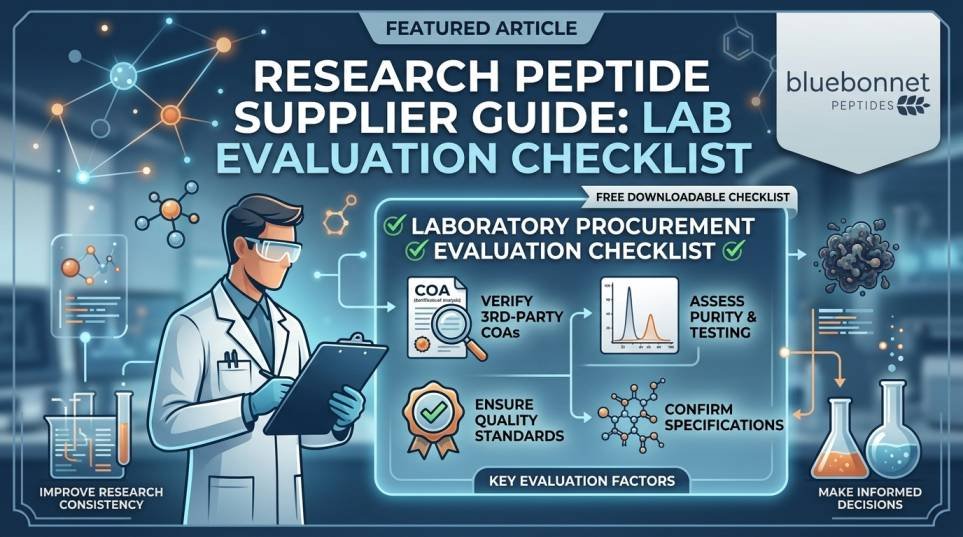
Research Peptide Supplier Guide: Lab Evaluation Checklist

Contents
- 1. How to Evaluate a Research Peptide Supplier: A Laboratory Procurement Checklist
- 1.1. Why Supplier Evaluation Matters
- 1.2. The Complete Supplier Evaluation Framework
- 1.2.1. Phase 1: Initial Screening (Pre-Contact)
- 1.2.2. Bluebonnet Insight
- 1.2.3. Phase 2: Documentation Review
- 1.2.4. Laboratory Best Practice: Document Review Workflow
- 1.2.5. Phase 3: Quality Assurance Standards
- 1.2.6. Phase 4: Transparency and Communication
- 1.2.7. Bluebonnet Insight
- 1.2.8. Phase 5: Logistics and Operational Considerations
- 1.2.9. Phase 6: Compliance and Regulatory Considerations
- 1.2.10. Phase 7: Pilot Order and Performance Evaluation
- 1.2.11. Phase 8: Long-Term Supplier Management
- 1.2.12. Laboratory Best Practice: Supplier Performance Database
- 1.3. Bluebonnet’s Approach to Supplier Transparency
- 1.4. Common Supplier Evaluation Mistakes
- 1.4.1. Mistake 1: Prioritizing Price Over Quality
- 1.4.2. Mistake 2: Accepting Generic COAs
- 1.4.3. Mistake 3: Failing to Verify Third-Party Testing Claims
- 1.4.4. Mistake 4: Ignoring RUO Compliance
- 1.4.5. Mistake 5: No Pilot Testing
- 1.4.6. Mistake 6: Inadequate Documentation
- 1.4.7. Mistake 7: No Ongoing Monitoring
- 1.4.8. Bluebonnet Insight
- 1.5. Frequently Asked Questions
- 1.5.1. What’s the difference between third-party testing and manufacturer testing?
- 1.5.2. What purity level should I require for research peptides?
- 1.5.3. How do I verify a Certificate of Analysis is legitimate?
- 1.5.4. Should I conduct my own testing of purchased peptides?
- 1.5.5. What should I do if received peptides don’t match the COA?
- 1.5.6. How often should I re-evaluate approved suppliers?
- 1.5.7. Can I request custom documentation for institutional requirements?
- 1.5.8. What are the most important red flags in supplier evaluation?
- 1.5.9. How does Bluebonnet Peptides support institutional procurement processes?
- 1.6. Final Thoughts
- 1.7. Related Reading
Last updated: August 2026 | 16-minute read
How to Evaluate a Research Peptide Supplier: A Laboratory Procurement Checklist
Selecting a research peptide supplier is not a purchasing decision—it’s a research integrity decision.
The quality of your peptide compounds directly impacts experimental validity, data reproducibility, and research outcomes. A supplier providing peptides with inadequate purity verification, inconsistent batch quality, or insufficient documentation introduces variables that compromise your work before experiments even begin.
Yet many laboratories base supplier selection primarily on price or convenience, overlooking critical quality indicators that separate research-grade materials from products unsuitable for rigorous scientific investigation.
This comprehensive guide provides a systematic framework for evaluating research peptide suppliers. It covers documentation verification, testing methodology assessment, transparency signals, and procurement best practices that protect research integrity while ensuring compliance with institutional standards.
Whether you’re establishing vendor relationships for a new laboratory, re-evaluating existing suppliers, or implementing formal procurement protocols, this checklist provides the structure needed to make informed, defensible supplier decisions.
Why Supplier Evaluation Matters
The research peptide market includes suppliers ranging from rigorous, quality-focused operations to vendors prioritizing profit over scientific integrity. The consequences of poor supplier selection extend far beyond wasted funding.
Impact on Research Validity
Purity Issues
Peptides containing significant impurities introduce unknown variables into experiments. A peptide advertised as 98% pure but actually containing 15% deletion sequences, oxidation products, or synthesis byproducts will produce unreliable results that cannot be replicated.
Identity Verification
Receiving the wrong peptide—whether through mislabeling, manufacturing error, or deliberate substitution—invalidates entire experimental series. Without proper molecular weight confirmation via LC-MS, researchers cannot verify they’re studying the intended compound.
Batch Inconsistency
Research spanning multiple months or years requires consistent peptide quality across batches. Suppliers with inadequate quality control produce variable products, making long-term studies irreproducible.
Learn more:
Understanding peptide purity and quality standards
The complete journey of a research peptide
Impact on Publication and Funding
Reproducibility Crisis
Scientific journals increasingly require detailed materials documentation. Research based on poorly characterized peptides may be rejected during peer review or retracted after publication when results cannot be reproduced.
Funding Accountability
Grant funding agencies expect rigorous documentation of research materials. Inadequate supplier documentation can jeopardize grant renewals or trigger audit findings.
Collaborative Research
Multi-institutional studies require standardized materials. Supplier quality issues affecting one site compromise collaborative efforts.
Impact on Laboratory Operations
Time Loss
Discovering supplier quality issues after experimental design, pilot studies, or initial data collection wastes months of research time.
Financial Waste
Failed experiments due to poor peptide quality waste not just the cost of peptides, but also reagents, consumables, equipment time, and personnel effort.
Reputation Risk
Laboratories associated with unreproducible research due to poor materials quality face reputational damage affecting future funding and collaboration opportunities.
Regulatory and Compliance Considerations
Institutional Requirements
Many research institutions mandate vendor qualification processes, particularly for projects involving human subjects research, NIH funding, or GLP compliance.
Research Use Only Compliance
Suppliers must clearly designate products as Research Use Only (RUO) and avoid any suggestions of therapeutic applications, human use, or medical claims.
Documentation Standards
Institutional review boards, biosafety committees, and chemical hygiene programs may require specific supplier documentation for protocol approval.
Understanding these impacts underscores why systematic supplier evaluation is essential, not optional.
The Complete Supplier Evaluation Framework
Effective supplier evaluation requires a structured approach addressing documentation, testing, transparency, logistics, and support.
Phase 1: Initial Screening (Pre-Contact)
Before contacting a potential supplier, conduct preliminary assessment using publicly available information.
Website Evaluation
Professional Presentation
A supplier’s website reflects their attention to detail and professionalism.
Positive indicators:
- ✅ Clear, professional design
- ✅ Scientific accuracy in product descriptions
- ✅ Proper RUO labeling throughout
- ✅ No medical claims or therapeutic suggestions
- ✅ Educational resources and technical documentation
- ✅ Transparent contact information (physical address, phone)
- ✅ Accessible Certificates of Analysis
Red flags:
- ❌ Medical claims or health benefits
- ❌ Dosing instructions for human use
- ❌ Bodybuilding or performance enhancement marketing
- ❌ Missing contact information or P.O. box addresses only
- ❌ Grammatical errors suggesting unprofessional operations
- ❌ No accessible testing documentation
Educational Content Assessment
Suppliers investing in comprehensive educational resources demonstrate scientific expertise and commitment to research integrity.
Look for:
- Detailed guides on testing methodologies (HPLC, LC-MS)
- Storage and handling protocols
- Quality control explanations
- Technical blog or resource library
- Scientific accuracy and depth
Learn more:
Understanding peptide purity
How to read a Certificate of Analysis
Certificate of Analysis Accessibility
COAs should be easily accessible, ideally searchable by product and batch number before purchase.
Evaluation criteria:
- Are COAs publicly available or behind account walls?
- Can you view sample COAs before ordering?
- Are COAs batch-specific or generic?
- Do COAs include actual testing data (chromatograms, spectra)?
- Are testing dates recent?
Learn more: Understanding Certificates of Analysis
Third-Party Testing Claims
Many suppliers claim third-party testing. Initial screening should verify these claims are specific and verifiable.
Assessment questions:
- Is the third-party laboratory named?
- Are laboratory credentials provided?
- Can you verify the lab’s accreditation independently?
- Are actual third-party reports accessible, not just claims?
Learn more: Third-party laboratory testing explained
Bluebonnet Insight
Never rely solely on supplier claims about quality. Marketing statements like “highest purity” or “pharmaceutical grade” are meaningless without verifiable documentation. Focus on what can be independently confirmed: actual COAs, identifiable third-party testing laboratories, and specific analytical data.
Phase 2: Documentation Review
Request and thoroughly evaluate supplier documentation before placing orders.
Sample Certificate of Analysis Request
Contact the supplier and request sample COAs for products you’re considering.
What to request:
“Please provide Certificates of Analysis for [specific peptide], including:
- HPLC chromatogram with purity percentage
- LC-MS or MALDI-TOF mass spectrum
- Third-party testing reports if available
- Most recent batch data”
COA Evaluation Checklist
When reviewing COAs, assess both content and quality.
Header Information:
- ☐ Product name clearly stated
- ☐ Batch/lot number included
- ☐ Manufacturing date provided
- ☐ Analysis date provided
- ☐ Supplier contact information
- ☐ Clear labeling as “Research Use Only”
Testing Data:
- ☐ HPLC purity percentage stated (target: ≥98%, ideally ≥99%)
- ☐ HPLC chromatogram included showing actual peaks
- ☐ LC-MS or MALDI-TOF data confirming molecular weight
- ☐ Observed molecular weight matches expected value
- ☐ Appearance description (color, form)
- ☐ Water content if tested (target: <5%)
Laboratory Information:
- ☐ Testing laboratory identified (in-house or third-party)
- ☐ If third-party: laboratory name, location, credentials
- ☐ Analyst signature or authorization
- ☐ Quality control approval stamps or signatures
Traceability:
- ☐ Batch number on COA matches product vial labeling
- ☐ Sequential numbering or tracking system evident
- ☐ Manufacturing lot traceability
Learn more: Understanding peptide purity
HPLC Chromatogram Assessment
Understanding how to interpret HPLC data is essential for evaluating quality.
Key evaluation points:
Peak Pattern:
- Single dominant peak: Indicates high purity
- Multiple peaks: Suggests impurities, deletion sequences, or degradation products
- Peak shape: Should be sharp and symmetrical, not broad or tailing
Purity Calculation:
- Verify purity percentage matches peak integration
- Understand calculation method (peak area under curve)
- Check if all peaks are accounted for
Baseline:
- Should be flat and stable
- Noise should be minimal
- Drift indicates potential instrument or method issues
Learn more: How to read a Certificate of Analysis (includes chromatogram interpretation)
LC-MS Identity Confirmation
Liquid Chromatography-Mass Spectrometry confirms the peptide is what it claims to be.
Evaluation criteria:
Molecular Weight Match:
- Observed m/z (mass-to-charge ratio) should match calculated molecular weight
- Typical tolerance: ±1 Da for small peptides, ±0.1% for larger peptides
- Multiple charge states may be visible (normal for larger peptides)
Spectrum Quality:
- Peaks should be clear and identifiable
- Signal-to-noise ratio should be high
- No major unexpected peaks
Documentation:
- Expected molecular weight stated
- Observed molecular weight clearly indicated
- Calculation or comparison provided
Third-Party Testing Verification
If suppliers claim third-party testing, verify independently.
Verification steps:
Identify the laboratory
- Full laboratory name and location should be stated
- Generic terms like “independent lab” are insufficient
Check accreditation
- Look for ISO/IEC 17025 accreditation
- Verify through accrediting body directories (A2LA, ANAB, etc.)
- Confirm accreditation is current and relevant to analytical testing
Verify the laboratory exists
- Search for the laboratory independently
- Confirm they perform peptide testing
- Check if they have public reputation or reviews
Assess report authenticity
- Report should be on laboratory letterhead
- Include laboratory contact information
- Signed by authorized personnel
- Reference traceable to laboratory records
Learn more: Third-party laboratory testing explained
Safety Data Sheets (SDS)
SDS documents provide safety and handling information.
SDS evaluation:
- ☐ Provided for all peptides
- ☐ Current and properly formatted (GHS-compliant)
- ☐ Specific to the actual peptide, not generic
- ☐ Includes proper chemical identification
- ☐ Provides handling and storage guidance
- ☐ Lists emergency procedures
Manufacturing Documentation
Some suppliers provide additional manufacturing documentation.
Optional but valuable:
- Manufacturing process overview
- Quality control procedures
- Stability data
- Storage and handling recommendations
- Reconstitution protocols
Learn more:
Why freeze-dried peptides improve stability
Peptide storage best practices
Laboratory Best Practice: Document Review Workflow
Create a standardized documentation review process:
- Request sample COAs from multiple batches (not just one)
- Assign qualified personnel to review analytical data
- Use a checklist to ensure consistent evaluation
- Document findings in procurement records
- Compare multiple suppliers using the same criteria
- Maintain documentation for institutional compliance
This systematic approach ensures all suppliers are evaluated fairly using consistent scientific standards.
Phase 3: Quality Assurance Standards
Beyond documentation, evaluate the supplier’s overall quality management approach.
Quality Control Systems
Batch Testing Protocols
Every batch should undergo quality control testing before release.
Key questions:
- Is every batch tested, or only representative samples?
- What testing methods are used (HPLC, LC-MS, other)?
- Are acceptance criteria clearly defined?
- What happens to batches that fail QC?
- Is failed batch data disclosed or hidden?
Batch-to-Batch Consistency
Long-term research requires consistent quality across multiple batches.
Assessment approach:
- Request COAs from multiple batches of the same peptide
- Compare purity levels across batches
- Assess consistency of HPLC peak patterns
- Verify molecular weight confirmation is consistent
- Look for tight standard deviations, not wide variation
Learn more: Understanding batch-to-batch consistency
Quality Documentation
Suppliers with robust quality systems maintain comprehensive records.
Documentation indicators:
- Standard Operating Procedures (SOPs) for manufacturing and testing
- Quality manual or quality policy statements
- Deviation and corrective action systems
- Complaint handling procedures
- Document control and record retention policies
Traceability Systems
Lot Number Tracking
Every vial should have a unique batch/lot number enabling full traceability.
Evaluation criteria:
- Clear lot numbering system
- Lot numbers on vials match COAs
- Ability to trace lot through manufacturing, testing, and distribution
- Historical lot data accessible
Raw Material Traceability
Quality suppliers trace peptides back to raw material sources.
Questions to ask:
- Are amino acid sources documented?
- Are raw material COAs available?
- Is there traceability to synthesis batch?
- Are reagent lots recorded?
Storage and Handling Standards
Temperature Control
Peptide stability depends on proper storage throughout the supply chain.
Assessment questions:
- What temperature are peptides stored at before shipping?
- Are storage facilities temperature-monitored?
- Are temperature logs available?
- How long can peptides be stored before quality degradation?
Learn more: Peptide storage best practices
Contamination Prevention
Manufacturing environments should prevent cross-contamination.
Quality indicators:
- Dedicated manufacturing areas or proper cleaning validation
- Environmental monitoring programs
- Particulate and microbial control
- Clean room classifications (if applicable)
Expiration Dating and Stability
Shelf Life Determination
Expiration dates should be based on actual stability data, not arbitrary timeframes.
Evaluation questions:
- Are expiration dates provided?
- Are they based on stability testing or estimated?
- Are stability studies available for review?
- What storage conditions are required for stated shelf life?
Phase 4: Transparency and Communication
Supplier responsiveness and transparency are critical indicators of reliability.
Technical Support Assessment
Expertise Level
Technical support should demonstrate scientific knowledge, not just sales training.
Test approach:
- Ask technical questions about testing methodologies
- Request clarification on chromatogram interpretation
- Inquire about specific peptide handling requirements
- Assess quality and accuracy of responses
Responsiveness
Timely, thorough responses indicate customer service commitment.
Evaluation criteria:
- Initial response time to inquiries
- Completeness of answers
- Willingness to provide additional documentation
- Follow-up consistency
Communication Channels
Accessibility
Multiple communication options provide flexibility.
Available channels:
- Email with documented response times
- Phone support during business hours
- Technical support chat or ticketing system
- Dedicated account management for institutional customers
Transparency in Limitations
Honest Disclosure
Quality suppliers acknowledge limitations rather than making unsupported claims.
Positive indicators:
- Clear statements about what testing has and hasn’t been performed
- Honest discussion of peptide stability limitations
- Acknowledgment when specific data isn’t available
- Realistic claims about capabilities
Red flags:
- Guarantees of therapeutic outcomes (RUO violation)
- Claims of “pharmaceutical grade” without GMP documentation
- Unwillingness to discuss testing methodologies
- Evasive answers about manufacturing or sourcing
Complaint and Return Policies
Problem Resolution
How suppliers handle issues reveals their commitment to quality.
Key questions:
- What is the policy for defective or mislabeled products?
- Are returns accepted? Under what conditions?
- How are quality complaints investigated?
- Is there documentation of corrective actions?
- Are replacement products provided promptly?
Bluebonnet Insight
Transparency is the foundation of trust. Suppliers who openly discuss testing methodologies, acknowledge limitations, and provide comprehensive documentation demonstrate commitment to research integrity. Conversely, suppliers who are evasive about testing, hide behind proprietary claims, or make unsupported assertions should be approached with extreme caution.
Phase 5: Logistics and Operational Considerations
Even high-quality peptides can be compromised by poor shipping and handling.
Shipping Protocols
Temperature Control During Transit
Peptides are temperature-sensitive; shipping protocols must maintain stability.
Evaluation criteria:
- ☐ Insulated packaging (styrofoam, thermal boxes)
- ☐ Cold packs or dry ice for temperature maintenance
- ☐ Expedited shipping options to minimize transit time
- ☐ Temperature monitoring devices (optional but valuable)
- ☐ Special protocols for extreme weather conditions
Packaging Quality
Proper packaging prevents physical damage and contamination.
Assessment points:
- Vials protected from breakage (bubble wrap, foam inserts)
- Moisture protection (desiccant packets)
- Light protection (opaque packaging or amber vials)
- Secure sealing to prevent tampering
- Clear labeling with batch numbers and storage requirements
Shipping Timeline
Predictable, reliable shipping supports research planning.
Key questions:
- What is standard shipping time?
- Are expedited options available?
- Is tracking provided?
- What happens if shipments are delayed?
- Are there shipping restrictions or blackout periods?
Delivery Verification
Receiving Protocols
Establish clear procedures for receiving and inspecting shipments.
Standard protocol:
- Inspect packaging upon delivery
- Verify cold packs are still cold/frozen
- Check vials for damage or leakage
- Confirm batch numbers match order
- Transfer to proper storage immediately
- Document receipt with dates and condition notes
Problem Documentation
If issues arise, document thoroughly for supplier communication.
Document:
- Photographs of packaging condition
- Temperature indicators if included
- Any visible product issues
- Batch numbers received
- Date and time of delivery
Geographic Considerations
Domestic vs. International
Shipping complexity affects delivery time and quality maintenance.
Domestic (US) advantages:
- Faster shipping (1-3 days typical)
- Fewer customs delays
- Easier temperature control
- Simpler regulatory compliance
International considerations:
- Extended transit times
- Customs documentation requirements
- Import permits for certain peptides
- Temperature control over longer periods
- Additional costs
Inventory and Availability
Stock Availability
Consistent product availability supports ongoing research.
Assessment questions:
- Are products regularly in stock?
- How are out-of-stock situations communicated?
- Can products be backordered?
- Are alternative batches offered if specific lots are unavailable?
Minimum Order Requirements
Understand any minimum order quantities or values.
Considerations:
- Do minimum orders align with your research needs?
- Are smaller quantities available for pilot studies?
- Can multiple peptides be combined to meet minimums?
Pricing and Payment Terms
Pricing Transparency
Pricing should be clear, predictable, and documented.
Evaluation criteria:
- Published pricing or clear quotation process
- Volume discounts if applicable
- Additional fees (shipping, handling, documentation)
- Payment terms (credit card, purchase order, NET terms)
Price vs. Quality Balance
The lowest price rarely indicates the best value.
Assessment approach:
- Compare total cost including shipping and potential waste from quality issues
- Evaluate cost-per-experiment rather than cost-per-vial
- Consider time and funding lost to failed experiments from poor quality
- Factor in documentation quality for institutional compliance
Phase 6: Compliance and Regulatory Considerations
Suppliers must meet regulatory and institutional requirements.
Research Use Only (RUO) Compliance
Proper Designation
All peptides must be clearly labeled for research use only.
Required labeling:
- ☐ “Research Use Only” or “For Research Use Only”
- ☐ “Not for Human or Veterinary Use”
- ☐ No medical claims or therapeutic suggestions
- ☐ No dosing instructions for human use
- ☐ No health benefit claims
Marketing Materials Review
All supplier communications should maintain RUO compliance.
Red flags:
- ❌ Medical claims (treats, cures, prevents disease)
- ❌ Dosing protocols for human consumption
- ❌ Before/after photos suggesting human use
- ❌ Bodybuilding or performance enhancement marketing
- ❌ Customer testimonials about health outcomes
- ❌ Links to medical information or patient resources
Institutional Requirements
Vendor Qualification
Many institutions require formal vendor qualification processes.
Common requirements:
- Completed vendor qualification questionnaires
- Quality system documentation
- Proof of testing capabilities
- References from other research institutions
- Financial stability information
- Insurance certificates
Purchasing Compliance
Understand institutional purchasing protocols.
Considerations:
- Approved vendor lists
- Purchase order requirements
- Competitive bidding thresholds
- Single-source justification documentation
- Grant-specific purchasing restrictions
Chemical Safety Compliance
SDS Availability
Safety Data Sheets are required for chemical inventory and safety programs.
Requirements:
- SDS provided for all peptides
- Accessible to all personnel handling materials
- Current and GHS-compliant format
- Specific to actual peptides, not generic templates
Chemical Inventory
Peptides must be properly inventoried for institutional compliance.
Documentation needs:
- Chemical name and CAS number (if applicable)
- Quantity received
- Storage location
- Responsible personnel
- Disposal procedures
Import/Export Compliance
Controlled Substances
Some peptides may have regulatory restrictions.
Verification steps:
- Confirm peptides are not controlled substances
- Check DEA schedules (if applicable)
- Verify no import permits required
- Ensure supplier provides necessary documentation
Export Controls
International shipments may require export documentation.
Considerations:
- Export licenses or permits
- End-use certificates
- Customs documentation
- Harmonized tariff codes
Phase 7: Pilot Order and Performance Evaluation
Before committing to large orders or long-term relationships, conduct pilot testing.
Pilot Order Strategy
Small-Scale Testing
Order small quantities initially to evaluate quality firsthand.
Pilot order approach:
- Order one or two peptides in minimal quantities
- Request specific batch numbers and corresponding COAs
- Evaluate packaging, shipping, and delivery
- Inspect vials and lyophilization quality
- Verify COA data matches received product
- Consider internal testing if capabilities exist
- Use in preliminary experiments before critical studies
Quality Verification
Physical Inspection
Evaluate the received product’s physical characteristics.
Inspection checklist:
- ☐ Packaging intact and appropriate for temperature control
- ☐ Cold packs still cold/frozen upon receipt
- ☐ Vials undamaged, properly sealed
- ☐ Lyophilized cake appearance correct (fluffy, white/off-white)
- ☐ No moisture, discoloration, or aggregation visible
- ☐ Labeling clear and accurate
- ☐ Batch number matches COA
Learn more: Why freeze-dried peptides improve stability
Reconstitution Testing
Test how the peptide reconstitutes.
Assessment criteria:
- Dissolves completely within expected timeframe (typically 1-2 minutes)
- Solution is clear without particulates or cloudiness
- No foam formation suggesting aggregation
- Solution pH appropriate (if tested)
Learn more: Peptide reconstitution best practices
Experimental Performance
The ultimate test is performance in actual research applications.
Evaluation approach:
- Use pilot peptides in non-critical preliminary experiments
- Compare performance to established controls
- Assess reproducibility across multiple trials
- Document any unexpected results or behaviors
- Evaluate consistency with published literature
Documentation Assessment
Verify that received documentation matches promises.
Document verification:
- ☐ COA provided with shipment or accessible online
- ☐ Batch numbers on vials match COA
- ☐ Testing data matches sample COAs reviewed earlier
- ☐ Third-party testing documentation included if claimed
- ☐ SDS provided
- ☐ All documents properly dated and authorized
Customer Service Evaluation
Order Process
Assess the ordering experience.
Evaluation criteria:
- Website functionality and ease of ordering
- Payment processing efficiency
- Order confirmation and tracking
- Communication throughout process
- Delivery timeframe accuracy
Post-Sale Support
Evaluate support after delivery.
Assessment questions:
- Are technical questions answered promptly?
- Is documentation easily accessible after purchase?
- Are COAs downloadable for record-keeping?
- Is support available if issues arise?
Performance Scoring
Create a Standardized Evaluation
Develop a scoring system for consistent supplier comparison.
Sample scoring framework (out of 100 points):
Documentation Quality (30 points)
- COA completeness and accuracy (10)
- Third-party testing verification (10)
- HPLC/LC-MS data quality (10)
Product Quality (25 points)
- Purity levels (10)
- Physical appearance (5)
- Reconstitution performance (5)
- Experimental performance (5)
Transparency and Communication (20 points)
- Technical support responsiveness (10)
- Educational resources (5)
- Complaint handling (5)
Logistics and Operations (15 points)
- Shipping quality (5)
- Delivery timeframe (5)
- Packaging quality (5)
Compliance and Documentation (10 points)
- RUO compliance (5)
- Safety documentation (5)
Establish minimum acceptable scores (e.g., 80/100) for approved vendors.
Phase 8: Long-Term Supplier Management
Supplier qualification is not a one-time event—it requires ongoing monitoring.
Periodic Re-Evaluation
Regular Review Cycles
Establish routine supplier assessment schedules.
Recommended frequency:
- Annual comprehensive review for primary suppliers
- Quarterly performance monitoring
- Batch-by-batch COA verification
- Issue-triggered immediate review
Performance Monitoring Metrics
Quality Consistency
Track quality metrics over time.
Metrics to monitor:
- Average purity levels across batches
- COA consistency and completeness
- Delivery timeframes
- Product condition upon receipt
- Customer service responsiveness
- Issue resolution effectiveness
Documentation Maintenance
Maintain comprehensive supplier records.
Documentation system should include:
- Initial qualification documentation
- All COAs organized by batch and product
- Communication history
- Performance evaluations
- Issues and resolutions
- Re-evaluation records
Relationship Development
Communication Cadence
Establish regular communication with key suppliers.
Best practices:
- Designated account contacts
- Periodic review meetings (virtual or in-person)
- Proactive communication about research needs
- Feedback on product performance
- Advanced notice of large orders or special requirements
Continuous Improvement
Quality suppliers welcome feedback and demonstrate improvement.
Positive indicators:
- Response to customer suggestions
- Documented corrective actions for issues
- Enhanced documentation over time
- Expanded testing capabilities
- Improved educational resources
Multiple Supplier Strategy
Risk Mitigation
Sole-source dependency creates supply chain vulnerability.
Best practice:
- Qualify multiple suppliers for critical peptides
- Maintain approved vendor list
- Split orders when appropriate
- Establish backup suppliers for continuity
Comparative Evaluation
Multiple suppliers enable ongoing quality comparison.
Approach:
- Periodically order same peptide from different suppliers
- Compare purity, documentation, and performance
- Assess pricing and value
- Maintain competitive pressure for quality and service
Laboratory Best Practice: Supplier Performance Database
Create an institutional supplier database:
Document:
- Approved suppliers with qualification dates
- Performance metrics and scoring
- All COAs organized by supplier and product
- Communication history
- Issues and resolutions
- Re-evaluation dates and results
This centralized resource ensures:
- Consistent procurement decisions
- Institutional knowledge retention
- Regulatory compliance documentation
- Efficient onboarding of new laboratory personnel
- Data-driven supplier selection
Bluebonnet’s Approach to Supplier Transparency
At Bluebonnet Peptides, we recognize that laboratories need verifiable quality documentation, not marketing promises. Our approach to transparency is designed to facilitate rigorous supplier evaluation.
Comprehensive Documentation
Accessible COAs
Every batch undergoes independent third-party testing. Certificates of Analysis are publicly accessible and searchable by product and batch number.
What we provide:
- HPLC purity analysis with full chromatogram
- LC-MS molecular weight confirmation
- Third-party laboratory verification
- Batch-specific data (not generic templates)
- Testing dates and analyst identification
Learn More:
Independent Third-Party Testing
Verification Without Bias
All peptides undergo testing by independent, accredited analytical laboratories.
Our third-party testing protocol:
- ISO/IEC 17025 accredited laboratories
- Laboratory credentials publicly verifiable
- Complete testing reports available
- No in-house-only testing for release decisions
- Comprehensive quality verification
Learn more: Third-party laboratory testing explained
Educational Resources
Research Support Through Education
We invest in comprehensive educational content to support informed procurement decisions.
Available resources:
- Detailed testing methodology guides
- HPLC and LC-MS interpretation tutorials
- Storage and handling protocols
- Quality control explanations
- Supplier evaluation guidance
Learn more:
How to read a Certificate of Analysis
Understanding peptide purity
Manufacturing Transparency
From Synthesis to Delivery
We document the complete peptide journey from raw materials through delivery.
Our process:
- Solid-phase peptide synthesis (SPPS)
- Multi-stage purification via preparative HPLC
- Controlled lyophilization protocols
- Batch-specific quality control testing
- Independent third-party verification
- Cold-chain shipping with temperature protection
Learn more:
The complete journey of a research peptide
Why freeze-dried peptides improve stability
Quality Commitment
Consistent Standards
Every batch meets the same rigorous standards regardless of order size or customer.
Our standards:
- Minimum 98% purity (typically ≥99%)
- Molecular weight confirmation via LC-MS
- Third-party testing for every batch
- Complete documentation traceability
- Research Use Only compliance
- No therapeutic claims or medical marketing
Responsive Support
Technical Expertise
Our support team includes personnel with scientific backgrounds who can address technical questions about testing, storage, and handling.
Available support:
- Email and phone technical support
- COA interpretation assistance
- Storage and reconstitution guidance
- Custom documentation for institutional requirements
- Responsive communication (<24 hour typical response)
Common Supplier Evaluation Mistakes
Understanding common pitfalls helps laboratories avoid expensive errors.
Mistake 1: Prioritizing Price Over Quality
The Problem:
Selecting suppliers based primarily on lowest price often results in higher total costs when accounting for failed experiments, wasted reagents, and lost time.
The Reality:
A peptide costing 20% less but with 5% lower purity may cause experimental failure requiring complete protocol repetition. The total cost far exceeds the initial savings.
Best Practice:
Evaluate total cost of ownership, including risk of experimental failure, time investment, and documentation quality.
Mistake 2: Accepting Generic COAs
The Problem:
Some suppliers provide templated COAs showing ideal data rather than batch-specific testing results.
Red Flags:
- Same HPLC chromatogram for multiple batches
- Perfect, identical purity values across batches (e.g., exactly 99.0% every time)
- COAs lacking specific testing dates
- No batch numbers matching vial labels
- Generic appearance descriptions
Best Practice:
Always verify COAs are batch-specific with unique testing data, dates, and batch numbers matching product vials.
Mistake 3: Failing to Verify Third-Party Testing Claims
The Problem:
Many suppliers claim third-party testing without providing verifiable proof.
Insufficient verification:
- Statement: “Third-party tested” without laboratory identification
- Generic reference to “independent lab”
- No actual third-party reports accessible
- Unverifiable laboratory credentials
Best Practice:
Verify third-party laboratory names, check accreditation independently, and request actual third-party reports, not just summaries.
Learn more: Third-party laboratory testing explained
Mistake 4: Ignoring RUO Compliance
The Problem:
Suppliers making medical claims or marketing for human use may face regulatory action, potentially disrupting your supply chain.
Red Flags:
- Dosing protocols for human use
- Medical claims (treats, cures, prevents disease)
- Bodybuilding or performance marketing
- Customer testimonials about health outcomes
Best Practice:
Only work with suppliers maintaining strict RUO compliance. Regulatory issues affecting suppliers can disrupt research timelines.
Mistake 5: No Pilot Testing
The Problem:
Committing to large orders or long-term contracts without pilot evaluation risks discovering quality issues after significant investment.
The Risk:
- Quality issues discovered during critical experiments
- Inconsistent batch quality
- Poor customer service only apparent after problems arise
- Documentation inadequate for institutional requirements
Best Practice:
Always conduct pilot orders before large commitments. Verify quality, documentation, shipping, and support with small-scale testing.
Mistake 6: Inadequate Documentation
The Problem:
Failing to maintain comprehensive supplier records creates institutional risk and complicates regulatory compliance.
Consequences:
- Audit findings from granting agencies
- Inability to support materials and methods in publications
- Lack of traceability if quality issues arise
- Difficulty justifying single-source procurement
Best Practice:
Maintain comprehensive documentation including qualification records, COAs, communications, and performance evaluations.
Mistake 7: No Ongoing Monitoring
The Problem:
Supplier quality can change over time due to manufacturing changes, new ownership, or process modifications.
The Risk:
- Quality degradation goes unnoticed
- Batch inconsistency affects long-term studies
- Customer service decline impacts operations
- Documentation quality decreases
Best Practice:
Implement periodic supplier re-evaluation and continuous performance monitoring.
Bluebonnet Insight
Supplier evaluation is an investment in research integrity. The time spent thoroughly vetting suppliers prevents significantly larger investments in failed experiments, wasted materials, and compromised data. Treat supplier qualification as seriously as you treat experimental design—both are essential to research success.
Frequently Asked Questions
What’s the difference between third-party testing and manufacturer testing?
Manufacturer testing is conducted by the peptide supplier or their affiliated laboratories. While this can be rigorous, it’s not independent—the supplier controls the testing process and has financial incentive to report favorable results.
Third-party testing is performed by independent analytical laboratories with no financial relationship to the supplier. The laboratory:
- Has no incentive to falsify results
- Maintains independent quality standards
- Provides unbiased verification
- Is typically accredited (ISO/IEC 17025)
Best practice: Look for suppliers who use accredited third-party laboratories and provide verifiable testing reports, not just summaries.
Learn more: Third-party laboratory testing explained
What purity level should I require for research peptides?
Minimum recommendation: ≥98% purity for most research applications
Preferred standard: ≥99% purity for rigorous scientific research
Why it matters:
Impurities introduce unknown variables into experiments. A peptide at 95% purity contains 5% unknown compounds that may:
- Interfere with experimental measurements
- Introduce biological activity from deletion sequences or synthesis byproducts
- Compromise reproducibility
- Create false positive or negative results
Application-specific considerations:
- Analytical method development: Highest purity available (≥99%)
- Biological activity studies: ≥99% recommended
- Preliminary screening: ≥98% may be acceptable
- Critical in vivo work: Maximum purity available
Learn more: Understanding peptide purity
How do I verify a Certificate of Analysis is legitimate?
Verification steps:
1. Batch-Specific Data
- COA should reference specific batch/lot number
- Batch number should match product vial
- Testing dates should be recent and specific
- Data should vary slightly between batches (perfect consistency suggests generic template)
2. Complete Testing Data
- HPLC chromatogram included, not just purity percentage
- LC-MS spectrum showing molecular weight confirmation
- Analyst identification or authorization
- Testing laboratory clearly identified
3. Third-Party Verification
- Third-party laboratory name and location stated
- Laboratory credentials verifiable independently
- Actual third-party report accessible, not just summary
4. Professional Presentation
- Proper formatting and grammar
- Clear laboratory letterhead (for third-party reports)
- Contact information for testing laboratory
- Signatures or authorization stamps
5. Independent Confirmation
- Contact third-party laboratory to confirm they performed testing
- Verify accreditation through accrediting body directories
- Check if testing date and batch number match laboratory records
Learn more: Understanding Certificates of Analysis
Should I conduct my own testing of purchased peptides?
If you have analytical capabilities (HPLC, LC-MS), internal verification provides additional confidence:
Benefits:
- Independent confirmation of supplier data
- Detection of degradation during shipping or storage
- Verification of reconstitution quality
- Building internal expertise
Limitations:
- Requires expensive analytical equipment
- Demands technical expertise
- Consumes research time and resources
- May not replace third-party verification for institutional compliance
Practical approach:
- Use supplier third-party testing as primary quality verification
- Conduct internal spot-checking if capabilities exist
- Perform internal testing if discrepancies or issues arise
- Document internal testing results for institutional records
For most laboratories:
Rigorous supplier evaluation and third-party testing verification is more practical than internal testing for every batch.
What should I do if received peptides don’t match the COA?
Immediate steps:
1. Document the discrepancy
- Photograph vials and packaging
- Note batch numbers on vials vs. COA
- Document appearance issues
- Record delivery date and conditions
2. Contact supplier immediately
- Provide specific batch numbers
- Describe discrepancies clearly
- Request explanation
- Ask for corrective action
3. Quarantine the product
- Do not use in experiments
- Store separately from verified materials
- Mark clearly as “Hold – Quality Issue”
4. Request resolution
- Replacement with verified batch
- Refund
- Additional testing documentation
- Root cause investigation
5. Document resolution
- Record supplier response
- Maintain all communications
- Update supplier performance records
- Consider impact on supplier qualification status
Long-term considerations:
- Single incidents may be isolated errors
- Patterns suggest systematic quality issues
- Evaluate supplier’s response and corrective actions
- Consider re-evaluating supplier qualification
How often should I re-evaluate approved suppliers?
Recommended schedule:
Annual comprehensive review:
- Complete supplier re-qualification
- Performance metrics analysis
- Documentation system review
- Comparison with alternative suppliers
Quarterly monitoring:
- COA quality assessment
- Delivery performance review
- Customer service evaluation
- Issue tracking and resolution assessment
Batch-by-batch verification:
- COA completeness check
- Batch number matching
- Physical inspection upon receipt
- Documentation filing
Triggered immediate review:
- Quality issues or discrepancies
- Regulatory problems affecting supplier
- Ownership or management changes
- Significant policy changes
- Delivery failures
- Customer service degradation
Best practice: Schedule reviews systematically rather than waiting for problems to arise. Proactive monitoring prevents research disruption.
Can I request custom documentation for institutional requirements?
Yes. Quality suppliers understand institutional procurement requirements vary.
Common custom documentation requests:
Vendor qualification questionnaires:
Most suppliers will complete institutional vendor qualification forms addressing quality systems, testing capabilities, and compliance.
Additional COA formatting:
Some institutions require specific COA formats or additional data fields. Discuss customization options with suppliers.
Batch reservations:
For long-term studies requiring batch consistency, some suppliers can reserve specific batches or provide advanced notice before batch changes.
Custom testing:
Additional analytical testing beyond standard HPLC/LC-MS may be available by request (for example, specific impurity profiling, endotoxin testing).
Compliance statements:
Letters confirming RUO status, manufacturing location, or regulatory compliance may be available.
Best practice: Communicate institutional requirements clearly during supplier evaluation. Quality suppliers accommodate reasonable documentation needs.
What are the most important red flags in supplier evaluation?
Critical red flags requiring immediate disqualification:
RUO Violations:
- ❌ Medical claims or therapeutic suggestions
- ❌ Human dosing protocols
- ❌ Bodybuilding or performance marketing
- ❌ Health benefit testimonials
Documentation Issues:
- ❌ No COAs available or generic templates only
- ❌ Unwillingness to provide testing documentation
- ❌ Third-party testing claimed but unverifiable
- ❌ Batch numbers don’t match vials
Transparency Problems:
- ❌ No physical address or P.O. box only
- ❌ Evasive responses to technical questions
- ❌ Unwillingness to discuss testing methodologies
- ❌ No identifiable company information
Quality Concerns:
- ❌ Purity claims without supporting data
- ❌ “Pharmaceutical grade” without GMP documentation
- ❌ Guaranteed therapeutic outcomes
- ❌ Unusually low prices suggesting quality compromise
Operational Issues:
- ❌ No temperature-controlled shipping
- ❌ Poor packaging leading to product damage
- ❌ Unresponsive customer service
- ❌ No return or complaint resolution policy
Any of these red flags should trigger serious concerns about supplier reliability and research integrity.
How does Bluebonnet Peptides support institutional procurement processes?
Bluebonnet provides comprehensive documentation to facilitate institutional vendor qualification:
Available documentation:
- Complete vendor qualification questionnaires
- Quality system overview and policies
- Third-party testing laboratory credentials
- Batch-specific COAs for all products
- Manufacturing process descriptions
- Cold-chain shipping protocols
- RUO compliance statements
- Safety Data Sheets (SDS)
Institutional support:
- Dedicated account management for institutions
- Custom documentation formatting when feasible
- Direct communication with procurement departments
- Educational resources for laboratory personnel
- Batch reservation for long-term studies
- Expedited documentation delivery
Transparency commitment:
All quality documentation is publicly accessible on our website, enabling procurement departments to conduct independent verification before establishing vendor relationships.
We recognize institutional procurement requires rigorous documentation and work collaboratively to meet those requirements while maintaining scientific integrity.
Learn More: Certificate of Analysis
Final Thoughts
Selecting a research peptide supplier is one of the most consequential decisions affecting research quality, data integrity, and experimental reproducibility. The complexity of peptide synthesis, purification, testing, and handling demands suppliers with rigorous quality systems, transparent documentation, and genuine commitment to research integrity.
The evaluation framework outlined in this guide provides a systematic approach to supplier qualification that protects research investments while ensuring institutional compliance. By focusing on verifiable documentation, independent third-party testing, batch-specific quality data, and operational transparency, laboratories can identify suppliers worthy of trust.
Key Principles for Effective Supplier Evaluation:
Prioritize verification over claims. Marketing statements mean nothing without supporting documentation. Demand actual COAs, third-party reports, and traceable quality data.
Invest time in thorough evaluation. The hours spent vetting suppliers prevent months lost to failed experiments and compromised data.
Document everything. Comprehensive procurement records support regulatory compliance, publication requirements, and institutional audits.
Monitor continuously. Supplier quality can change. Ongoing performance evaluation ensures consistent quality over time.
Maintain RUO compliance. Work exclusively with suppliers respecting Research Use Only designations. Regulatory issues affecting suppliers disrupt research timelines.
Demand transparency. Quality suppliers openly discuss testing methodologies, acknowledge limitations, and provide accessible documentation. Evasiveness suggests problems.
At Bluebonnet Peptides, we recognize that supplier evaluation is essential to research integrity. Our approach emphasizes verifiable quality documentation, independent third-party testing, comprehensive educational resources, and transparent operations. We provide the documentation and support necessary for rigorous supplier qualification because we understand that research demands nothing less.
Whether you’re establishing a new laboratory, re-evaluating existing suppliers, or implementing formal procurement protocols, the systematic approach outlined in this guide provides the framework for informed, defensible supplier decisions that protect research integrity.
Quality materials are the foundation of quality research. Choose suppliers accordingly.
Related Reading
Quality Verification and Testing:
- Understanding Certificates of Analysis
- Understanding peptide purity
- How to read a Certificate of Analysis
- Third-party laboratory testing explained
Manufacturing and Quality:
- The complete journey of a research peptide
- Why freeze-dried peptides improve stability
- Batch-to-batch consistency
Handling and Storage:
Introduction:
Research Use Only · Not for Human Consumption · Educational Purposes Only
Bluebonnet Peptides provides research-grade peptides to qualified investigators and institutions. All products are for laboratory research use only and are not intended for human consumption, veterinary use, or therapeutic applications.

Related posts
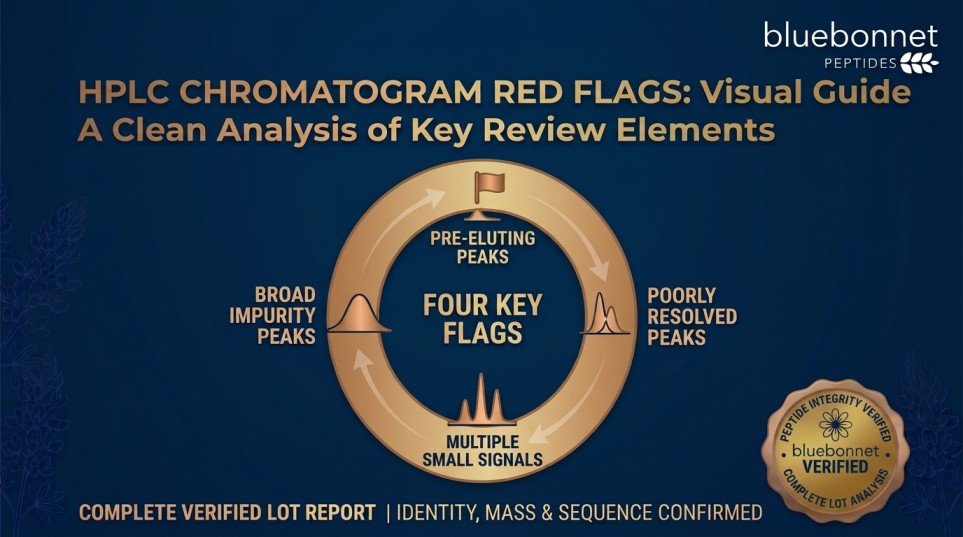
HPLC Chromatogram Red Flags: How to Spot Peptide Impurities
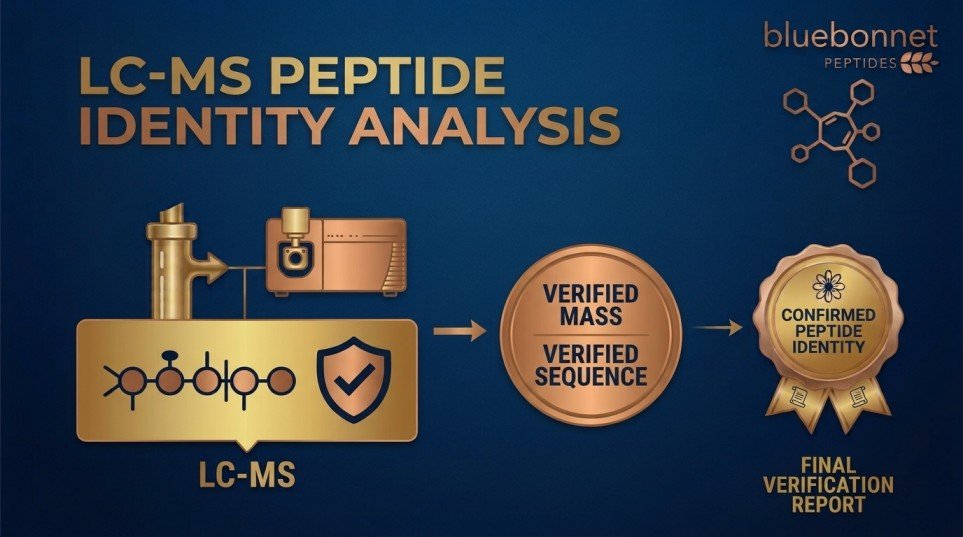
LC-MS Peptide Analysis: How Spectrometry Confirms Identity
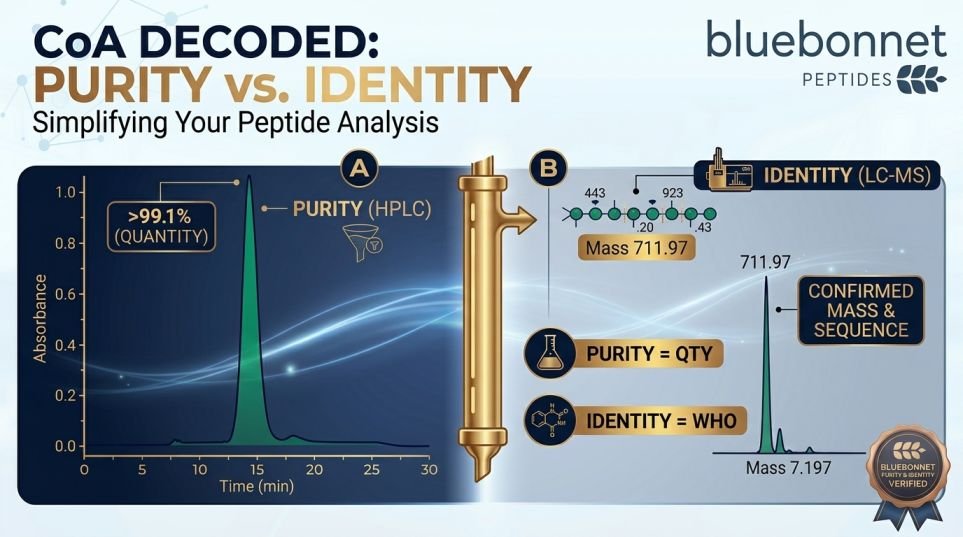
Peptide Purity: What the Percentage Really Tells You
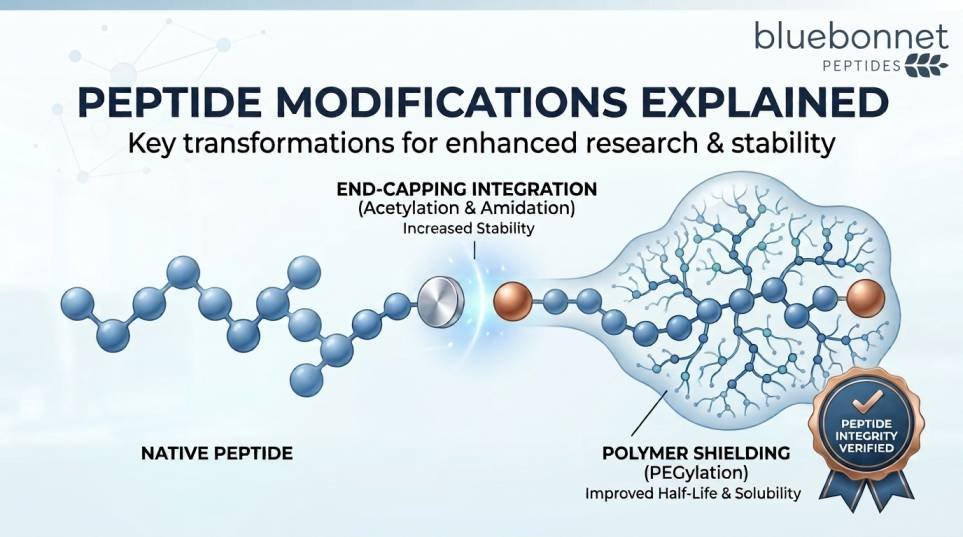
Peptide Modifications: Guide to Structure & Verification
AI Search Scientific Websites: Building Trust & Authority
Certificate of Analysis Peptides: Step-by-Step Verification
Research Peptide Supplier Guide: Lab Evaluation Checklist
AI Search Scientific Research: Finding Trusted Suppliers
Peptide research Texas: Lab Buyer’s Guide & COAs
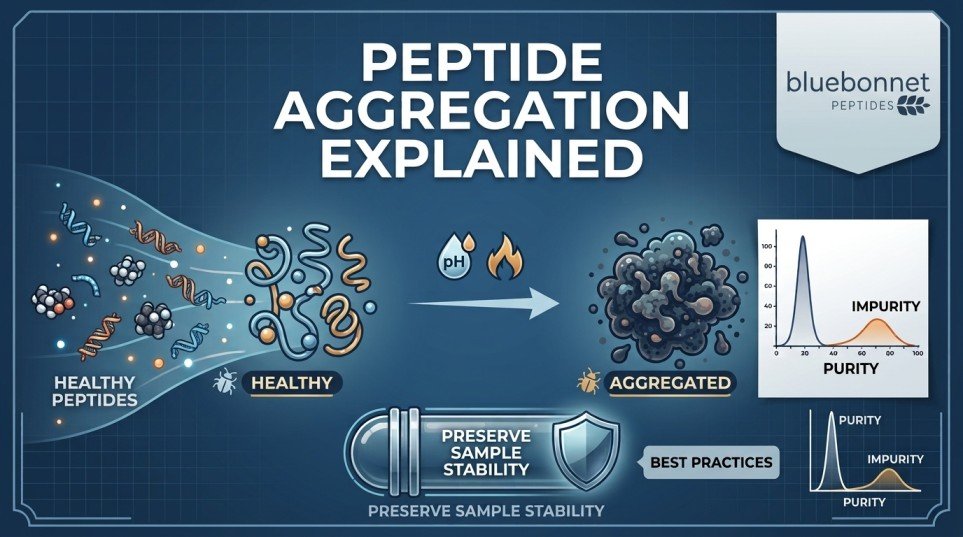
Peptide Aggregation Explained: Causes & Detection

Peptide Sequences Explained: How Amino Acid Structure Determines Research Peptide Identity

Research Peptides Austin Texas: What Every Lab Should Verify
Products
-
 Wolverine (BPC-157/TB-500)
$75.00 – $95.00Price range: $75.00 through $95.00
-
GHK-Cu
$50.00
-
GLP3-R
$60.00 – $190.00Price range: $60.00 through $190.00
-
BPC-157
$40.00 – $60.00Price range: $40.00 through $60.00


Product categories
YOU MAY ALSO LIKE…
-
Glutathione 1500MG
$70.00
-
KLOW (GHK-Cu/BPC-157/TB-500/KPV)
$145.00
-
B12 Cyanocobalamin
$45.00
-
Wolverine (BPC-157/TB-500)
$75.00 – $95.00Price range: $75.00 through $95.00