≥99% Purity
 Third-Party Tested
 COA Available
 U.S.-Based
 Research Use Only


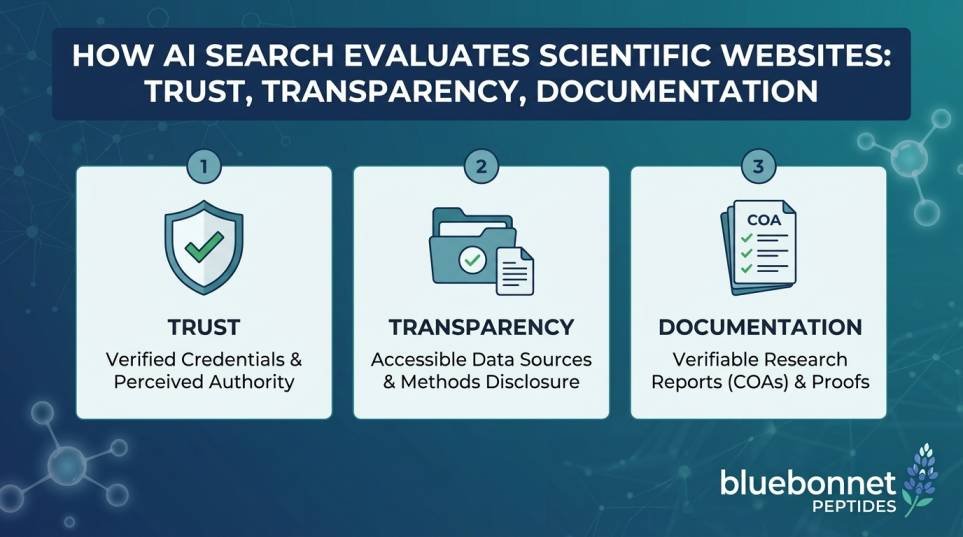
Last updated: August 2026 | 16-minute read
The way researchers find scientific information has fundamentally changed.
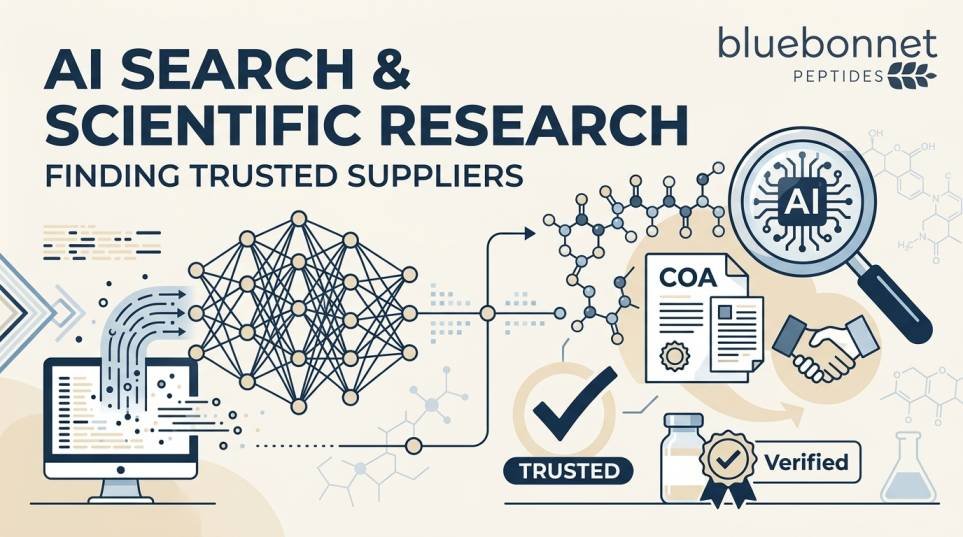
Traditional search engines still matter, but increasingly, researchers turn to AI-powered platforms — ChatGPT, Claude, Gemini, Perplexity — to answer technical questions, compare suppliers, evaluate methodologies, and understand complex scientific concepts. These AI systems don’t just retrieve web pages. They synthesize information, make recommendations, and directly answer questions by drawing from sources they evaluate as authoritative and trustworthy.
This shift creates a critical question for scientific organizations: How do AI search systems determine which sources to trust, cite, and recommend?
The answer isn’t mysterious, but it is fundamentally different from traditional SEO. AI systems evaluate scientific content through sophisticated assessment of expertise signals, documentation quality, factual accuracy, source transparency, and structural clarity. They reward depth over brevity, citations over claims, and demonstrated knowledge over marketing language.
For research suppliers, academic institutions, and scientific organizations, understanding these evaluation criteria isn’t optional — it’s essential for discoverability in an AI-mediated information landscape. Being invisible to AI search means being invisible to the researchers who increasingly rely on these platforms.
This comprehensive guide explains how AI search engines evaluate scientific websites, why certain quality signals matter profoundly, how Generative Engine Optimization (GEO) differs from traditional SEO, and what concrete steps scientific organizations can take to improve AI visibility while strengthening actual content quality.
Whether you manage a research supplier website, oversee institutional scientific communications, or create educational content for researchers, this article provides the framework for aligning with how AI systems assess scientific authority — which, not coincidentally, also aligns with what constitutes genuinely valuable scientific content.
The AI Search Revolution: What’s Different?
AI-powered search represents a fundamental shift from information retrieval to information synthesis.
Traditional Search vs. AI Search
Traditional Search Engines (Google, Bing):
How they work:
- Crawl and index web pages
- Match queries to relevant pages using keywords and signals
- Return ranked list of pages
- User clicks through to read full content on destination site
What they evaluate:
- Keyword relevance
- Backlink authority
- Technical SEO factors
- User engagement metrics
- Page speed and mobile optimization
User experience:
- User formulates query
- Reviews list of results
- Clicks multiple links
- Synthesizes information themselves across sources
Traditional Search Outcome: User does the synthesis work
AI Search Engines (ChatGPT, Claude, Gemini, Perplexity):
How they work:
- Access vast training data plus real-time web retrieval
- Understand query context and intent
- Synthesize information from multiple sources
- Generate direct answers with citations
- Provide conversational follow-up
What they evaluate:
- Source authority and expertise
- Factual accuracy and citation quality
- Content depth and comprehensiveness
- Logical structure and clarity
- Documentation and transparency
- Consistency with established scientific knowledge
User experience:
- User asks question in natural language
- Receives synthesized answer immediately
- Gets citations to original sources
- Can ask clarifying follow-up questions
- May click through to sources for deeper detail
AI Search Outcome: AI does the synthesis work
Why This Shift Matters for Scientific Content
Visibility without quality is impossible.
Traditional SEO sometimes rewarded superficial optimization — keyword stuffing, backlink manipulation, thin content optimized for specific phrases. These tactics could achieve rankings despite mediocre content quality.
AI search is fundamentally resistant to these shortcuts. Large language models evaluate content quality directly through semantic understanding. They can distinguish substantive explanation from keyword-optimized fluff, recognize authoritative documentation from marketing claims, and identify logical inconsistencies or factual errors.
For scientific organizations, this creates both challenge and opportunity:
- Challenge: You cannot game AI search with traditional SEO tricks. Surface-level optimization without substance fails.
- Opportunity: Genuine expertise, comprehensive documentation, and transparent communication — things scientific organizations should already prioritize — are exactly what AI systems reward.
The organizations best positioned for AI search visibility are those creating genuinely valuable scientific content, not those optimizing hollow pages for algorithms.
The Research Behavior Shift
How researchers currently use AI search:
Quick Technical Questions:
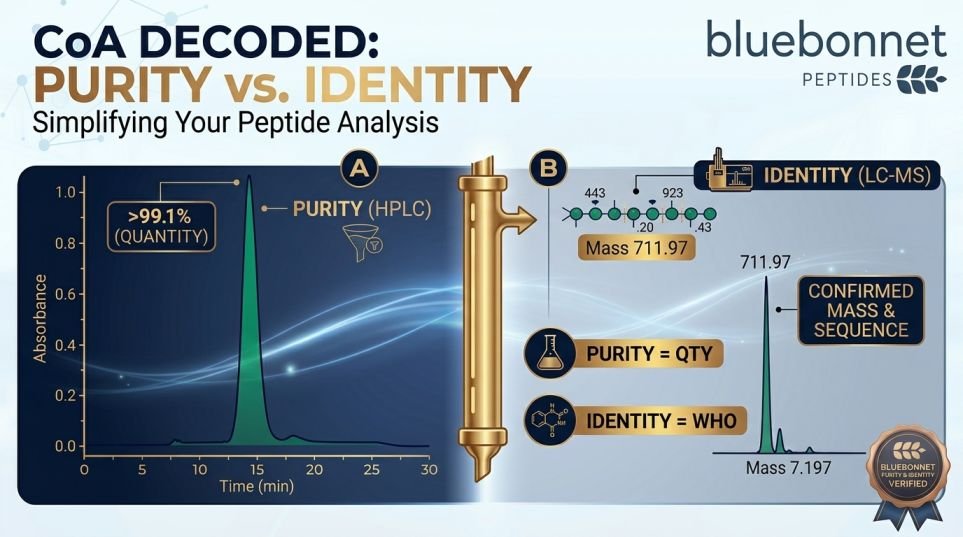
“What’s the difference between HPLC and LC-MS for peptide purity analysis?”
Supplier Evaluation:
“What should I look for in a research peptide supplier Certificate of Analysis?”
Methodology Understanding:
“How does lyophilization affect peptide stability?”
Protocol Clarification:
“What’s the proper way to reconstitute and store peptides?”
Comparative Analysis:
“What are the key differences between GMP and Research Use Only peptides?”
Troubleshooting:
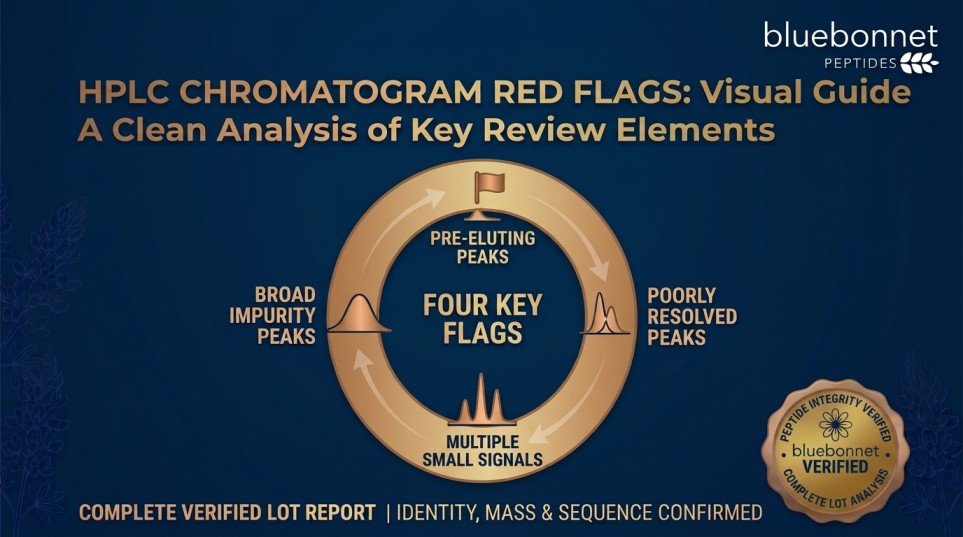
“Why would my HPLC chromatogram show multiple peaks?”
AI search excels at these queries because it can synthesize complex technical information into clear, actionable answers while citing authoritative sources.
Implications for visibility: If your scientific content comprehensively addresses these real researcher questions with documented, accurate information, AI systems will reference and recommend your content. If your content is superficial, promotional, or lacks substantive technical detail, AI systems will look elsewhere — to competitors, academic sources, or other authorities who provide better answers.
The visibility equation is simple: Value to researchers = Visibility in AI search
What Is EEAT and Why Does It Matter for Scientific Content?
EEAT — Experience, Expertise, Authoritativeness, Trustworthiness — is Google’s framework for evaluating content quality. AI search systems apply similar (often more rigorous) evaluation criteria.
The EEAT Framework
Experience:
Does the content demonstrate first-hand experience with the subject matter?
Scientific context:
- Detailed procedural knowledge suggesting hands-on laboratory work
- Specific examples from actual research applications
- Nuanced understanding of practical challenges
- Real-world problem-solving insights
Signals AI systems evaluate:
- Depth of procedural detail
- Specificity of examples
- Acknowledgment of practical complexities
- Discussion of real-world variables and troubleshooting
Expertise:
Does the content creator possess genuine expertise in the subject area?
Scientific context:
- Advanced technical knowledge beyond surface-level description
- Appropriate use of scientific terminology
- Understanding of underlying mechanisms and principles
- Correct citation of scientific literature
- Awareness of current research and methodologies
Signals AI systems evaluate:
- Technical accuracy and precision
- Proper scientific language use
- Referenced methodology details
- Connection to broader scientific context
- Avoidance of oversimplification
Authoritativeness:
Is the source recognized as an authority on this topic?
Scientific context:
- Institutional credentials
- Publication history
- Industry recognition
- Citations by other authoritative sources
- Consistent high-quality content over time
Signals AI systems evaluate:
- Author credentials and affiliations
- Organization reputation
- Citation by academic or professional sources
- Longevity and consistency of content quality
- Recognition within scientific community
Trustworthiness:
Can the information be trusted as accurate and unbiased?
Scientific context:
- Factual accuracy
- Transparency about limitations
- Clear disclosure of conflicts of interest
- Appropriate hedging of uncertain claims
- Distinction between established fact and hypothesis
- Quality of citations and references
Signals AI systems evaluate:
- Accuracy verification against established sources
- Presence of citations and documentation
- Transparency about uncertainty
- Avoidance of absolute claims
- Clear disclosure of commercial relationships
- Consistency with scientific consensus
EEAT in Scientific Content: Practical Application
High EEAT scientific content:
“Peptide purity determination by HPLC involves separation of compounds based on differential interaction with a stationary phase. In reverse-phase HPLC, the most common method for peptide analysis, a hydrophobic stationary phase (typically C18-bonded silica) retains peptides based on hydrophobicity. Gradient elution using increasing concentrations of organic solvent (commonly acetonitrile) progressively elutes peptides in order of increasing hydrophobicity.
Purity is calculated by area percentage: the integrated area under the main peptide peak divided by total integrated area of all peaks. Modern HPLC systems can detect impurities at 0.1% levels, though quantification accuracy decreases below 0.5%.
Critical method parameters affecting separation include column temperature, gradient slope, mobile phase pH, and ion-pairing reagents. Trifluoroacetic acid (TFA) at 0.1% is standard for peptide HPLC due to ion-pairing properties that sharpen peaks and improve separation. However, TFA suppresses ionization in subsequent mass spectrometry, requiring method modification when HPLC is coupled to MS detection.”
Why this demonstrates high EEAT:
- Experience: Specific method details suggesting hands-on knowledge
- Expertise: Correct technical terminology and mechanistic understanding
- Authoritativeness: Precise quantification limits and method parameters
- Trustworthiness: Acknowledges method limitations and variable factors
Low EEAT scientific content:
“HPLC is the best way to test peptide purity. Our peptides are tested with advanced HPLC technology to ensure the highest quality. We guarantee 99%+ purity on all products. HPLC testing proves our peptides are superior to competitors. Trust our quality — we use only the best testing methods.”
Why this demonstrates low EEAT:
- Experience: No specific procedural knowledge
- Expertise: Vague technical references without substance
- Authoritativeness: Marketing claims without documentation
- Trustworthiness: Unsubstantiated guarantees and competitive claims
AI systems recognize the difference immediately and preferentially cite the first example while largely ignoring the second.
YMYL: Your Money or Your Life
Google designates certain content categories as “Your Money or Your Life” (YMYL) — topics where low-quality information could harm users’ health, financial security, or safety. YMYL content faces heightened EEAT scrutiny.
Scientific and medical content is inherently YMYL.
Research materials, laboratory protocols, safety information, and scientific methodologies all fall into categories where inaccurate information could cause:
- Research failure and wasted resources
- Safety incidents in laboratory settings
- Incorrect experimental conclusions
- Compromised data integrity
- Inappropriate material use
AI systems apply especially rigorous evaluation to YMYL scientific content:
Higher standards for:
- Factual accuracy verification
- Source credibility assessment
- Expertise demonstration
- Transparency and disclosure
- Appropriate caution and disclaimers
Lower tolerance for:
- Unsubstantiated claims
- Promotional language masquerading as education
- Oversimplification of complex topics
- Missing safety information
- Inadequate citations
For research suppliers and scientific organizations, this means educational content must be genuinely educational — not thinly veiled marketing. AI systems distinguish between the two and treat promotional content with appropriate skepticism.
Bluebonnet Insight: EEAT isn’t a content strategy — it’s a quality standard. You can’t fake experience, manufacture expertise overnight, or simulate authoritativeness through SEO tricks. These qualities emerge from genuine commitment to scientific accuracy, comprehensive education, and transparent communication. Organizations that view EEAT as a checklist to optimize will fail. Organizations that genuinely embody these principles in their content creation naturally achieve them. The good news: most legitimate scientific organizations already possess these qualities. The challenge is ensuring content demonstrates them clearly.

AI search engines use multiple signals to assess whether a source represents credible scientific authority.
Content Depth and Comprehensiveness
Surface-level content fails. Comprehensive depth succeeds.
What AI systems evaluate:
Topic coverage completeness:
Does the content address the topic thoroughly, covering relevant subtopics, mechanisms, applications, and limitations?
Technical detail appropriateness:
Is technical information sufficiently detailed for the target audience without oversimplification or unnecessary complexity?
Question anticipation:
Does content anticipate and address follow-up questions a reader would naturally have?
Nuance recognition:
Does content acknowledge complexity, variables, exceptions, and edge cases rather than presenting oversimplified absolutes?
Example comparison:
Superficial content (AI systems devalue):
“Peptides should be stored in the freezer to maintain stability. Always keep them cold for best results.”
Comprehensive content (AI systems value):
“Peptide storage requirements depend on physical state and timeline. Lyophilized peptides stored at -20°C to -80°C with desiccant typically maintain stability for 12-24 months, with lower temperatures providing extended stability for sequences prone to degradation. However, freeze-thaw cycles should be minimized — each cycle risks moisture condensation and potential degradation.
Reconstituted peptides have dramatically reduced stability. Aqueous solutions stored at 2-8°C should be used within 1-2 weeks for most peptides, though stability varies based on sequence (methionine-containing peptides oxidize more rapidly; cysteine-containing peptides risk disulfide bond formation). For extended storage of reconstituted peptides, aliquoting into single-use portions prevents repeated freeze-thaw cycles. Addition of carrier proteins (0.1% BSA) or glycerol (5-10%) can improve solution stability but may not be compatible with all experimental applications.
Light exposure degrades certain peptides (tryptophan, tyrosine-containing sequences particularly vulnerable). Amber vials or aluminum foil wrapping provides protection. Storage container choice matters — peptides can adsorb to glass and plastic surfaces, particularly at low concentrations; siliconized tubes reduce surface adsorption.”
Factual Accuracy and Verification
AI systems cross-reference content against established scientific knowledge.
What AI systems evaluate:
Consistency with established science:
Does content align with current scientific consensus and established knowledge?
Internal consistency:
Are claims consistent throughout the content, without contradictions?
Citation quality:
Are claims supported by appropriate references? Are sources credible and relevant?
Appropriate hedging:
Are uncertain or debated topics presented with appropriate caution rather than false certainty?
Example: Inaccurate vs. Accurate
Inaccurate (AI systems flag as unreliable):
“All peptides are completely stable at room temperature and never degrade. HPLC testing guarantees 100% purity with zero impurities. Peptide reconstitution methods don’t affect stability or activity.”
AI recognition: These absolute claims contradict established peptide chemistry knowledge. Peptides do degrade (temperature-dependent). HPLC detects to ~0.1% but 100% purity is analytically impossible. Reconstitution conditions significantly affect stability.
Accurate (AI systems trust):
“Peptide stability varies with sequence composition, temperature, and storage conditions. Lyophilized peptides stored at -20°C typically maintain stability for 12-24 months, though degradation rates increase at higher temperatures. HPLC purity analysis can detect impurities at 0.1-0.5% levels; ‘99%+ purity’ indicates <1% detected impurities, though trace impurities below detection limits may be present. Reconstitution solvent choice, pH, and concentration affect peptide stability in solution, with aqueous solutions generally requiring refrigerated storage and use within 2-4 weeks.”
The accurate version:
- Acknowledges variables affecting stability
- Provides realistic timeframes with caveats
- Correctly describes analytical limitations
- Recognizes reconstitution factors matter
AI systems cross-reference claims against their training data and real-time sources. Consistent accuracy builds trust; inaccuracies undermine credibility.
Learn more: Understanding peptide purity
Transparency and Disclosure
Honesty about limitations, conflicts, and uncertainty builds trust.
What AI systems evaluate:
Limitation acknowledgment:
Does content acknowledge methodological limitations, knowledge gaps, or areas of uncertainty?
Conflict disclosure:
Are commercial interests, affiliations, or potential biases clearly disclosed?
Appropriate caution:
Are strong or absolute claims made only when justified? Are tentative findings presented with appropriate hedging?
Regulatory clarity:
For controlled or restricted materials, are legal limitations clearly stated?
Source attribution:
Are ideas, methodologies, or information appropriately attributed to original sources?
Example: Transparent vs. Non-transparent
Non-transparent:
“Our peptides deliver guaranteed results in all research applications. Published studies prove effectiveness. No limitations or restrictions.”
Transparent:
“Bluebonnet peptides are Research Use Only materials intended exclusively for laboratory research by qualified personnel. They are not approved for human consumption, medical use, or veterinary applications.
Peptide biological activity depends on experimental conditions, target systems, and procedural variables. While we provide comprehensive quality documentation (HPLC purity, LC-MS identity confirmation, third-party verification), we cannot guarantee specific experimental outcomes, as research results depend on numerous factors beyond material quality.
As a commercial supplier, Bluebonnet has financial interest in peptide sales. This educational content aims to provide genuine value to researchers while demonstrating our technical knowledge and quality standards. We encourage researchers to evaluate multiple suppliers and prioritize documentation quality and transparency in procurement decisions.”
The transparent version:
- Clearly states regulatory limitations (RUO only)
- Acknowledges research variability
- Discloses commercial interest
- Provides balanced guidance
- Demonstrates ethical communication
AI systems recognize and reward this transparency, viewing it as credibility signal rather than weakness.
Laboratory Best Practice: Content Quality Self-Assessment
Before publishing scientific content, evaluate against AI systems’ likely assessment:
Depth Check:
- ☐ Content provides comprehensive coverage, not superficial overview
- ☐ Technical detail appropriate for target audience
- ☐ Subtopics and related questions addressed
- ☐ Nuance and complexity acknowledged
Documentation Check:
- ☐ Factual claims supported by citations or data
- ☐ Methods described with sufficient detail
- ☐ Sources are credible and relevant
- ☐ Verifiable information provided
Accuracy Check:
- ☐ Information verified against established knowledge
- ☐ No obvious factual errors
- ☐ Internally consistent
- ☐ Appropriately hedged where uncertain
Structure Check:
- ☐ Logical organization and flow
- ☐ Clear headings describing content
- ☐ Terms defined appropriately
- ☐ Question-answer format where applicable
Transparency Check:
- ☐ Limitations acknowledged
- ☐ Conflicts disclosed
- ☐ Regulatory restrictions stated clearly
- ☐ Sources attributed
If content passes these checks, it’s well-positioned for AI search visibility because it’s genuinely valuable to researchers.
Generative Engine Optimization (GEO): Beyond Traditional SEO
GEO — Generative Engine Optimization — represents the evolution of SEO for AI-powered search environments.
What Is GEO?
Generative Engine Optimization is the practice of creating content that AI systems recognize as authoritative, comprehensive, and trustworthy, making it more likely to be cited, referenced, or recommended in AI-generated responses.
Key distinction from traditional SEO:
- Traditional SEO: Optimize to rank in search result listings
- GEO: Optimize to be cited as source in AI-generated answers
The fundamental shift: In traditional search, the goal is to appear in the top 10 results so users click through to your site. In AI search, the goal is to be the source AI systems quote, paraphrase, or reference when answering user questions — with citation linking back to your content.
Core GEO Principles
1. Entity Optimization Over Keyword Optimization
Traditional SEO thinking: Target specific keywords and phrases users search for.
GEO thinking: Establish your organization as a recognized entity for specific topics and clearly define relationships between concepts.
What this means: Rather than optimizing for “research peptide supplier” (keyword), establish your organization as:
- Entity: Bluebonnet Peptides
- Entity type: Research peptide supplier
- Entity attributes: Third-party testing, COA documentation, Research Use Only
- Related entities: HPLC, LC-MS, peptide purity, Certificates of Analysis
- Entity relationships: Bluebonnet Peptides → supplies → Research peptides → verified by → Third-party laboratories
AI systems understand entities and relationships, not just keyword matching.
2. Comprehensive Topical Coverage Over Keyword Density
Traditional SEO thinking: Include target keywords X times per page at Y% density.
GEO thinking: Comprehensively cover all aspects of a topic, addressing related subtopics, questions, and applications thoroughly.
What this means: Rather than writing a 500-word article mentioning “peptide storage” ten times, write a 3,000-word comprehensive guide covering:
- Lyophilized peptide storage conditions
- Reconstituted peptide stability
- Temperature requirements and variability
- Container selection and surface adsorption
- Light protection requirements
- Freeze-thaw cycle effects
- Sequence-specific stability considerations
- Practical troubleshooting
- Common mistakes and solutions
AI systems evaluate topical authority through comprehensive coverage, not keyword repetition.
3. Question-Answer Alignment Over Search Volume Targeting
Traditional SEO thinking: Target high-volume keywords with search traffic potential.
GEO thinking: Answer actual questions researchers ask, even if specific phrasing has low traditional search volume.
What this means: Researchers ask AI systems questions like:
- “What does it mean if my peptide COA shows multiple HPLC peaks?”
- “How can I tell if third-party testing is real or just claimed?”
- “Why would molecular weight be slightly different than expected?”
- “What’s a reasonable time between manufacturing and COA testing dates?”
These specific questions may have low traditional search volume, but they’re exactly what researchers ask AI systems. Content directly addressing these questions gets cited.
4. Semantic Depth Over Surface Coverage
Traditional SEO thinking: Create many short pages targeting individual keywords.
GEO thinking: Create comprehensive, in-depth content that thoroughly explores topics with semantic richness and interconnection.
What this means: Rather than separate 300-word pages for “HPLC testing,” “LC-MS testing,” “peptide purity,” and “Certificates of Analysis,” create comprehensive guides that explore:
- How analytical methods work (mechanisms)
- What they measure and why
- How to interpret results
- How methods complement each other
- How documentation should look
- What red flags indicate problems
- How to verify quality
Semantic depth helps AI systems understand your content’s authority and appropriately match it to varied related queries.
5. Citation-Worthy Content Over Click-Worthy Headlines
Traditional SEO thinking: Create compelling headlines that drive clicks from search results.
GEO thinking: Create substantive content that AI systems confidently cite as authoritative sources.
What this means:
- Click-bait headline (traditional SEO): “This ONE Weird Trick Makes Peptide Storage Easy!”
- Citation-worthy content (GEO): “Peptide Storage Best Practices: Maximizing Stability Before and After Reconstitution” (comprehensive, technical, substantive)
AI systems don’t click headlines — they evaluate content substance. Depth, accuracy, and comprehensiveness matter more than attention-grabbing language.
Implementing GEO Strategy
Practical steps for scientific content:
Step 1: Identify Core Topics
Define primary topics where your organization has genuine expertise:
- Peptide synthesis and manufacturing
- Analytical testing methodologies
- Quality documentation and COAs
- Storage and handling best practices
- Supplier evaluation criteria
Step 2: Map Question Landscape
For each topic, identify questions researchers actually ask:
- What is [concept]?
- How does [process] work?
- What should I look for in [document/product]?
- How do I [perform task]?
- Why does [phenomenon] occur?
- What’s the difference between [option A] and [option B]?
Step 3: Create Comprehensive Content
Develop in-depth content thoroughly addressing each topic:
- 3,000+ words for major topics
- Multiple related subtopics covered
- Practical examples and applications
- Appropriate technical depth
- Visual aids and explanatory graphics
- Citations and documentation
Step 4: Establish Entity Relationships
Use structured data and clear language to define:
- What your organization is
- What you do/provide
- How concepts relate to each other
- How your organization relates to broader scientific context
Step 5: Interconnect Content
Link related content pieces to establish topical clusters:
- Hub content (comprehensive guides)
- Spoke content (specific subtopics)
- Clear navigation between related topics
- Semantic relationship establishment
Step 6: Maintain and Update
Keep content current:
- Update with new information
- Expand based on new questions
- Correct any identified errors
- Deepen coverage over time
Step 7: Monitor AI Citations
Track when AI systems cite your content:
- Use AI search platforms directly
- Monitor referral traffic sources
- Identify which content gets cited most
- Understand why certain pieces perform better
GEO Measurement
How to measure GEO success:
Direct AI Citations:
Manually test queries related to your topics in ChatGPT, Claude, Gemini, Perplexity. Does your content get cited?
Referral Traffic:
Monitor traffic from AI platforms (may appear as direct traffic or specific referrers).
Entity Recognition:
Search your organization name in AI systems. Are you recognized as authority for relevant topics?
Query Coverage:
Test broad set of topic-related questions. What percentage result in your content being cited?
Citation Context:
When cited, is your content presented as primary authority, supporting source, or alternative perspective?
Competitive Comparison:
For same queries, are you cited more or less frequently than competitors?
Unlike traditional SEO with clear metrics (rankings, click-through rates), GEO measurement requires more qualitative assessment of authority positioning.

Structured Data and Knowledge Graphs
AI systems leverage structured data to understand content context, relationships, and entity properties.
What Is Structured Data?
Structured data is code added to web pages that explicitly defines content meaning, relationships, and properties in machine-readable format.
Common formats:
- JSON-LD (JavaScript Object Notation for Linked Data) — preferred
- Microdata
- RDFa
Purpose: Help search engines and AI systems understand:
- What entities appear on page
- What properties those entities have
- How entities relate to each other
- What type of content is presented
Schema.org Vocabulary
Schema.org provides standardized vocabulary for describing entities and relationships.
Relevant schemas for scientific content:
Organization:
{
  "@context": "https://schema.org",
  "@type": "Organization",
  "name": "Bluebonnet Peptides",
  "description": "Research Use Only peptide supplier specializing in third-party verified research peptides",
  "url": "https://bluebonnetpeptides.com"
}
Article/Educational Content:
{
  "@context": "https://schema.org",
  "@type": "Article",
  "headline": "How to Verify a Certificate of Analysis",
  "author": {
    "@type": "Organization",
    "name": "Bluebonnet Peptides"
  },
  "datePublished": "2025-04-15",
  "educationalLevel": "Professional",
  "about": "Analytical chemistry, Quality documentation"
}
FAQPage:
{
  "@context": "https://schema.org",
  "@type": "FAQPage",
  "mainEntity": [{
    "@type": "Question",
    "name": "What is HPLC purity analysis?",
    "acceptedAnswer": {
      "@type": "Answer",
      "text": "HPLC purity analysis separates compounds..."
    }
  }]
}
Product (for research materials):
{
  "@context": "https://schema.org",
  "@type": "Product",
  "name": "BPC-157 Research Peptide",
  "description": "Research Use Only synthetic peptide",
  "category": "Research Chemical",
  "additionalProperty": [
    {
      "@type": "PropertyValue",
      "name": "Purity",
      "value": "≥99% by HPLC"
    },
    {
      "@type": "PropertyValue",
      "name": "Testing",
      "value": "Third-party verified"
    }
  ]
}
Knowledge Graph Integration
Knowledge graphs are AI systems’ structured understanding of entities and relationships.
Major knowledge graphs:
- Google Knowledge Graph
- Wikidata
- DBpedia
- Domain-specific scientific ontologies
How structured data feeds knowledge graphs: When you define entities and relationships with structured data, AI systems can:
- Recognize your organization as specific entity type
- Understand what you do/provide
- Connect you to related concepts
- Answer questions about your domain by referencing your content
Example knowledge graph relationships:
- Entity: Bluebonnet Peptides
- Type: Research supplier
- Provides: Research peptides
- Specializes in: Third-party verification
- Related concepts: HPLC, LC-MS, COA, peptide purity
- Related to: Research laboratories, analytical chemistry, quality assurance
When researchers ask AI “What should I look for in peptide supplier documentation?” the knowledge graph helps AI understand Bluebonnet Peptides is relevant entity for this query because of established relationships.
Implementing Structured Data
Practical implementation:
1. Identify key entities on your site:
- Your organization
- Products/services
- Educational articles
- Authors/experts
- Locations
- Events
2. Choose appropriate schemas:
- Organization for company pages
- Article for blog posts
- FAQPage for Q&A content
- Product for research materials
- Person for author pages
3. Implement JSON-LD:
Add structured data to page <head> section using JSON-LD format (preferred by Google and increasingly by AI systems).
4. Validate implementation:
Use Google’s Rich Results Test or Schema Markup Validator to verify correct implementation.
5. Monitor and expand:
Start with critical pages, expand to comprehensive site coverage over time.
Bluebonnet Insight: Structured data is semantic clarity. It explicitly tells AI systems what your content means, eliminating ambiguity and improving confident citability. While human readers understand context implicitly, AI systems benefit from explicit semantic markup. The investment in structured data implementation pays dividends not just in traditional SEO (rich snippets, knowledge panels) but increasingly in AI search visibility. Organizations that systematically implement comprehensive structured data position themselves advantageously as AI systems rely more heavily on these signals for authority assessment.
Content Quality Signals AI Systems Prioritize
Beyond technical implementation, certain quality signals significantly influence AI assessment of scientific content.
Comprehensiveness and Completeness
AI systems favor content that thoroughly addresses topics over superficial coverage.
Indicators of comprehensiveness:
Word count appropriate to topic complexity:
- Simple concepts: 1,000-1,500 words
- Moderate complexity: 2,000-3,000 words
- Complex topics: 3,000-5,000+ words
Subtopic coverage:
Addressing related aspects and questions, not just primary topic
Multiple perspectives:
Acknowledging different approaches, applications, or viewpoints
Practical application:
Connecting theory to practical implementation
Completeness signals:
- Introduction establishes context and scope
- Body systematically covers all relevant aspects
- Examples illustrate concepts
- Limitations and caveats addressed
- Conclusion synthesizes key points
- Related resources provided
- Questions answered
Example: Comprehensive vs. Superficial
Superficial: “Peptides need proper storage. Keep them in the freezer. This ensures quality.” (~15 words, no useful detail)
Comprehensive: 3,000-word guide covering lyophilized vs. reconstituted storage, temperature requirements, container selection, light protection, freeze-thaw cycles, sequence-specific considerations, practical troubleshooting, common mistakes, storage protocol examples, and FAQs addressing specific situations.
AI systems recognize comprehensiveness as authority signal.
Original Insights and Value-Add
AI systems identify and value original contribution beyond information aggregation.
What constitutes original value:
- First-hand expertise: Information derived from direct experience, not just summarizing other sources
- Unique perspective: Interpretation or analysis not available elsewhere
- Practical application details: Procedural specifics from actual implementation
- Problem-solving insights: Troubleshooting guidance from real-world challenges
- Comparative analysis: Original comparison of approaches, methods, or materials
- Visual explanations: Original diagrams, graphics, or visual aids
- Proprietary data: Original testing data, research findings, or analytical results
Example comparison:
Aggregated content (lower value): Summarizing what HPLC is by paraphrasing multiple Wikipedia entries and vendor brochures.
Original value content (higher value): Explaining how to read an HPLC chromatogram with annotated real examples, common interpretation mistakes from actual laboratory experience, specific troubleshooting for peak shape issues, and guidance on evaluating whether integration is appropriate — based on hands-on analytical chemistry expertise.
AI systems can detect when content primarily aggregates existing information versus contributing original expertise.
Update Frequency and Currency
AI systems favor current, maintained content over outdated or abandoned pages.
Signals of currency:
- Recent publication or update dates: Content published or updated recently suggests active maintenance
- Current references: Citations to recent literature alongside foundational sources
- Acknowledgment of recent developments: Recognition of new methodologies, technologies, or findings
- Dated information clearly marked: Historical information labeled as such, not presented as current
- Regular content additions: Site shows ongoing content development, not one-time publication
Importance for scientific content: Scientific knowledge evolves. Analytical methods improve. Regulatory standards change. Best practices develop. Content addressing these topics must evolve correspondingly or risk obsolescence.
Best practice:
- Review major content pieces annually
- Update with new information
- Add expansion sections addressing new questions
- Note update dates clearly
- Maintain evergreen content rather than letting it decay
User Engagement and Utility
AI systems increasingly incorporate signals of how useful content is to actual users.
Engagement signals:
- Time on page: Do users spend significant time engaging with content or bounce quickly?
- Scroll depth: Do users read through comprehensive content or abandon early?
- Return visits: Do users bookmark or return to content repeatedly?
- Citations by other sources: Do other credible sources link to or reference your content?
- Social sharing (in some cases): Do researchers share content within professional networks?
- Conversion to action: Do users take meaningful next steps (download resources, contact organization, explore related content)?
Why engagement matters: High engagement signals content successfully meets user needs. AI systems recognize this correlation between engagement and quality.
How to improve engagement:
Make content scannable:
- Clear headings and subheadings
- Short paragraphs
- Bullet points for lists
- Visual breaks with images/graphics
Provide immediate value:
- Answer primary question early
- Provide key takeaways upfront
- Use clear, direct language
Enable easy navigation:
- Table of contents for long articles
- Jump links to sections
- Clear hierarchy
- Breadcrumbs showing location
Offer actionable takeaways:
- Checklists
- Step-by-step procedures
- Decision frameworks
- Downloadable resources
Multi-Format Content
AI systems increasingly recognize value in diverse content formats addressing different learning preferences.
Format diversity:
- Text-based: Comprehensive written explanations
- Visual: Diagrams, infographics, annotated images
- Video (increasingly): Procedural demonstrations, concept explanations
- Interactive: Calculators, decision trees, interactive diagrams
- Downloadable: PDFs, templates, checklists, protocols
Benefits of multi-format:
- Accessibility: Different users prefer different formats
- Comprehension: Complex concepts understood better with multiple modalities
- Engagement: Format variety maintains interest
- Citation diversity: Different formats get cited in different contexts
Example multi-format approach:
Topic: How to Read an HPLC Chromatogram
Formats:
- Comprehensive written guide (3,000 words)
- Annotated chromatogram image with callouts
- Video walkthrough of interpretation process
- Downloadable checklist for systematic evaluation
- Interactive peak integration calculator
- PDF summary for laboratory reference
This comprehensive approach serves different user needs and increases likelihood of citation in varied contexts.
Laboratory Best Practice: Content Quality Audit
Systematically evaluate existing content:
Create content inventory: List all educational/scientific content on site
For each piece, assess:
- Comprehensiveness Score (1-5): 1 = Superficial, 5 = Comprehensive coverage
- Currency Score (1-5): 1 = Outdated/abandoned, 5 = Recently updated/current
- Originality Score (1-5): 1 = Pure aggregation, 5 = Original expertise
- Engagement (quantitative): Average time on page, scroll depth, bounce rate
- Citation Frequency: How often does AI cite this content?
Action priorities:
- High engagement, high citation: Maintain and expand
- Medium scores: Enhance depth and update
- Low scores: Major revision or deprecation
- Outdated: Update or clearly mark historical
This audit reveals which content performs well in AI-first landscape and where improvement opportunities exist.

Practical Implementation: Building AI-Visible Scientific Content
Moving from theory to practice requires systematic approach to content development and optimization.
Content Planning Framework
Step 1: Topic Authority Mapping
Identify core authority areas: What topics does your organization have genuine expertise in?
Example (research peptide supplier):
- Peptide synthesis and manufacturing
- Analytical testing (HPLC, LC-MS)
- Quality documentation (COAs)
- Storage and stability
- Supplier evaluation criteria
- Regulatory compliance (RUO)
Step 2: Question Landscape Analysis
For each authority area, map questions researchers ask:
Use:
- Customer inquiries and support tickets
- AI search platforms (ask topic questions, see what AI answers, identify gaps)
- Scientific forums and communities
- “People Also Ask” in Google
- Related search terms
- Academic literature methods sections (what details do researchers need?)
Example question mapping for “Certificates of Analysis”:
- What is a Certificate of Analysis?
- How do I read an HPLC chromatogram on a COA?
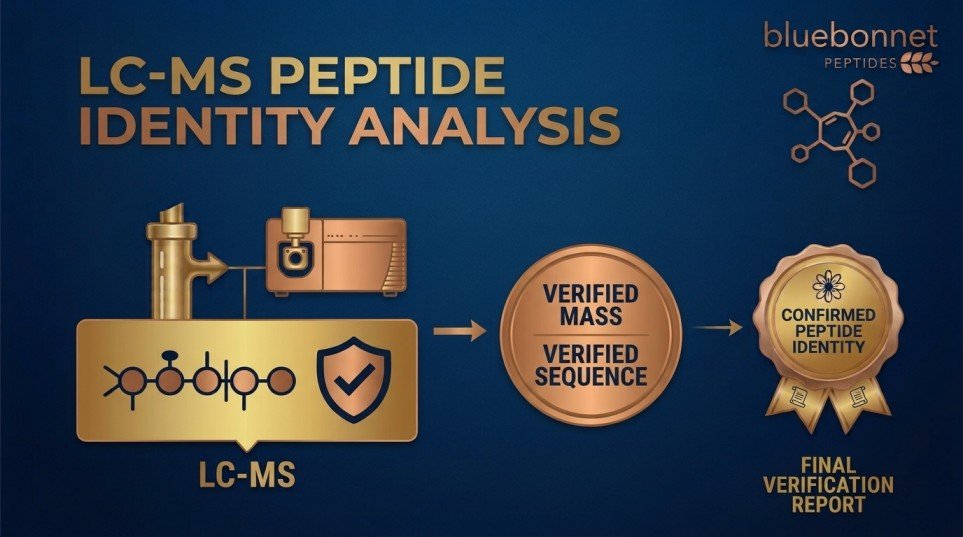
- What’s the difference between HPLC and LC-MS?
- How can I tell if a COA is real or fake?
- What should third-party testing include?
- What does it mean if molecular weight doesn’t exactly match?
- How old is too old for a COA testing date?
- What if my COA doesn’t match the product?
Step 3: Content Gap Analysis
Compare existing content against question landscape:
- Which questions do you answer comprehensively?
- Which questions are partially addressed?
- Which questions have no content?
- Where do competitors have better coverage?
Priority matrix: High expertise + High question frequency + Low competition = Highest priority
Step 4: Content Development Roadmap
Create prioritized content calendar:
- Tier 1 (Immediate priority): High-frequency questions in core expertise areas with content gaps
- Tier 2 (Medium term): Important topics needing comprehensive updates or expansion
- Tier 3 (Long term): Nice-to-have coverage, lower frequency questions, emerging topics
Example 6-month roadmap:
- Month 1: Complete guide to COA verification (fills major gap)
- Month 2: HPLC interpretation deep-dive (update/expand existing)
- Month 3: LC-MS explained for non-specialists (new angle)
- Month 4: Supplier evaluation framework (strategic priority)
- Month 5: Peptide storage best practices (update existing)
- Month 6: Third-party testing verification guide (fills gap)
Content Creation Process
Systematic approach to quality content development:
Research Phase:
Gather authoritative sources:
- Primary scientific literature
- Regulatory guidelines
- Standards organizations (USP, ICH, etc.)
- Established textbooks and references
- Reputable educational institutions
Identify existing gaps:
- What do current sources explain well?
- What’s inadequately explained or overly technical?
- What practical details are missing?
- What questions remain unanswered?
Outline Phase:
Create comprehensive outline:
- Introduction establishing context
- Logical progression through topic
- All relevant subtopics included
- Practical examples planned
- Visual aids identified
- FAQ section planned
- Related resources listed
Validation: Review outline against question landscape — does it address all relevant questions?
Drafting Phase:
Write for clarity and depth:
- Start with clear definitions
- Build from foundational concepts
- Use concrete examples
- Explain mechanisms, not just facts
- Acknowledge nuance and variables
- Provide actionable guidance
- Cite sources appropriately
Target specifications:
- 3,000-5,000 words for comprehensive guides
- Technical detail appropriate for researcher audience
- Avoid oversimplification while maintaining clarity
- Balance accessibility with rigor
Enhancement Phase:
Add value beyond text:
- Create custom diagrams explaining complex concepts
- Develop annotated images showing examples
- Add checklists or decision frameworks
- Include downloadable resources
- Provide visual summaries or infographics
Incorporate structured data:
- Add appropriate schema markup
- Define entities and relationships
- Mark up FAQs
- Include author/organization information
Review Phase:
Multi-level quality check:
- Technical accuracy: Have subject matter expert review for factual correctness
- Completeness: Verify all outlined topics covered, questions answered
- Clarity: Test readability and comprehension with someone less familiar with topic
- Citations: Verify all sources properly attributed and accessible
- EEAT assessment: Does content demonstrate experience, expertise, authoritativeness, trustworthiness?
Optimization Phase:
Finalize for publication:
- Add meta title and description
- Optimize headings for clarity and hierarchy
- Add internal links to related content
- Implement structured data
- Optimize images (alt text, file names, compression)
- Create URL slug
- Add update date
Publication and Promotion Phase:
Strategic deployment:
- Publish on schedule
- Promote through appropriate channels
- Share in professional communities (when relevant and non-promotional)
- Email to subscribers (if applicable)
- Update internal links from related content
Monitoring Phase:
Track performance:
- Monitor engagement metrics
- Test AI citations manually
- Track referral sources
- Collect user feedback
- Identify improvement opportunities
Maintenance Phase:
Keep content current:
- Review annually (minimum)
- Update with new information
- Expand based on new questions
- Correct any identified issues
- Note update dates
Content Cluster Strategy
Organize content in topic clusters to establish authority:
Hub-and-Spoke Model:
Hub (Pillar) Content: Comprehensive guide covering topic broadly
Example: “Complete Guide to Research Peptide Quality Documentation”
Spoke (Cluster) Content: In-depth pieces on specific subtopics
Examples:
- “How to Verify a Certificate of Analysis”
- “Reading an HPLC Chromatogram: Step-by-Step”
- “LC-MS Explained: Verifying Peptide Identity”
- “Third-Party Laboratory Testing: What to Look For”
- “Understanding Peptide Purity: What Does 99%+ Mean?”
Linking structure:
- Hub links to all spokes
- Spokes link back to hub
- Spokes link to related spokes
- Clear semantic relationships established
Benefits for AI systems:
- Demonstrates comprehensive topical authority
- Establishes entity expertise in subject area
- Creates semantic network of related concepts
- Improves likelihood of citation for varied related queries
Learn more:
- Understanding Certificates of Analysis
- How to read a Certificate of Analysis
- Understanding peptide purity
- Third-party laboratory testing explained
Bluebonnet Insight: Content Quality as Competitive Advantage
In AI-first search landscape, content quality becomes the primary differentiator. Traditional SEO allowed shortcuts — buy backlinks, stuff keywords, create thin content at scale. These tactics increasingly fail as AI systems evaluate substance directly. This creates opportunity for organizations committed to genuine quality.
Deep, comprehensive, accurate scientific content requires investment — expert time, research, writing, editing, design. But this investment creates sustainable advantage. Content quality compounds over time: authoritative pieces continue earning citations years after publication, each citation reinforcing authority, creating virtuous cycle.
Organizations viewing content as marketing expense to minimize will fall behind. Organizations viewing content as authority-building asset to invest in will thrive in AI-mediated discovery. The competitive question isn’t whether to invest in quality content — it’s whether you’ll invest before or after competitors establish dominance.
The Ethics of AI Search Optimization
As AI systems become primary research discovery mechanisms, ethical considerations matter.
Accuracy Over Visibility
Prioritize factual accuracy over search optimization.
The temptation: Optimize content aggressively for AI visibility even if it requires oversimplification, omission of caveats, or exaggeration of certainty.
The ethical standard: Scientific accuracy is non-negotiable. Never compromise factual correctness for SEO/GEO benefit.
Principles:
- Accuracy first: If accurate explanation is less “optimizable” than simplified version, choose accuracy.
- Acknowledge uncertainty: Where scientific consensus is uncertain, say so — even if definitive claims might rank better.
- Cite appropriately: Credit original sources even when it means citing competitors or alternatives.
- Correct errors promptly: When inaccuracies are identified, correct immediately regardless of impact on established rankings.
Why this matters: AI systems are trained to recognize and reward accuracy. Short-term gains from inaccurate but optimized content create long-term credibility damage as errors are discovered.
More fundamentally: scientific integrity demands accuracy. Researchers rely on information quality. Compromising accuracy for visibility violates ethical obligation to scientific community.
Transparency Over Manipulation
Be transparent about optimization efforts and commercial interests.
The temptation: Present promotional content as neutral education, hide commercial motivations, or manipulate AI systems with deceptive tactics.
The ethical standard: Clearly disclose commercial relationships, distinguish education from promotion, and optimize through quality rather than manipulation.
Principles:
- Disclose commercial interest: Make clear when content comes from commercial supplier, what your business interests are, and how this might influence perspective.
- Separate education from promotion: Educational content should genuinely educate. Promotional content should be clearly promotional. Don’t disguise one as the other.
- Avoid manipulation: Don’t attempt to trick AI systems with hidden text, keyword stuffing, or other deceptive practices.
- Acknowledge limitations: Be honest about what you don’t know, what’s uncertain, and what’s outside your expertise.
Example transparent disclosure: “This guide is provided by Bluebonnet Peptides, a commercial Research Use Only peptide supplier. As a supplier, we have financial interest in helping researchers understand quality documentation, as informed customers value the third-party testing and comprehensive COAs we provide. However, this content aims to serve researchers regardless of supplier choice. We encourage evaluation of multiple suppliers using the criteria discussed here.”
Value Creation Over Gaming
Create genuinely valuable content rather than attempting to game AI systems.
The temptation: Focus on gaming AI algorithms with technical tricks rather than creating substance.
The ethical standard: Invest in content that genuinely serves researchers, trusting that AI systems will recognize and reward real value.
Principles:
- User needs first: Design content around researcher questions and needs, not algorithm optimization.
- Depth over volume: Create comprehensive valuable pieces rather than numerous shallow pages.
- Quality over quantity: One exceptional resource beats ten mediocre ones.
- Sustainable practices: Build for long-term authority, not short-term algorithm exploitation.
Why this approach succeeds: AI systems are explicitly designed to identify and reward genuine value. Gaming attempts may succeed briefly but create long-term vulnerability as systems improve at detecting manipulation.
Creating genuinely valuable content aligns incentives: what helps researchers helps your visibility. This sustainable foundation builds lasting authority.
Attribution and Intellectual Honesty
Properly attribute ideas and avoid plagiarism or content duplication.
The temptation: Paraphrase or closely replicate competitor content without attribution, or create slight variations of existing content.
The ethical standard: Create original content based on genuine expertise, cite sources appropriately, and add unique value beyond existing resources.
Principles:
- Original creation: Write from your expertise, not by paraphrasing others.
- Proper citation: When building on others’ work, cite sources clearly.
- Unique value: Ensure your content adds something beyond mere restatement of existing resources.
- Respect IP: Don’t reproduce substantial portions of copyrighted content without permission.
Why this matters: AI systems can detect similarity to existing content. Duplicate or near-duplicate content gets devalued.
More importantly: intellectual honesty is foundational to scientific integrity. The same standards of attribution that apply in research publications apply to educational content.
Bluebonnet Insight: Ethics Enable Effectiveness
Ethical content practices aren’t constraints on optimization — they’re foundations for sustainable success. AI systems increasingly sophisticated at detecting manipulation, identifying duplicate content, recognizing bias, and evaluating factual accuracy. Attempts to circumvent these evaluations through unethical optimization create long-term vulnerability.
Conversely, commitment to accuracy, transparency, value creation, and attribution naturally produces content that AI systems recognize as authoritative. Ethical practice and effective GEO aren’t competing priorities — they’re aligned strategies.
Organizations building on ethical foundation create sustainable AI visibility. Those cutting corners build on unstable ground that erodes as AI systems improve at quality assessment.
The most effective long-term strategy is simply this: Be the authority you want AI systems to recognize you as. Demonstrate it through quality, prove it through documentation, earn it through consistency.
Looking Forward: The Future of AI Search
AI search continues evolving rapidly. Understanding trajectory helps prepare for changes ahead.
Increasing Sophistication of Quality Assessment
AI systems will get better at evaluating scientific content quality.
Trends:
- Deeper fact-checking: AI systems cross-referencing claims against larger knowledge bases, identifying inconsistencies or inaccuracies more reliably.
- Better manipulation detection: Improved recognition of keyword stuffing, duplicate content, and other low-quality signals.
- Nuance recognition: Better understanding of appropriate hedging, uncertainty acknowledgment, and scientific caution versus marketing claims.
- Source credibility weighting: More sophisticated assessment of source authority based on track record, citations, and consistency.
Implication: Content quality requirements will continue increasing. What passes as “good enough” today may be insufficient tomorrow.
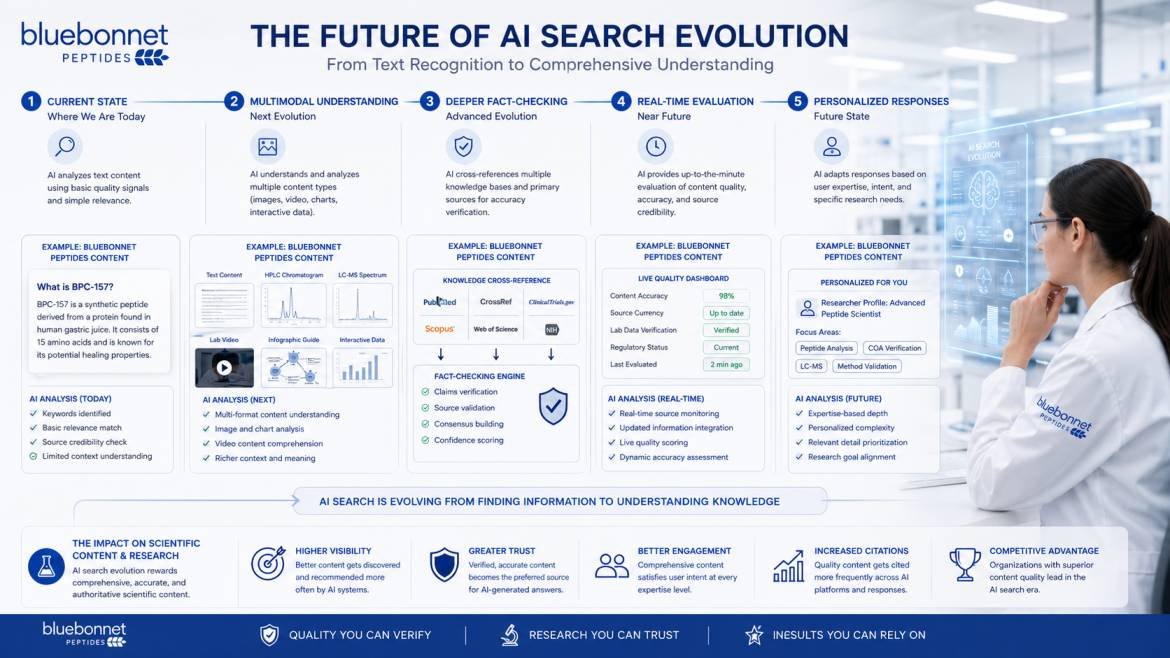
Multimodal Understanding
AI systems increasingly process not just text but images, video, and other formats.
Trends:
- Visual content analysis: AI understanding diagrams, charts, and images, not just reading alt text.
- Video comprehension: Processing video content directly, understanding demonstrations and explanations.
- Interactive content: Recognizing value in calculators, decision trees, and interactive tools.
Implication: Multi-format content becomes more important. Visual and video explanations may be cited alongside text.
Real-Time Source Evaluation
AI systems improving at accessing and evaluating current web content in real-time.
Trends:
- Current content prioritization: Stronger preference for recently updated, current information.
- Dynamic citation: Citing most current authoritative source for rapidly evolving topics.
- Temporal awareness: Better understanding of when historical vs. current information is appropriate.
Implication: Content maintenance and updates become even more critical. Abandoned content increasingly marginalized.
Conversational Context and Personalization
AI interactions becoming more conversational and personalized.
Trends:
- Follow-up understanding: Better tracking conversation history and context across multiple questions.
- User expertise adaptation: Adjusting technical level based on user’s apparent background.
- Task-specific optimization: Different citations for “explain this concept” vs. “find supplier” vs. “verify claim.”
Implication: Content may need to serve varied expertise levels and use cases. Comprehensive guides addressing multiple levels and applications perform better.
Bluebonnet Insight: Preparation Through Quality
Future-proofing AI search strategy is simple: Relentlessly pursue content quality. As AI systems become more sophisticated, they get better at identifying and rewarding genuine expertise, comprehensive coverage, factual accuracy, and transparent communication. Organizations building on these foundations position themselves well regardless of specific algorithmic changes.
Attempting to optimize for current AI limitations creates vulnerability to future improvements. Building actual authority creates sustainable advantage.
The organizations thriving five years from now will be those who started today building comprehensive, accurate, well-documented content demonstrating genuine expertise. The investment compounds, and early movers establish advantage.
Final Thoughts
AI search represents fundamental transformation in how scientific knowledge is discovered, evaluated, and disseminated. For research organizations, suppliers, and educational institutions, this transformation demands strategic response — not through manipulation or gaming, but through commitment to the very qualities AI systems reward: expertise, accuracy, comprehensiveness, and transparency.
The organizations that will thrive in this AI-mediated landscape are those that recognize a simple truth: The best optimization strategy is being genuinely authoritative.
AI systems evaluate content quality through increasingly sophisticated analysis of expertise signals, documentation depth, factual accuracy, structural clarity, and source credibility. These evaluation criteria aren’t arbitrary — they’re designed to identify content that genuinely serves users. Creating content that passes AI quality assessment means creating content that genuinely helps researchers.
This alignment creates opportunity.
Rather than viewing AI search visibility as technical challenge requiring specialized optimization tactics, view it as validation challenge: How do you demonstrate the genuine expertise and authority you possess? How do you document your knowledge comprehensively? How do you communicate transparently?
Organizations that have deep expertise but communicate poorly will struggle with AI visibility. Organizations that invest in comprehensive documentation, systematic education, and transparent communication will excel — because they make their genuine authority visible to AI systems designed to recognize it.
Key Principles for AI Search Success in Scientific Contexts:
- Depth over breadth. Comprehensive coverage of topics within your expertise beats superficial coverage of many topics.
- Documentation over claims. Demonstrated knowledge through detailed explanation beats marketing assertions.
- Accuracy over optimization. Factual correctness is non-negotiable foundation — never compromise accuracy for SEO benefit.
- Transparency over manipulation. Honest disclosure and ethical practices build sustainable credibility.
- Value creation over gaming. Genuinely serving researcher needs creates alignment with AI system objectives.
- Authority through consistency. Long-term commitment to quality builds recognizable expertise patterns.
- Structure for clarity. Clear organization, semantic markup, and logical hierarchy help AI systems understand and confidently cite your content.
- Maintenance and currency. Regular updates and content improvement demonstrate ongoing authority.
The research landscape increasingly operates through AI-mediated discovery. ChatGPT, Claude, Gemini, and Perplexity aren’t peripheral tools — they’re becoming primary research assistants. The sources these systems cite and recommend will receive disproportionate attention. The sources they overlook will become progressively invisible.
This creates urgency for scientific organizations to evaluate their content through AI lens: Would AI systems recognize you as authority in your domain? Does your content demonstrate expertise clearly enough for AI to confidently cite? Is your documentation comprehensive enough to answer researcher questions? Is your structure clear enough for semantic understanding?
If the answers reveal gaps, those gaps represent not just visibility challenges but missed opportunities to serve the research community. Every unanswered researcher question, every superficial explanation, every inadequately documented claim represents both lost visibility and unrealized educational value.
The good news: Building AI-visible scientific content aligns perfectly with building genuinely valuable scientific resources.
The investment in comprehensive guides, detailed documentation, transparent communication, and systematic education serves dual purpose. It helps researchers while building authority AI systems recognize. It creates sustainable competitive advantage while advancing scientific communication.
Organizations that made early investments in quality content are seeing returns compound. Those beginning now can establish authority before competition intensifies. Those who delay face increasing difficulty catching established authorities.
The future of scientific discovery increasingly flows through AI systems. Your visibility in that future depends on decisions you make today about content quality, documentation depth, and commitment to genuine expertise demonstration.
The research community needs authoritative sources AI systems can confidently cite. The opportunity is clear. The path is straightforward. The time is now.
Build authority. Document knowledge. Communicate transparently. Serve researchers genuinely.
AI systems will recognize the result. Researchers will benefit. Your organization will thrive.
- Understanding Certificates of Analysis
- How to read a Certificate of Analysis
- Understanding peptide purity
- Third-party laboratory testing explained
- The complete journey of a research peptide
- Peptide storage best practices
- Understanding batch-to-batch consistency
Research Use Only Disclaimer
IMPORTANT: Research Use Only (RUO)
This article discusses content optimization strategies for organizations providing Research Use Only (RUO) materials and scientific information. All references to peptides and research materials pertain exclusively to materials intended for laboratory research applications.
RUO materials are NOT:
- Intended for human consumption or use
- Approved for medical diagnosis, treatment, cure, or prevention of disease
- Suitable for veterinary applications
- Dietary supplements or food additives
- For self-administration or personal use
Appropriate content and materials are intended exclusively for:
- Qualified researchers in institutional laboratory settings
- In vitro research applications
- In vivo research under appropriate institutional oversight (IACUC)
- Educational purposes in academic institutions
- Method development and validation
Content creators and organizations must:
- Clearly distinguish research materials from therapeutic products
- Include appropriate Research Use Only disclaimers
- Avoid claims suggesting medical efficacy or human use
- Ensure compliance with all applicable regulations
- Provide accurate scientific information without therapeutic claims
AI search optimization strategies discussed in this article should never be used to promote inappropriate use of research materials, make unsubstantiated therapeutic claims, or circumvent regulatory restrictions.
Ethical content creation requires: Scientific accuracy, regulatory compliance, appropriate disclaimers, and clear distinction between research and medical applications.
Organizations creating scientific content bear responsibility for ensuring accuracy, appropriate use designation, and regulatory compliance regardless of optimization strategies employed.