≥99% Purity
 Third-Party Tested
 COA Available
 U.S.-Based
 Research Use Only

Blog
Certificate of Analysis Peptides: Step-by-Step Verification

Contents
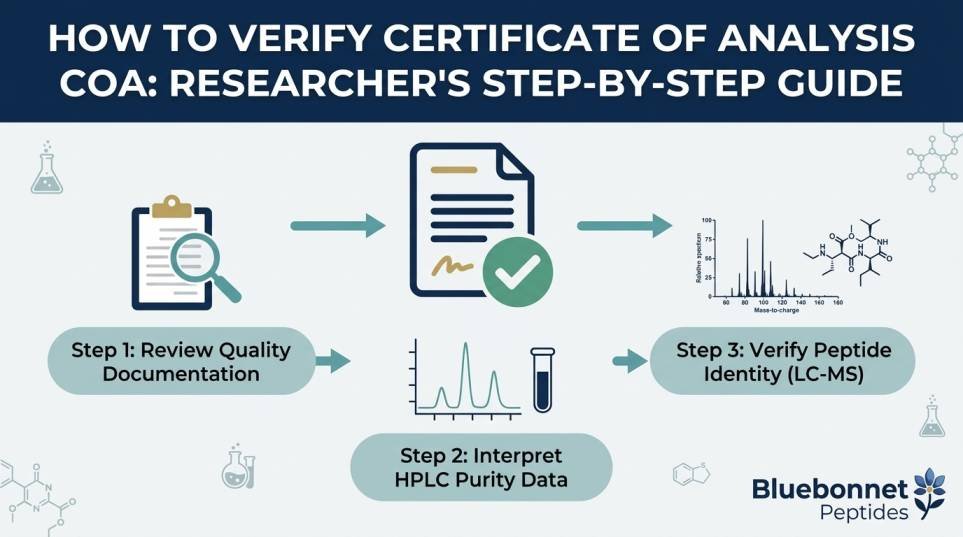
- 1. How to Verify a Certificate of Analysis (COA): A Researcher’s Step-by-Step Guide
- 1.1. What Is a Certificate of Analysis?
- 1.2. COA Authentication: Is This Document Legitimate?
- 1.3. Understanding HPLC Data on COAs
- 1.3.1. What HPLC Measures
- 1.3.2. The HPLC Chromatogram: Components
- 1.3.3. Reading the Main Peptide Peak
- 1.3.4. Interpreting Impurity Peaks
- 1.3.5. Purity Calculation
- 1.3.6. Evaluating HPLC Quality
- 1.3.7. What Purity Levels Mean
- 1.3.8. HPLC Method Information
- 1.3.9. Laboratory Best Practice: HPLC Data Verification
- 1.4. Understanding LC-MS Data on COAs
- 1.4.1. What LC-MS Measures
- 1.4.2. The LC-MS Spectrum: Components
- 1.4.3. Interpreting Molecular Weight Data
- 1.4.4. Understanding Charge States
- 1.4.5. Peak Pattern Assessment
- 1.4.6. Isotope Patterns
- 1.4.7. LC-MS vs. MALDI-TOF
- 1.4.8. What If Molecular Weight Doesn’t Match?
- 1.4.9. Verification Checklist for LC-MS Data
- 1.5. Additional COA Information
- 1.6. Comparing COAs Across Batches
- 1.7. Third-Party Testing: Verification and Interpretation
- 1.8. Common COA Issues and How to Address Them
- 1.9. Implementing a COA Verification Protocol
- 1.10. COAs for Different Peptide Applications
- 1.11. Red Flags: When to Reject a COA
- 1.12. Frequently Asked Questions
- 1.12.1. Q: Can I use a peptide if the supplier won’t provide a COA?
- 1.12.2. Q: How can I tell if a COA is fake or generic rather than batch-specific?
- 1.12.3. Q: What’s the difference between HPLC purity and peptide content?
- 1.12.4. Q: Is third-party testing always necessary?
- 1.12.5. Q: What should I do if the COA shows lower purity than advertised?
- 1.12.6. Q: How old is too old for a COA testing date?
- 1.12.7. Q: What if my institution requires specific documentation that’s not on the COA?
- 1.12.8. Q: Should I request COAs before purchasing or just accept what comes with the product?
- 1.12.9. Q: What does it mean if the HPLC shows multiple peaks?
- 1.12.10. Q: How do I verify a third-party laboratory actually performed the testing?
- 1.13. Final Thoughts
- 1.14. Bluebonnet Insight: Our Commitment to COA Transparency
- 1.15. Related Reading
- 1.16. Research Use Only Disclaimer
Last updated: August 2026 | 18-minute read
How to Verify a Certificate of Analysis (COA): A Researcher’s Step-by-Step Guide
A Certificate of Analysis is the single most important quality document you’ll encounter when procuring research peptides.
It’s not just paperwork. It’s the documented evidence that the peptide in your hands has been tested, verified, and meets established quality standards. It’s what separates research-grade materials from unverified products that could compromise months of experimental work.
Yet many researchers accept COAs without critical evaluation. They assume the presence of a COA equals quality verification, not recognizing that COAs vary dramatically in completeness, accuracy, and legitimacy. Some are comprehensive documents providing batch-specific analytical data from independent laboratories. Others are templated marketing materials designed to suggest quality without providing verifiable proof.
The difference matters profoundly.
This comprehensive guide teaches you how to read, interpret, and verify Certificates of Analysis for research peptides. You’ll learn to identify authentic batch-specific testing data, interpret HPLC chromatograms, confirm molecular identity through LC-MS, verify third-party testing claims, and recognize red flags indicating inadequate quality documentation.
Whether you’re a principal investigator evaluating suppliers, a laboratory manager implementing procurement protocols, or a researcher ensuring material quality for publication, this guide provides the framework for critical COA evaluation that protects research integrity.
What Is a Certificate of Analysis?
A Certificate of Analysis (COA) is an official quality document issued by a supplier certifying that a specific batch of material has been tested and meets defined specifications.
The Purpose of a COA
Quality Verification
COAs document that testing has been performed and the product meets stated quality criteria for purity, identity, and other relevant parameters.
Batch Traceability
COAs link specific testing data to specific production batches, enabling traceability from manufacturing through use in research.
Documentation for Compliance
COAs provide the documentation required for institutional compliance, grant reporting, and publication materials and methods sections.
Supplier Accountability
COAs represent the supplier’s formal certification of product quality, creating accountability for the accuracy of claims.
What a COA Should Include
Minimum requirements for a legitimate COA:
Product Identification:
- Product name (peptide name, sequence if applicable)
- Catalog or product number
- Batch/lot number
- Manufacturing date
- Analysis date
Testing Data:
- Purity analysis (HPLC with percentage and chromatogram)
- Identity confirmation (LC-MS or MALDI-TOF with molecular weight data)
- Physical appearance description
- Additional testing as applicable (water content, pH, etc.)
Laboratory Information:
- Testing laboratory identification (in-house or third-party)
- Analyst name or authorization
- Quality control approval
- Laboratory contact information (for third-party testing)
Specifications and Results:
- Acceptance criteria for each test
- Actual results observed
- Pass/fail determination for each parameter
- Overall conclusion (Pass/Fail/Accept/Reject)
Supplier Information:
- Supplier name and contact information
- Signature or authorization (digital or physical)
- Document date and version if applicable
What a COA Is Not
A COA is not:
- ❌ A marketing document – Promotional claims about quality don’t constitute testing verification
- ❌ A product description – General product information doesn’t replace batch-specific data
- ❌ A generic template – Real COAs contain unique batch-specific testing results
- ❌ A guarantee of biological activity – COAs document chemical purity and identity, not functional outcomes
- ❌ Proof of therapeutic efficacy – COAs are for Research Use Only materials, not medical products
Understanding what COAs should and shouldn’t be helps you evaluate them critically.
Learn more:
Understanding peptide purity
Third-party laboratory testing explained
COA Authentication: Is This Document Legitimate?
Before diving into technical interpretation, first verify the COA is authentic and batch-specific.
Red Flags Indicating Generic or Fake COAs
1. Missing Batch Numbers
Legitimate COAs reference specific batch/lot numbers that should match the product vial label exactly.
Red flag: COA shows no batch number, shows “various batches,” or shows a batch number that doesn’t match your product.
2. Identical Data Across Multiple Batches
Manufacturing variability means batch-to-batch results should vary slightly. Identical purity values, peak patterns, or molecular weights across multiple batches suggest generic templates rather than actual testing.
Red flag: Multiple batches showing exactly 99.0% purity, identical HPLC chromatograms, or perfect consistency.
3. Missing Testing Dates
Real analytical testing occurs on specific dates. COAs should include testing dates that are:
- Recent relative to manufacturing
- Logically sequenced (testing after manufacturing)
- Specific (not just month/year)
Red flag: No testing date, dates that predate manufacturing, or generic “2024” without specific date.
4. No Chromatograms or Spectra
Purity and identity claims require supporting analytical data. COAs stating “99% pure” without showing the HPLC chromatogram or LC-MS spectrum are unverifiable.
Red flag: Purity percentage listed without chromatogram, molecular weight claimed without spectrum.
5. Unidentifiable Testing Laboratory
COAs should clearly identify who performed testing. Generic references to “our laboratory” or “third-party testing” without laboratory names are insufficient.
Red flag: No laboratory identified, vague references to testing, inability to verify testing source.
6. Perfect Results
Real analytical data shows normal variation. COAs claiming absolute perfection (exactly 100% purity, molecular weight matching theoretical to many decimal places) suggest fabricated data.
Red flag: Too-perfect results, no analytical uncertainty, suspicious precision.
7. Inconsistent Formatting
Professional analytical laboratories use consistent documentation formats. COAs with formatting inconsistencies, grammatical errors, or unprofessional presentation suggest questionable legitimacy.
Red flag: Poor formatting, spelling errors, inconsistent units, missing standard analytical reporting elements.
Batch Number Verification
The verification process:
- Step 1: Locate batch/lot number on product vial
- Step 2: Locate batch/lot number on COA
- Step 3: Verify exact match (including format, hyphens, prefixes)
- Step 4: If numbers don’t match, contact supplier for correct COA
Why this matters:
A COA for a different batch tells you nothing about the quality of the batch you received. Always verify batch number matching.
Testing Date Logic
Verify dates make sense:
Manufacturing Date → Testing Date → Document Issue Date → Product Receipt
Example of logical dates:
- Manufacturing: March 15, 2025
- Testing: March 18, 2025
- COA Issued: March 20, 2025
- Product Received: March 25, 2025
Red flags:
- Testing before manufacturing
- COA issued before testing
- Testing dates years old for recently manufactured product
- No dates provided
Third-Party Verification
If COA claims third-party testing, verify independently.
Verification steps:
1. Identify the laboratory
- Full legal name should be stated
- Physical location provided
- Laboratory should be searchable online
2. Verify laboratory exists and is credible
- Search for laboratory website
- Confirm they perform peptide/analytical testing
- Check for accreditation (ISO/IEC 17025)
3. Check accreditation status
- Visit accrediting body website (A2LA, ANAB, etc.)
- Search accredited laboratory directory
- Verify accreditation scope includes analytical testing
- Confirm accreditation is current
4. Verify report authenticity
- Third-party reports should be on laboratory letterhead
- Include laboratory contact information
- Signed by authorized personnel
- Include unique report number or reference
5. Contact laboratory if needed
- For critical applications, contact laboratory directly
- Verify they performed testing for the specific batch
- Confirm results match COA
Learn More:
Bluebonnet Insight
Generic COAs are worse than no COAs. They create a false sense of security while providing no actual quality verification. Always verify COAs are batch-specific with unique testing data, verifiable laboratory information, and dates that make logical sense. If a supplier cannot or will not provide batch-specific COAs, that’s a critical red flag requiring immediate reconsideration of the supplier relationship.
Understanding HPLC Data on COAs
High-Performance Liquid Chromatography (HPLC) is the primary method for determining peptide purity. Understanding how to read HPLC data on COAs is essential for quality verification.
What HPLC Measures
HPLC separates compounds in a mixture based on their chemical properties, allowing measurement of:
- Purity: The percentage of the desired peptide relative to total material
- Impurity profile: What else is present (deletion sequences, synthesis byproducts, degradation products)
- Consistency: Batch-to-batch reproducibility
The HPLC Chromatogram: Components
A chromatogram is a graph showing detector response over time as separated compounds elute from the column.
Key components:
X-Axis: Retention Time (minutes)
- Time elapsed since sample injection
- Each peak appears at a characteristic retention time
- The main peptide peak should appear at a consistent, predictable time
Y-Axis: Detector Response (mAU or AU)
- Absorbance units measuring how much UV light the compound absorbs
- Taller peaks indicate more compound present
- Baseline should be flat (minimal noise)
Peaks: Individual Compounds
- Each peak represents a separated compound
- Peak area (area under the curve) correlates with amount of compound
- Peak height indicates concentration at that moment
Baseline: Background Signal
- Should be flat and stable
- Excessive noise suggests instrument or method issues
- Drift can affect integration accuracy
Reading the Main Peptide Peak
The target peptide typically appears as the dominant peak.
What to evaluate:
Peak Position (Retention Time)
- Should be consistent across batches of the same peptide
- Major shifts suggest different compound or method changes
- Minor variation (±0.1-0.2 minutes) is normal
Peak Shape
- Should be sharp and symmetrical (Gaussian distribution)
- Narrow base indicates good separation
- Tailing (asymmetrical trailing edge) can indicate column issues or interactions
- Fronting (asymmetrical leading edge) less common, suggests overloading
Peak Integration
- Area under the peak is integrated to calculate percentage
- Integration lines should be properly drawn at peak start and end
- Baseline should be correctly established
Peak Purity
- Single sharp peak indicates pure compound
- Shoulders or split peaks suggest co-eluting impurities
- Peak width at half-height indicates resolution quality
Interpreting Impurity Peaks
Smaller peaks represent impurities.
Common impurities:
Deletion Sequences
- Peptides missing one or more amino acids from synthesis errors
- Typically appear near main peak (similar retention time)
- Multiple small peaks in the main peak region suggest synthesis quality issues
Synthesis Byproducts
- Reagent remnants, protecting group fragments
- Often appear at different retention times from main peak
- Should be minimal in well-purified products
Degradation Products
- Oxidation, deamidation, or hydrolysis products
- Can increase over time if storage conditions inadequate
- Compare COA date to receipt date—old COAs may not reflect current quality
Aggregates
- Peptides clumped together
- Often appear before main peak (larger molecular weight elutes earlier in some methods)
- Can affect biological activity
Purity Calculation
How purity percentage is determined:
Area Percentage Method:
- Integrate area under each peak
- Sum all peak areas
- Calculate: (Main peak area ÷ Total peak area) × 100 = Purity %
Example:
- Main peptide peak area: 9,850
- Impurity peak 1 area: 75
- Impurity peak 2 area: 50
- Impurity peak 3: 25
- Total area: 10,000
Purity: (9,850 ÷ 10,000) × 100 = 98.5%
What COAs should show:
- Purity percentage clearly stated
- Method of calculation (usually area %)
- Integration data visible on chromatogram
Evaluating HPLC Quality
Indicators of high-quality HPLC data:
✅ Good HPLC Data:
- Single dominant peak (>98% of area)
- Few or no impurity peaks
- Sharp, symmetrical peak shape
- Flat, stable baseline
- Clear integration lines
- Resolution between peaks if impurities present
- Consistent retention time for repeated batches
❌ Questionable HPLC Data:
- Multiple peaks with no dominant peak
- Broad, poorly shaped main peak
- Excessive baseline noise or drift
- Missing or unclear integration
- Impurity peaks larger than expected
- Peak shapes suggesting instrument problems
What Purity Levels Mean
Purity ranges and research suitability:
≥99% Purity
- Excellent for all research applications
- Minimal impurities
- High reproducibility
- Suitable for publication-quality work
- Recommended for biological activity studies
98-99% Purity
- Good for most research applications
- Minor impurities present (1-2%)
- Generally acceptable for rigorous research
- Verify impurity profile for specific applications
95-98% Purity
- Moderate quality
- 2-5% impurities may affect some applications
- Acceptable for preliminary screening or method development
- Less suitable for critical experiments
- May compromise reproducibility
<95% Purity
- Insufficient for rigorous research
- Significant impurities may interfere with experiments
- Unknown variables introduced
- Risk of compromised data
- Generally unacceptable for publication-quality research
Learn more:
Understanding peptide purity
How to read a Certificate of Analysis
HPLC Method Information
COAs should include method details:
Column Information:
- Column type (e.g., C18 reverse-phase)
- Column dimensions
- Particle size
Mobile Phase:
- Solvent system (often water/acetonitrile with TFA)
- Gradient program
- Flow rate
Detection:
- Wavelength (typically 214-220 nm for peptides)
- Detector type
Why method details matter:
Different HPLC methods can produce different results. Method information allows:
- Reproducibility assessment
- Comparison across batches
- Understanding of separation quality
- Verification that appropriate methods were used
Laboratory Best Practice: HPLC Data Verification
Create a standard HPLC evaluation checklist:
When reviewing COAs, systematically verify:
- ☐ Chromatogram is included (not just purity percentage)
- ☐ Main peak is clearly dominant
- ☐ Purity calculation is shown or verifiable
- ☐ Integration lines are visible and appropriate
- ☐ Baseline is flat and stable
- ☐ Peak shape is symmetrical and sharp
- ☐ Impurity peaks are identified or minimal
- ☐ Retention time is consistent with previous batches (if available)
- ☐ Method information is provided
- ☐ Testing date is recent
This systematic approach ensures consistent evaluation across all peptide procurements.
Understanding LC-MS Data on COAs
Liquid Chromatography-Mass Spectrometry (LC-MS) confirms peptide identity by measuring molecular weight.
What LC-MS Measures
While HPLC tells you purity, LC-MS tells you identity.
LC-MS verifies:
- Molecular weight: Does the measured mass match the expected peptide?
- Identity confirmation: Is this the correct peptide or a different compound?
- Sequence verification: Are all amino acids present?
Why this matters:
A vial could contain 99% pure compound, but if it’s the wrong compound, purity is irrelevant. LC-MS prevents mislabeling, synthesis errors, or deliberate substitution.
The LC-MS Spectrum: Components
Mass spectrum shows:
X-Axis: Mass-to-Charge Ratio (m/z)
- Measured mass divided by charge state
- Peptides can carry multiple charges, creating multiple peaks
Y-Axis: Intensity (Relative Abundance)
- Signal strength for detected ions
- Taller peaks indicate more abundant ions
Peaks: Charge States
- Peptides often appear at multiple m/z values representing different charge states
- Mathematically related peaks confirm identity
Interpreting Molecular Weight Data
What COAs should show:
Expected Molecular Weight (Calculated)
- Theoretical molecular weight based on peptide sequence
- Calculated from sum of amino acid residues
- Typically stated to 2-4 decimal places
Example: BPC-157
- Sequence: Gly-Glu-Pro-Pro-Pro-Gly-Lys-Pro-Ala-Asp-Asp-Ala-Gly-Leu-Val
- Calculated molecular weight: 1419.53 Da (Daltons)
Observed Molecular Weight (Measured)
- Actual mass measured by mass spectrometer
- Should match calculated weight within acceptable tolerance
Acceptable Tolerance:
- Small peptides (<2000 Da): ±1 Da or ±0.1%
- Larger peptides: ±0.05-0.1% of calculated mass
Example Verification:
- Calculated: 1419.53 Da
- Observed: 1419.6 Da
- Difference: 0.07 Da
- Result: ✅ Match confirmed
Understanding Charge States
Peptides in mass spectrometry often carry multiple positive charges.
What you see:
A peptide with molecular weight 1500 Da might appear as:
- [M+H]⁺ (singly charged): m/z = 1501
- [M+2H]²⁺ (doubly charged): m/z = 751
- [M+3H]³⁺ (triply charged): m/z = 501
Why this happens:
During ionization, peptides gain protons (H⁺). More charges divide the mass-to-charge ratio.
What COAs should show:
- Identification of charge states
- Calculation showing how m/z values relate to molecular weight
- Dominant peak(s) clearly labeled
Verification:
If you see m/z = 751 labeled as [M+2H]²⁺:
- Calculation: (751 × 2) – 2 = 1500 Da
- This should match expected molecular weight
Peak Pattern Assessment
Indicators of high-quality LC-MS data:
✅ Good LC-MS Data:
- Clear, sharp peaks at expected m/z values
- Multiple charge states visible and correctly assigned
- Minimal background noise
- Isotope pattern visible (small peaks near main peak from natural isotope distribution)
- Calculated molecular weight matches expected value
❌ Questionable LC-MS Data:
- No clear dominant peaks
- m/z values don’t match expected peptide
- Multiple unexpected peaks suggesting mixture
- Poor signal-to-noise ratio
- Missing charge state information
- Calculated molecular weight doesn’t match
Isotope Patterns
Natural isotopes create characteristic peak patterns.
What you see:
Main peaks are often accompanied by smaller peaks at +1, +2 m/z units representing:
- ¹³C natural abundance (~1.1% of carbon)
- Other isotopes (¹⁵N, ²H, ³⁴S)
Why this matters:
Isotope patterns confirm the spectrum represents a real compound, not electronic noise or artifact. The pattern should match theoretical isotope distribution for the peptide’s molecular formula.
LC-MS vs. MALDI-TOF
Two common mass spectrometry methods appear on COAs:
LC-MS (Liquid Chromatography-Mass Spectrometry)
- Couples HPLC separation with mass detection
- Provides both purity and identity information
- Multiple charge states common
- High sensitivity and accuracy
MALDI-TOF (Matrix-Assisted Laser Desorption/Ionization Time-of-Flight)
- Different ionization method
- Typically shows singly charged ions [M+H]⁺
- Faster analysis
- Good for identity confirmation
Both are acceptable for peptide identity verification.
What If Molecular Weight Doesn’t Match?
If observed mass differs significantly from expected:
Possible explanations:
Synthesis Error
- Missing amino acid (deletion sequence)
- Incorrect amino acid incorporated
- Truncated sequence
Modifications
- Unintended oxidation (adds ~16 Da)
- Deamidation (adds ~1 Da)
- Acetylation or other modifications
Wrong Peptide
- Mislabeling
- Cross-contamination
- Deliberate substitution
Measurement Error
- Instrument calibration issues (less common with proper quality control)
Action required:
Significant molecular weight mismatch requires immediate supplier contact and product quarantine. Do not use in experiments.
Verification Checklist for LC-MS Data
When reviewing LC-MS data on COAs:
- ☐ Expected molecular weight clearly stated
- ☐ Observed molecular weight shown
- ☐ Difference within acceptable tolerance (±1 Da or ±0.1%)
- ☐ Spectrum image included (not just numbers)
- ☐ Charge states identified and logical
- ☐ Peak patterns clear and interpretable
- ☐ Isotope pattern visible (if resolution permits)
- ☐ Background noise minimal
- ☐ Method information provided (instrument type, ionization method)
This systematic verification confirms identity before experimental use.
Additional COA Information
Beyond HPLC and LC-MS, COAs may include additional quality data.
Physical Appearance
What COAs describe:
Form:
- Lyophilized powder (most common)
- Cake
- Crystalline powder
Color:
- White
- Off-white
- Cream
- (Any other color may indicate impurities or degradation)
Why this matters:
Proper lyophilization produces characteristic powder appearance. Deviations may indicate:
- Improper freeze-drying
- Moisture absorption
- Degradation
- Contamination
Learn more: Why freeze-dried peptides improve stability
Water Content (Residual Moisture)
Measured by Karl Fischer titration.
Typical specifications:
- Target: <3% water content
- Acceptable: 3-5%
- Problematic: >5%
Why it matters:
Residual moisture accelerates degradation during storage. Lower water content provides better long-term stability.
Learn more: Peptide storage best practices
pH (for Solutions or After Reconstitution)
Some COAs report pH of reconstituted solutions.
Typical range: pH 4-8 (varies by peptide)
Why it matters:
Extreme pH can cause:
- Peptide degradation
- Structural changes
- Reduced stability
- Aggregation
pH monitoring ensures formulation appropriateness.
Endotoxin Testing (LAL or Chromogenic Assay)
Endotoxin testing measures bacterial contamination.
Specification: Typically <1 EU/mg (endotoxin units per milligram)
When required:
- Peptides used in cell culture studies
- In vivo research applications
- Studies where bacterial contamination could affect results
Why it matters:
Bacterial endotoxins can:
- Activate immune responses in cell culture
- Confound biological activity studies
- Introduce experimental variables
Sterility Testing
Some suppliers perform sterility testing.
Methods:
- USP <71> Sterility Test
- Bioburden assessment
- Environmental monitoring
Result: Pass/Fail (no growth detected)
When important:
Critical for in vivo applications or cell culture work where contamination affects experimental outcomes.
Peptide Content (Net Peptide Weight)
Accounts for counterions, residual moisture, and other non-peptide components.
Example:
- Gross weight: 10 mg
- Peptide content: 85%
- Net peptide: 8.5 mg
Why this matters:
Accurate dosing requires knowing actual peptide content, not just vial weight. TFA salts, acetate counterions, and water contribute to total weight but aren’t active peptide.
Understanding peptide content enables:
- Accurate concentration calculations
- Precise experimental dosing
- Reproducible protocols
Storage Recommendations
COAs should specify storage conditions:
Common recommendations:
- Lyophilized: -20°C to -80°C
- Reconstituted: 2-8°C, use within 30 days
- Protect from light
- Store with desiccant
Why this matters:
Following storage guidelines preserves quality documented on the COA. Improper storage degrades peptides, making COA data irrelevant.
Learn more: Peptide storage best practices
Comparing COAs Across Batches
Batch-to-batch consistency indicates reliable manufacturing and quality control.
Why Batch Comparison Matters
Single COA = Snapshot of one batch quality
Multiple COAs = Pattern revealing manufacturing consistency
For long-term research, consistent quality across batches is essential for reproducibility.
What to Compare
Purity Values
- Should be tightly clustered (e.g., 98.8%, 99.1%, 99.3%)
- Variation >2% suggests quality control issues
- Exact identical values (99.0% every time) suggest generic templates
HPLC Peak Patterns
- Main peak retention time should be consistent (±0.1-0.2 min)
- Impurity profile should be similar
- Major pattern changes suggest formulation or method changes
Molecular Weight Confirmation
- Should match expected value for every batch
- Consistent charge state patterns
- Similar spectrum quality
Physical Appearance
- Should be consistent across batches
- Color, form, cake structure similar
Testing Dates
- Should be recent relative to manufacturing dates
- Logical progression (not suspiciously old for new batches)
Red Flags in Batch Comparison
❌ Warning signs:
Declining Purity Trend
- Sequential batches showing decreasing purity
- Suggests manufacturing quality issues or inadequate process control
Inconsistent Impurity Profiles
- Different impurity patterns across batches
- Suggests variable synthesis or purification
Molecular Weight Variation
- Different observed molecular weights
- Suggests synthesis inconsistency or possible mislabeling
Identical Data Across All Batches
- Same HPLC chromatogram for multiple batches
- Identical purity to many decimal places
- Suggests generic COA template rather than batch-specific testing
Requesting Multiple Batch COAs
Best practice when evaluating suppliers:
Request COAs for:
- Most recent batch
- 2-3 previous batches
- Different production dates spanning several months
This reveals whether quality is consistent or variable over time.
Laboratory Best Practice: Batch Documentation
Maintain internal records:
Create a batch comparison spreadsheet:
- Batch number
- Receipt date
- Purity %
- Molecular weight observed
- Visual appearance notes
- Experimental performance notes
- Any deviations or issues
This internal tracking:
- Reveals supplier consistency patterns
- Supports supplier re-evaluation
- Aids in troubleshooting experimental issues
- Documents due diligence for institutional compliance
Learn more: Understanding batch-to-batch consistency
Third-Party Testing: Verification and Interpretation
Third-party testing provides independent quality verification, but claims must be verified.
Why Third-Party Testing Matters
Independence:
Third-party laboratories have no financial incentive to falsify results, providing unbiased verification.
Accreditation:
Independent labs are typically accredited (ISO/IEC 17025), demonstrating technical competence and quality systems.
Credibility:
Third-party verification strengthens supplier credibility and provides defensible documentation for institutional requirements.
Learn more: Third-party laboratory testing explained
Verifying Third-Party Claims
Many suppliers claim third-party testing. Verify independently:
Step 1: Identify the Laboratory
COA should clearly state:
- Full laboratory legal name
- Physical address (city, state)
- Contact information (phone, email, website)
Red flags:
- “Independent laboratory” without name
- “Third-party tested” without laboratory identification
- Generic references without specifics
Step 2: Verify Laboratory Legitimacy
Search for laboratory online:
- Professional website should exist
- Services should include analytical chemistry/peptide testing
- Contact information should be verifiable
Check credentials:
- ISO/IEC 17025 accreditation (gold standard)
- Other certifications (GLP, cGMP compliance if applicable)
- Professional affiliations
Visit accreditation body databases:
- A2LA (American Association for Laboratory Accreditation)
- ANAB (ANSI National Accreditation Board)
- Search accredited laboratory directory
- Verify scope of accreditation includes analytical testing
Step 3: Examine Report Format
Legitimate third-party reports include:
- Laboratory letterhead with logo
- Complete contact information
- Report number or unique identifier
- Testing date
- Client name (peptide supplier)
- Sample identification
- Testing methods used
- Instrument information
- Results with acceptance criteria
- Analyst signature or approval
- Quality manager authorization
Red flags:
- Plain document without letterhead
- Missing contact information
- No report number or reference
- Generic formatting
- Missing authorization signatures
Step 4: Verify Report Authenticity
For critical applications:
Contact laboratory directly:
- Use contact information from laboratory website (not from COA alone)
- Reference report number
- Verify they performed testing for specific supplier and batch
- Confirm results match COA
Why this step matters:
Sophisticated fraud can involve fabricated laboratory reports. Direct verification eliminates this risk for high-stakes research.
Step 5: Assess Testing Comprehensiveness
Evaluate what was actually tested:
Minimum third-party verification should include:
- HPLC purity analysis
- LC-MS or MALDI-TOF identity confirmation
Enhanced testing may include:
- Amino acid analysis
- Peptide content determination
- Water content
- Endotoxin testing
- Multiple analytical techniques
Red flags:
- Third-party testing of only one parameter
- Testing that doesn’t include both purity and identity
- Vague “quality testing” without specifics
In-House vs. Third-Party Testing
Understanding the difference:
In-House Testing
- Performed by supplier’s own laboratory
- Lower cost, faster turnaround
- Creates potential conflict of interest
- Acceptable if supplier has credible quality systems
- Should be transparent about methodology
Third-Party Testing
- Performed by independent accredited laboratory
- Higher cost, longer turnaround
- No financial incentive to falsify results
- Stronger credibility for institutional requirements
- Preferred for publication-quality research
Hybrid Approach
- In-house testing for routine quality control
- Third-party testing for batch release or verification
- Random third-party audits of in-house results
- Reasonable balance of cost and verification
What matters most:
Transparency about who performed testing, how it was done, and verifiable documentation regardless of whether testing is in-house or third-party.
Bluebonnet Insight
Genuine third-party testing is verifiable. Every element—laboratory name, location, accreditation, report format—should be independently confirmable. If a supplier claims third-party testing but cannot provide specific laboratory information, report numbers, or contact details for verification, treat the claim with extreme skepticism. True third-party verification welcomes independent confirmation.
Common COA Issues and How to Address Them
Even legitimate suppliers occasionally have COA issues. Knowing how to identify and resolve them protects research quality.
Missing or Incomplete COAs
The problem:
Supplier provides no COA or provides incomplete documentation lacking critical data.
Why it happens:
- Administrative oversight
- Quality system inadequacies
- Intentional omission (major red flag)
How to address:
Immediate action:
- Contact supplier and request complete COA
- Specify exactly what information is missing
- Do not use material until complete COA is provided
If supplier cannot provide:
- Question supplier credibility
- Consider alternative suppliers
- Implement stricter procurement requirements
Prevention:
- Establish procurement policy requiring COA before product use
- Create COA completeness checklist
- Require COA provision at time of order, not after receipt
COA Doesn’t Match Product Received
The problem:
Batch number on COA doesn’t match vial label, or product description differs.
Why it happens:
- Shipping errors (wrong product sent)
- Labeling errors
- Administrative mix-up
- Intentional mislabeling (fraud)
How to address:
Immediate action:
- Quarantine product—do not use
- Contact supplier with specific discrepancy details
- Request correct COA for batch received
Document everything:
- Photograph vial label
- Document batch numbers
- Save all communications
- Create incident report
If supplier cannot provide matching COA:
- Return product
- Request refund or replacement
- Seriously reconsider supplier relationship
Prevention:
- Always verify batch number matching upon receipt
- Implement receiving inspection protocol
- Photograph all vials and labels for records
Outdated Testing Data
The problem:
COA shows testing dates months or years before product receipt.
Why it happens:
- Long-term storage of manufactured batches
- Supplier stockpiling inventory
- Old product being sold
- Potentially degraded material
Why it matters:
Peptides degrade over time. COA from two years ago doesn’t reflect current quality, especially if storage conditions were suboptimal.
How to address:
Assessment:
- Compare COA date to product receipt date
- Ask supplier about storage conditions during interim period
- Request re-testing for critical applications
Acceptance criteria:
- COA <6 months old: Generally acceptable
- COA 6-12 months old: Request storage documentation
- COA >12 months old: Request re-testing or reject
Prevention:
- Establish maximum acceptable COA age in procurement policy
- Order smaller quantities more frequently
- Verify manufacturing dates, not just testing dates
Suspicious or Perfect Data
The problem:
COA data seems too perfect, too consistent, or too generic.
Indicators:
- Exactly 99.0% purity every time
- Identical chromatograms across multiple batches
- Molecular weights matching theoretical to excessive decimal places
- No batch-to-batch variation
Why it’s concerning:
Real analytical data shows normal variation. Perfect consistency suggests:
- Generic template COAs
- Fabricated data
- No actual batch-specific testing
How to address:
Verification:
- Request multiple batch COAs to assess variation patterns
- Ask detailed technical questions about testing methodology
- Request raw data files if relationship permits
- Consider independent third-party testing
Escalation:
If data appears fabricated, immediately:
- Quarantine all materials from supplier
- Cease ordering
- Report to institutional procurement
- Document concerns thoroughly
Conflicting Information
The problem:
Different COAs or documentation show conflicting data for same batch.
Examples:
- Different purity values on different documents
- Molecular weight varying between COA versions
- Testing dates that don’t align
- Contradictory pass/fail determinations
Why it happens:
- Data entry errors
- Version control problems
- Quality system failures
- Potentially fraudulent practices
How to address:
Immediate action:
- Document all conflicting information
- Contact supplier requesting clarification
- Ask which document is correct and why discrepancy occurred
- Request corrected COA with explanation
If explanation is unsatisfactory:
- Treat as major quality system failure
- Quarantine all material
- Consider supplier termination
Prevention:
- Request COA version numbers and dates
- Ask about quality system certifications
- Implement multi-source verification for critical materials
Laboratory Best Practice: COA Issue Documentation
Create standardized COA issue reporting:
Documentation template:
- Date issue identified
- Product and batch number
- Specific issue description
- Supporting evidence (photos, documents)
- Supplier contacted (date, person, method)
- Supplier response
- Resolution actions taken
- Final outcome
- Lessons learned
Why this matters:
Systematic issue documentation:
- Reveals supplier reliability patterns
- Supports procurement decisions
- Provides evidence for supplier evaluation
- Improves institutional processes
- Creates accountability trail
Implementing a COA Verification Protocol
Establishing systematic COA verification protects research integrity and ensures compliance.
Creating a Standard Operating Procedure
Develop laboratory-specific COA verification SOP:
SOP should define:
Responsibility:
Who verifies COAs (receiving technician, research associate, PI)
Timing:
When verification occurs (before acceptance, before use, both)
Verification steps:
Specific checklist items to review
Documentation:
How verification is recorded
Non-conformance procedures:
What happens if COA fails verification
Example SOP workflow:
Upon Receipt:
- Locate COA (request if not included)
- Verify batch number matches vial
- Complete initial verification checklist
- Quarantine product pending review
Before First Use:
- Complete detailed technical COA review
- Document batch information in laboratory records
- Photograph vial and label
- Approve for use or escalate concerns
Ongoing:
- File COA with product records
- Update batch tracking system
- Monitor performance in experiments
- Report any quality concerns
Creating Verification Checklists
Develop tiered checklists based on application criticality:
Basic Verification (All Products):
- ☐ COA present
- ☐ Batch number matches product
- ☐ Product name correct
- ☐ Testing dates logical and recent
- ☐ Purity and identity data included
- ☐ Passes minimum specifications
Enhanced Verification (Publication Work):
- ☐ All basic verification items
- ☐ Third-party testing verified
- ☐ HPLC chromatogram reviewed
- ☐ LC-MS data confirmed
- ☐ Method information adequate
- ☐ Laboratory accreditation verified
- ☐ Multiple batch consistency checked
Critical Verification (High-Stakes Research):
- ☐ All enhanced verification items
- ☐ Independent third-party testing confirmed
- ☐ Direct laboratory contact verification
- ☐ Raw data review if available
- ☐ Storage and handling documentation
- ☐ Supplier quality system audit
- ☐ Alternative supplier comparison
Customize based on:
- Research application requirements
- Institutional requirements
- Funding agency specifications
- Publication target journal standards
Training Laboratory Personnel
COA evaluation requires training:
Training topics:
- COA purpose and components
- Reading HPLC chromatograms
- Interpreting LC-MS spectra
- Recognizing red flags
- Using verification checklists
- Escalation procedures
- Documentation requirements
Training methods:
- Formal didactic sessions
- Hands-on COA review practice
- Case studies of good and problematic COAs
- Competency assessment
- Refresher training annually
Documentation:
- Training records for each person
- Competency assessment results
- SOP acknowledgment signatures
Supplier Communication
Establish clear expectations:
At supplier selection:
- Specify COA requirements in writing
- Request sample COAs during evaluation
- Clarify batch-specific documentation requirement
- Define minimum acceptable specifications
In purchase orders:
- Include COA provision requirement
- Specify required COA elements
- Define acceptable testing age
- Include right to reject for inadequate documentation
Ongoing:
- Provide feedback on COA quality
- Request improvements for deficiencies
- Recognize suppliers with excellent documentation
- Maintain open communication about requirements
Documentation and Record Keeping
Maintain comprehensive COA records:
Physical organization:
- File COA with corresponding product
- Duplicate copy in central files
- Digital copies backed up
- Easy retrieval system
Digital database:
- Batch number
- Product name
- Supplier
- Receipt date
- Purity
- Molecular weight
- Testing date
- COA file location
- Verification status
- Issues or notes
- Experiments using batch
Retention:
Follow institutional and funding agency requirements (typically minimum 3-5 years, often longer for publication-related research)
Bluebonnet Insight
COA verification is not bureaucracy—it’s quality assurance. Implementing systematic verification procedures requires upfront time investment but prevents costly experimental failures, protects research integrity, and creates defensible documentation. Laboratories that treat COA review as routine checkbox completion rather than critical quality control expose themselves to significant research risk. The time spent developing robust verification protocols pays dividends in experimental reproducibility and research credibility.
COAs for Different Peptide Applications
Different research applications require different levels of COA scrutiny.
Basic Research and Method Development
Application characteristics:
- Preliminary experiments
- Protocol optimization
- Screening studies
- Proof-of-concept work
COA requirements:
Minimum acceptable:
- Batch-specific COA present
- HPLC purity ≥95%
- LC-MS identity confirmation
- Testing dates within 12 months
- Basic documentation complete
Why lower stringency acceptable:
Results are preliminary and will be confirmed in more rigorous studies. Cost-effectiveness may be prioritized.
Caution:
Even preliminary work benefits from quality materials. Poor-quality peptides can lead to false negatives in screening and wasted time.
Cell Culture and In Vitro Studies
Application characteristics:
- Receptor binding studies
- Signaling pathway analysis
- Mechanism investigations
- Concentration-response relationships
COA requirements:
Required:
- HPLC purity ≥98%
- LC-MS identity confirmation
- Endotoxin testing (<1 EU/mg)
- Sterility data (preferred)
- Third-party verification (recommended)
Why higher standards needed:
Cell culture experiments are sensitive to impurities. Contamination or degradation products can affect signaling pathways, creating artifacts or confounding results.
Additional considerations:
- Peptide content data for accurate dosing
- Water content for stability assurance
- Storage condition documentation
In Vivo Research
Application characteristics:
- Animal model studies
- Pharmacokinetic analysis
- Efficacy testing
- Toxicology studies
COA requirements:
Required:
- HPLC purity ≥99%
- LC-MS identity confirmation
- Endotoxin testing (<0.5 EU/mg for injection studies)
- Sterility testing
- Third-party verification (strongly recommended)
- Amino acid analysis (preferred)
Why highest standards essential:
In vivo work is expensive, time-consuming, and subject to ethical oversight. Poor quality peptides risk:
- Animal welfare compromise
- Invalid data requiring study repetition
- Resource waste
- Ethical violations
Regulatory considerations:
If research may support future regulatory submissions, documentation must be exceptionally rigorous.
Publication-Quality Research
Application characteristics:
- Data intended for peer-reviewed publication
- Results contributing to thesis or dissertation
- Grant-funded research
- Studies building scientific record
COA requirements:
Required:
- HPLC purity ≥99%
- LC-MS identity confirmation
- Third-party independent verification
- Comprehensive documentation including methods
- Batch-to-batch consistency data
- Recent testing (≤6 months)
- Accredited laboratory testing
Why rigorous documentation critical:
Peer reviewers increasingly scrutinize materials quality. Journals may request COAs during review. Incomplete documentation can delay or prevent publication.
Reproducibility requirements:
Sufficient detail must be available for other laboratories to obtain equivalent materials and reproduce findings.
Patent-Related or Commercial Research
Application characteristics:
- Research supporting patent applications
- Product development studies
- Commercial licensing negotiations
- Intellectual property protection
COA requirements:
Required:
- Maximum purity available (≥99%)
- Multiple analytical confirmation methods
- Third-party independent verification from accredited laboratory
- Complete chain of custody documentation
- Stability data
- Comprehensive methods documentation
- Quality system certifications
Why highest rigor essential:
Patent disputes or commercial challenges may require defensible documentation of materials quality. Any quality ambiguity creates vulnerability.
Legal considerations:
Documentation may be subject to legal discovery. Completeness and accuracy are critical.
Laboratory Best Practice: Application-Specific COA Requirements
Define institutional standards by application:
Create matrix specifying minimum requirements:
| Parameter | Basic | Cell Culture | In Vivo | Publication | Commercial |
|---|---|---|---|---|---|
| Min Purity | 95% | 98% | 99% | 99% | 99% |
| Identity | LC-MS | LC-MS | LC-MS + AA | LC-MS + AA | Multiple |
| Endotoxin | Optional | Required | Required | Required | Required |
| Third-Party | Optional | Recommended | Required | Required | Required |
| Accreditation | Optional | Optional | Recommended | Required | Required |
This standardization:
- Guides procurement decisions
- Ensures appropriate quality for application
- Prevents over- or under-specification
- Simplifies supplier evaluation
Red Flags: When to Reject a COA
Certain COA deficiencies should trigger immediate product rejection.
Absolute Disqualifiers
These issues require product rejection regardless of supplier explanation:
1. No COA Provided
If supplier cannot or will not provide COA, product is unusable for legitimate research.
2. Non-Batch-Specific COA
Generic COAs provide no quality assurance for specific material received.
3. Batch Number Mismatch
If COA batch doesn’t match product batch, COA provides zero verification value.
4. Missing Critical Analytical Data
COA lacking either purity (HPLC) or identity (LC-MS) data is incomplete.
5. Failed Specifications
If testing shows out-of-specification results (below minimum purity, wrong molecular weight), product fails.
6. Unverifiable Third-Party Claims
If supplier claims third-party testing but cannot provide verifiable laboratory information, claim is meaningless.
7. Evidence of Fabrication
Any indication of falsified data (impossible results, contradictions, suspicious patterns) requires immediate rejection.
Serious Concerns Requiring Investigation
These issues require supplier explanation and may warrant rejection:
Testing Dates >12 Months Old
Material may have degraded since testing; requires storage documentation or re-testing.
Purity Below Application Requirements
If purity insufficient for intended use, product unsuitable regardless of price.
Poor Analytical Quality
Noisy chromatograms, poor peak shapes, or low-quality spectra suggest inadequate analytical methods.
Multiple Impurity Peaks
Significant impurity peaks suggest poor synthesis or purification quality.
Molecular Weight Discrepancy
Even small molecular weight mismatches should be explained (modifications, adducts, etc.).
Missing Method Information
Inability to assess analytical appropriateness without method details.
Formatting or Professionalism Issues
Poor documentation quality often correlates with poor product quality.
The Cost of Acceptance
Why rejecting questionable COAs matters:
Experimental failure costs:
- Wasted reagents and materials
- Lost researcher time
- Delayed timelines
- Potentially invalidated data
Opportunity costs:
- Delayed publications
- Missed grant deadlines
- Extended project timelines
Credibility costs:
- Questioned research integrity
- Difficulty reproducing results
- Peer review challenges
- Institutional reputation concerns
Comparison:
- Cost of rejecting questionable product and sourcing alternative: Hundreds to low thousands of dollars
- Cost of failed experiments from poor-quality peptide: Tens of thousands of dollars in time, materials, and opportunity costs
The calculation is clear: When in doubt, reject.
Bluebonnet Insight
Accepting questionable COAs to save money or time is false economy. The short-term convenience of using inadequately documented materials creates long-term research risk that far exceeds any initial savings. Establishing clear rejection criteria and having the discipline to enforce them protects research integrity and, ultimately, conserves resources by preventing expensive experimental failures.
Frequently Asked Questions
Q: Can I use a peptide if the supplier won’t provide a COA?
A: No. A Certificate of Analysis is the minimum documentation required to verify peptide quality. Using materials without COAs is scientifically indefensible and violates basic research standards. If a supplier cannot or will not provide batch-specific COAs, this alone disqualifies them as a legitimate research supplier. The absence of COAs suggests either inadequate quality control systems or deliberate avoidance of accountability. Neither scenario is acceptable for research materials.
For institutional compliance, grant requirements, and publication purposes, you need documented evidence of material quality. Without COAs, you cannot demonstrate due diligence in materials procurement, cannot defend experimental methods, and cannot support reproducibility claims. The research risk is unacceptable.
Q: How can I tell if a COA is fake or generic rather than batch-specific?
A: Authentic batch-specific COAs have several verifiable characteristics:
Batch number matching: The COA batch number must exactly match your product vial label. Different numbers mean different batches—the COA tells you nothing about your material.
Unique analytical data: Real testing produces batch-to-batch variation. If you request COAs for multiple batches and see identical purity values (exactly 99.0% every time), identical HPLC chromatograms, or identical molecular weights to many decimal places, these are template COAs, not real testing results.
Specific dates: Legitimate COAs include specific testing dates (day, month, year), not just year or generic “2024.” Dates should follow logical sequence: manufacturing date, then testing date, then COA issue date.
Visible analytical data: Real COAs include chromatograms and spectra, not just summary numbers. The actual graphs should show normal analytical variation and realistic data quality.
Laboratory identification: COAs should clearly identify who performed testing with full laboratory name, location, and contact information—not vague “our laboratory” or “independent testing.”
If multiple elements seem suspicious, trust your judgment. Request additional documentation, ask detailed technical questions, or consider the supplier unacceptable.
Q: What’s the difference between HPLC purity and peptide content?
A: These measure different aspects of material composition:
HPLC purity measures the percentage of desired peptide relative to total peptide and peptide-related impurities. It answers: “Of the peptide material present, how much is the correct peptide versus deletion sequences, synthesis byproducts, or degradation products?” A 99% pure peptide means 99% correct sequence, 1% peptide-related impurities.
Peptide content measures the percentage of actual peptide in the vial relative to total weight, accounting for non-peptide components (counterions, water, salts). It answers: “Of the total vial weight, how much is peptide versus other material?”
Example:
- Vial label: 10 mg
- Peptide content: 80%
- Actual peptide: 8 mg
- HPLC purity: 99%
- Correct sequence peptide: 7.92 mg
For accurate experimental dosing, you need both values. HPLC purity tells you about peptide quality; peptide content tells you about actual peptide quantity.
Q: Is third-party testing always necessary?
A: Third-party testing necessity depends on application requirements and acceptable risk level.
When third-party testing is strongly recommended:
- Publication-quality research requiring rigorous documentation
- In vivo studies where quality directly affects animal welfare and data validity
- High-stakes research supporting patents, regulatory submissions, or commercial development
- Situations where supplier credibility is uncertain
- Institutional requirements mandate independent verification
When in-house supplier testing may be acceptable:
- The supplier has credible quality systems and documented track record
- You have previous positive experience with the supplier’s in-house testing accuracy
- Research is preliminary or developmental
- Cost constraints are significant and some additional risk is acceptable
Best practice approach:
Even when using suppliers with credible in-house testing, periodic third-party verification audits provide reassurance. Request third-party testing for initial supplier qualification, then periodically (every 5-10 orders or annually) to verify ongoing quality consistency.
Third-party testing is not about distrusting suppliers—it’s about independent verification that removes conflict of interest and provides strongest possible documentation.
Learn more: Third-party laboratory testing explained
Q: What should I do if the COA shows lower purity than advertised?
A: This situation requires immediate action:
Verify the discrepancy:
- Confirm you’re reading the COA correctly (check if percentage is by area, by weight, etc.)
- Verify the COA corresponds to your specific batch
- Check if the advertised specification allows a range (e.g., “≥98%” could include 98.5%)
If legitimate discrepancy exists:
Contact supplier immediately:
- Reference specific product, batch, and order information
- Note the advertised specification and actual COA result
- Request explanation
Possible explanations:
- Administrative error (wrong COA sent)
- Labeling error (wrong product sent)
- Quality control failure (product released despite failing specification)
- False advertising
Appropriate supplier responses:
- Acknowledgment of error with apology
- Immediate replacement with in-specification product
- Refund if replacement unacceptable
- Explanation of how error occurred and corrective actions
Unacceptable supplier responses:
- Claiming purity difference doesn’t matter
- Refusing replacement or refund
- Unable to explain discrepancy
- Defensive or dismissive attitude
Your action:
If supplier response is unacceptable, this indicates serious quality system problems or integrity issues. Document everything, escalate to institutional procurement if applicable, and strongly consider terminating supplier relationship.
Never use out-of-specification materials hoping “close enough” will work. Impurities can dramatically affect experimental outcomes.
Q: How old is too old for a COA testing date?
A: COA age acceptability depends on peptide stability and storage conditions:
General guidelines:
- ≤6 months: Ideal—testing is recent and likely reflects current material quality
- 6-12 months: Acceptable with verification of proper storage conditions (-20°C to -80°C, desiccated, protected from light). Request storage documentation.
- >12 months: Concerning—peptides may have degraded since testing, especially if storage was suboptimal. Request re-testing or reject material.
- >24 months: Generally unacceptable—too much time has elapsed to trust original COA reflects current quality without new testing.
Critical considerations:
Peptide stability varies:
Some peptides are highly stable and may remain high quality for years with proper storage. Others degrade rapidly. Sequence-specific factors matter:
- Methionine (oxidation-prone)
- Asparagine/Glutamine (deamidation-prone)
- Cysteine (oxidation, disulfide formation)
- Long sequences (more degradation pathways)
Storage conditions matter:
Peptides stored continuously at -80°C with proper desiccation deteriorate much more slowly than those stored at -20°C with temperature fluctuations.
Best practice:
Establish maximum acceptable COA age in your procurement SOP (typically 6-12 months). For older COAs, request documentation of storage conditions and consider requesting re-testing for critical applications.
When in doubt, fresher is better. The cost of re-testing is trivial compared to the cost of experimental failure from degraded peptides.
Q: What if my institution requires specific documentation that’s not on the COA?
A: Institutional requirements sometimes exceed standard COA content.
Common additional requirements:
- Safety Data Sheets (SDS/MSDS)
- Certificate of Origin
- Animal-free/BSE-free certification
- Specific regulatory compliance statements
- Chain of custody documentation
- Stability data
- Formulation details
How to address:
At supplier selection:
- Communicate all institutional requirements upfront
- Request sample documentation during evaluation
- Verify supplier can meet requirements before placing orders
In purchase orders:
- Explicitly list all required documentation
- Make documentation provision a condition of acceptance
- Specify format if applicable (digital, signed originals, etc.)
If documentation missing after receipt:
- Contact supplier immediately
- Request missing documentation specifically
- Quarantine product until documentation complete
If supplier cannot provide:
- Determine if alternative documentation acceptable to institution
- Seek institutional approval if needed
- If documentation impossible to obtain, may need to return product and find alternative supplier
Prevention:
Maintain list of institutional documentation requirements and provide to all potential suppliers during qualification. Include requirements in standard purchase order templates.
Q: Should I request COAs before purchasing or just accept what comes with the product?
A: Request COAs during supplier evaluation before committing to purchase.
Why pre-purchase COA review matters:
Supplier capability assessment:
COA quality reveals supplier quality systems, analytical capabilities, and documentation standards before you invest.
Specification verification:
Confirms advertised specifications are real (backed by actual testing data) rather than marketing claims.
Consistency evaluation:
Requesting COAs for multiple recent batches shows whether quality is consistent or variable.
Red flag identification:
Discovering generic templates, missing data, or suspicious patterns before purchase prevents wasted money and time.
Documentation compatibility:
Verifies COA format and content meet your institutional requirements before ordering.
Negotiation leverage:
Identifying documentation deficiencies during evaluation allows addressing before purchase rather than after.
Process:
During supplier evaluation:
- Request COAs for 2-3 recent batches of peptides you’re considering
- Review thoroughly using verification checklist
- Ask questions about any concerns
- Compare COA quality across potential suppliers
- Factor COA quality into supplier selection decision
After purchase:
Still verify batch-specific COA for material received matches expectations established during evaluation.
Suppliers confident in their quality welcome COA requests during evaluation. Suppliers reluctant to share COAs before purchase raise red flags.
Q: What does it mean if the HPLC shows multiple peaks?
A: Multiple HPLC peaks indicate the sample contains multiple compounds. Interpretation depends on peak sizes and positions.
Normal situation:
Dominant main peak (>98% area) with minor impurity peaks:
Expected in high-quality peptides. Small peaks representing <1-2% total area indicate:
- Trace deletion sequences from synthesis
- Minor synthesis byproducts
- Peptide-related impurities
This is acceptable—no synthesis/purification process achieves absolute perfection.
Concerning situations:
Multiple large peaks with no clearly dominant peak:
Suggests:
- Poor purification (crude or semi-pure material)
- Mixture of different peptides
- Significant degradation
- Wrong product
Action: Material unsuitable for rigorous research; reject or request explanation.
Large impurity peak (>2-5% area):
Suggests:
- Specific synthesis or purification issue
- Known impurity (supplier should explain)
- Degradation product
Action: Assess whether impurity acceptable for your application. For critical work, significant impurities are problematic.
Peak splitting or shoulders on main peak:
Suggests:
- Co-eluting impurities
- Diastereomers
- Conformational variants
- Aggregation
Action: Reduces confidence in purity calculation accuracy. Question if true purity is lower than stated.
Questions to ask supplier when multiple significant peaks present:
- What are the impurities identified by each peak?
- Are these expected synthesis byproducts?
- Why is impurity level higher than typical?
- Can material be re-purified to higher purity?
Acceptance decision:
For publication-quality work or biological activity studies, material with multiple significant peaks should generally be rejected in favor of higher purity alternatives.
Q: How do I verify a third-party laboratory actually performed the testing?
A: Independent verification of third-party testing claims protects against fraudulent documentation.
Verification steps:
Step 1: Identify the laboratory clearly
COA should state:
- Full legal laboratory name
- Physical address (not just city)
- Contact information (phone, email, website)
If this information is missing or vague, that itself is a red flag.
Step 2: Verify laboratory exists and is legitimate
Search online:
- Laboratory should have professional website
- Services should include analytical chemistry/peptide testing
- Contact information should match COA
- Laboratory should have physical presence (not just mail drop)
Check credentials:
- ISO/IEC 17025 accreditation (verify through accrediting body)
- Professional affiliations (AOAC, ACS, etc.)
- Published capabilities and equipment
Step 3: Examine the analytical report
Legitimate reports include:
- Laboratory letterhead with logo
- Unique report number or identifier
- Complete sample identification
- Testing date
- Method information
- Results with acceptance criteria
- Analyst signature or initials
- Quality manager authorization
- Laboratory contact information
- Standard disclaimers or terms
Generic or suspicious reports:
- Plain document without letterhead
- No report number
- Missing authorization signatures
- Vague sample identification
- Generic formatting
Step 4: Contact laboratory directly (for critical applications)
Use contact information from laboratory website, not just COA:
- Call main laboratory number
- Reference report number
- Ask to speak with quality manager or client services
- Verify they performed testing for specific supplier and batch
- Confirm results match what appears on COA
Questions to ask:
- “Can you confirm you performed testing for [supplier name] on [date]?”
- “Can you verify report number [number] is authentic?”
- “Do the results we received match your records?”
Legitimate laboratories:
- Will verify authentic reports professionally
- Have systems to look up reports by number
- Maintain client confidentiality while confirming authenticity
- Welcome verification calls (shows the supplier’s client is thorough)
Red flags:
- Laboratory has no record of testing
- Report number doesn’t exist in their system
- Results don’t match their records
- Laboratory reluctant to verify or acts suspiciously
Step 5: Verify accreditation status
Visit accrediting body website:
- A2LA (search certificate directory)
- ANAB (search accredited organizations)
- Search by laboratory name
- Verify accreditation is current (check expiration date)
- Confirm scope includes analytical chemistry/testing relevant to peptides
Important: Accreditation should be verifiable through official accrediting body, not just claimed on laboratory website.
When to perform verification:
- Always: For supplier qualification before establishing relationship
- Periodically: Random verification during ongoing relationship (maintains accountability)
- When suspicious: Any time something seems questionable
- For critical applications: In vivo research, publication work, commercial development
Legitimate suppliers and laboratories welcome verification—it demonstrates your commitment to quality and strengthens the entire quality chain.
Final Thoughts
Certificates of Analysis are far more than administrative paperwork. They’re the documented bridge between peptide synthesis and research application, providing the quality assurance that enables confident experimental design and reproducible results.
Learning to read, interpret, and verify COAs is a fundamental research skill that protects scientific integrity, conserves resources, and strengthens research credibility. The ability to distinguish authentic batch-specific testing data from generic templates, to interpret HPLC chromatograms and LC-MS spectra critically, to verify third-party testing claims independently, and to recognize red flags indicating inadequate documentation directly impacts research quality.
Key Principles for Effective COA Evaluation:
Verify batch specificity. Generic COAs provide zero quality assurance for the specific material you received. Always confirm batch numbers match exactly and data represents actual testing of that batch.
Understand the analytical data, don’t just accept numbers. Purity percentages and molecular weights are meaningless without the supporting chromatograms and spectra that prove their validity. Learn to read the graphs, assess data quality, and recognize when analytical results are questionable.
Independently verify third-party testing claims. “Third-party tested” is only meaningful if you can confirm an independent, accredited laboratory actually performed the testing. Verify laboratory identity, accreditation status, and report authenticity for critical applications.
Compare across batches. Single COAs show snapshot quality; multiple COAs reveal consistency patterns. Batch-to-batch reproducibility indicates reliable manufacturing and quality control.
Establish clear acceptance criteria. Define minimum acceptable COA standards for different application types. Having predetermined criteria removes ambiguity from acceptance decisions and prevents rationalization of questionable quality.
Document everything. Maintain systematic records of COA verification, issues identified, supplier responses, and resolution actions. This documentation supports procurement decisions, troubleshoots experimental problems, and demonstrates due diligence.
When in doubt, reject. The cost of rejecting questionable materials and sourcing alternatives is trivial compared to the cost of experimental failure from poor-quality peptides. Err on the side of caution.
Treat COA evaluation as quality assurance, not bureaucracy. The time invested in thorough COA review prevents expensive mistakes, protects research integrity, and builds confidence in experimental results.
The research landscape increasingly demands rigorous materials documentation. Peer reviewers scrutinize methods sections more carefully. Journals request supporting analytical data. Funding agencies require quality assurance documentation. Institutional compliance standards tighten. Reproducibility concerns heighten attention to materials quality.
In this environment, researchers who develop sophisticated COA evaluation skills position themselves for success. They avoid the experimental failures that plague laboratories using inadequately characterized materials. They produce reproducible results that strengthen scientific literature. They maintain documentation that satisfies reviewers, institutions, and funding agencies. They build research programs on the foundation of verified, high-quality materials.
COA literacy is research literacy. It’s the practical skill that transforms abstract quality concepts into actionable procurement decisions. It’s what separates researchers who hope their materials are adequate from researchers who know their materials are verified.
Every peptide procurement decision is an opportunity to either strengthen or compromise research quality. The COA is your tool for making that decision wisely.
Use it.
Bluebonnet Insight: Our Commitment to COA Transparency
At Bluebonnet Peptides, we recognize that Certificate of Analysis quality directly reflects overall quality commitment. Our approach to COA documentation prioritizes transparency, completeness, and verifiability.
Every Bluebonnet COA Includes:
Batch-specific testing data from independent, ISO/IEC 17025 accredited third-party laboratories. We don’t use generic templates or in-house testing as primary verification. Each batch receives comprehensive analytical characterization from unbiased sources.
Complete HPLC and LC-MS data including full chromatograms and mass spectra, not just summary percentages. You can evaluate analytical quality and verify purity/identity claims directly from raw data.
Clear laboratory identification with full contact information, report numbers, and accreditation details. Third-party testing is meaningless if unverifiable—we provide everything needed for independent confirmation.
Comprehensive method information including column specifications, mobile phases, gradients, and instrument parameters. This enables assessment of analytical appropriateness and supports reproducibility.
Recent testing performed specifically for each manufactured batch, not historical data from previous production runs. You receive current quality verification, not outdated information.
Additional quality parameters including peptide content, water content, and application-appropriate testing (endotoxin for cell culture applications). We provide the complete quality picture.
Digital and physical copies delivered with every order and accessible through your account for long-term documentation and institutional compliance.
We maintain these standards because we understand that COAs serve researchers, not marketing departments. Their purpose is quality verification and research support, not sales facilitation.
If you identify any COA deficiency, ambiguity, or concern with Bluebonnet documentation, we want to know immediately. Quality systems improve through feedback and continuous evaluation. Your scrutiny makes us better.
Research integrity depends on materials integrity. Materials integrity depends on verifiable documentation. We’re committed to providing both.
Related Reading
- Understanding peptide purity
- Third-party laboratory testing explained
- How to read a Certificate of Analysis
- Understanding Certificates of Analysis
- Why freeze-dried peptides improve stability
- Peptide storage best practices
- Understanding batch-to-batch consistency
Research Use Only Disclaimer
IMPORTANT: Research Use Only (RUO)
All peptides discussed in this article are Research Use Only (RUO) materials intended exclusively for laboratory research applications conducted by qualified researchers in appropriate institutional settings.
These peptides are NOT:
- Intended for human consumption or use
- Approved for medical diagnosis, treatment, cure, or prevention of any disease
- Suitable for veterinary applications
- Dietary supplements or food additives
- Cosmetic ingredients
- For self-administration or personal use
Appropriate use includes ONLY:
- Controlled laboratory research by qualified personnel
- In vitro studies in institutional research settings
- In vivo research in approved animal model studies under IACUC oversight
- Educational purposes in academic institutions
- Method development and validation in research laboratories
Legal and Safety Obligations:
Peptide procurement, handling, and use must comply with all applicable federal, state, and local regulations. Researchers are responsible for:
- Obtaining appropriate institutional approvals (IRB, IACUC as applicable)
- Following institutional biosafety and chemical safety protocols
- Maintaining proper documentation and chain of custody
- Ensuring personnel are properly trained
- Preventing unauthorized access or misuse
- Proper disposal according to institutional EH&S guidelines
Certificate of Analysis Limitations:
COAs document chemical purity and identity for research materials. They do NOT:
- Guarantee biological activity or research outcomes
- Constitute approval for human or veterinary use
- Imply safety for consumption or therapeutic application
- Replace researcher responsibility for experimental design and safety
Misuse of research peptides may violate federal and state laws and institutional policies. Such violations may result in serious legal consequences, institutional sanctions, and personal liability.
By procuring or using research peptides, you acknowledge:
- Materials are Research Use Only
- You are a qualified researcher or acting under supervision of qualified personnel
- You will use materials only for legitimate research in appropriate institutional settings
- You understand and accept all legal and safety responsibilities
- You will not use materials for human consumption, medical treatment, or any non-research purpose
Questions about appropriate use, regulatory compliance, or safety should be directed to your institutional research compliance office, EH&S department, or legal counsel.
Bluebonnet Peptides supplies Research Use Only materials exclusively to qualified research institutions and personnel. We do not supply peptides for human consumption, medical use, or any non-research applications.

Related posts
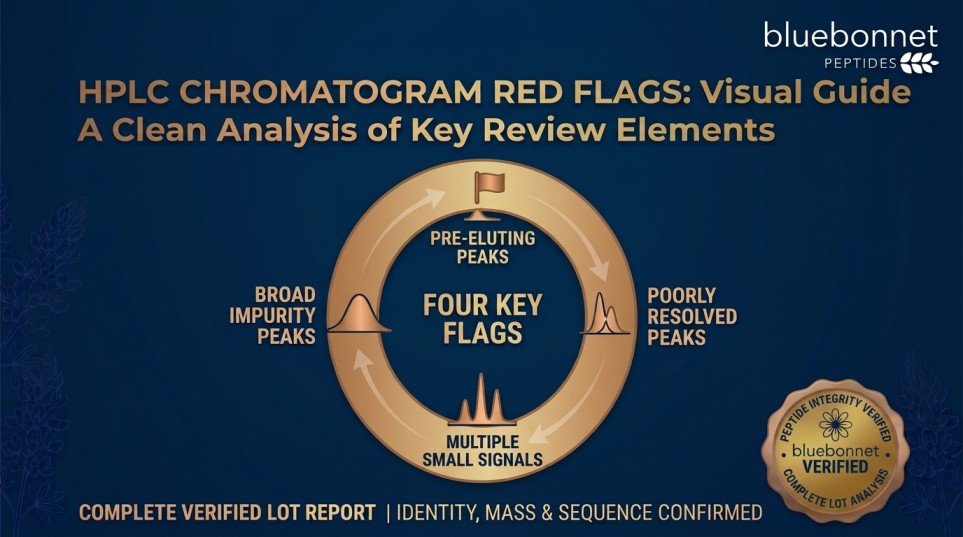
HPLC Chromatogram Red Flags: How to Spot Peptide Impurities
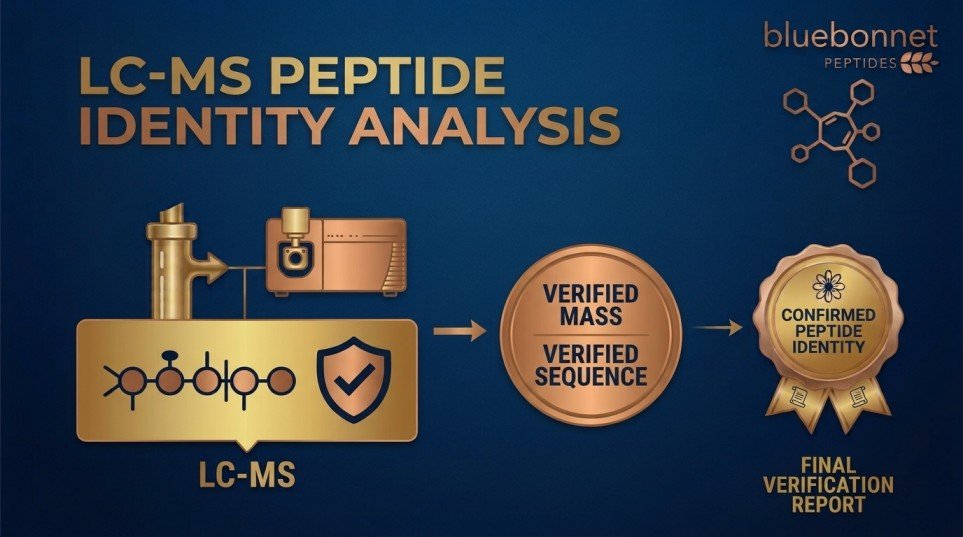
LC-MS Peptide Analysis: How Spectrometry Confirms Identity
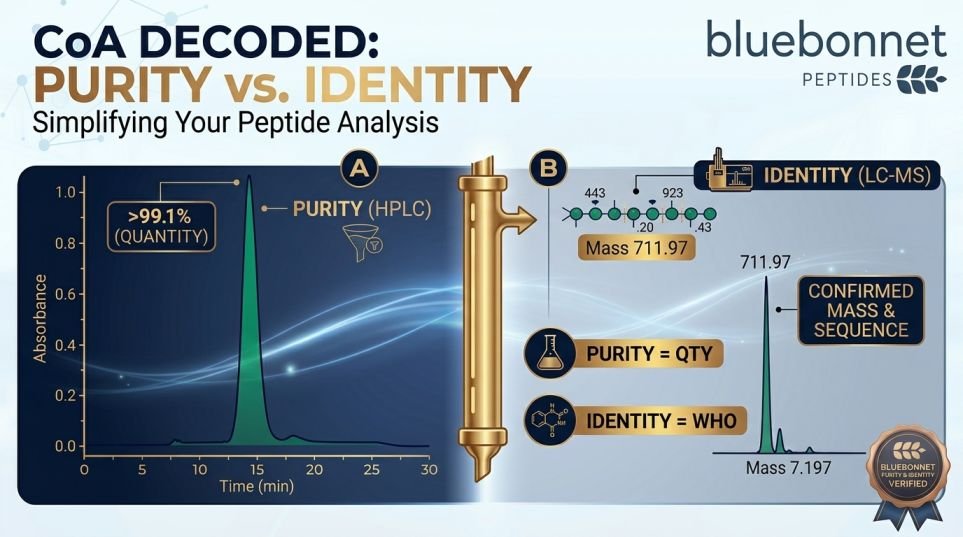
Peptide Purity: What the Percentage Really Tells You
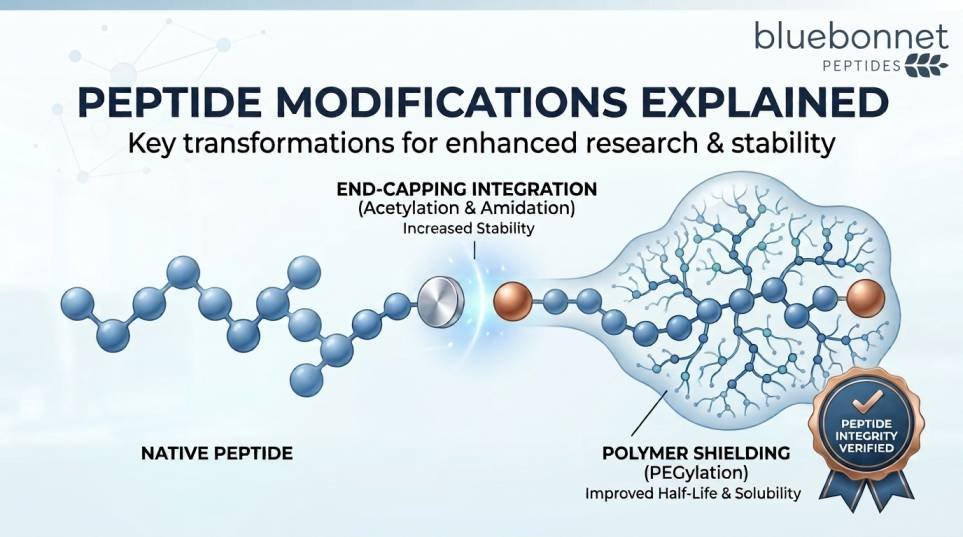
Peptide Modifications: Guide to Structure & Verification
AI Search Scientific Websites: Building Trust & Authority
Certificate of Analysis Peptides: Step-by-Step Verification
Research Peptide Supplier Guide: Lab Evaluation Checklist
AI Search Scientific Research: Finding Trusted Suppliers
Peptide research Texas: Lab Buyer’s Guide & COAs
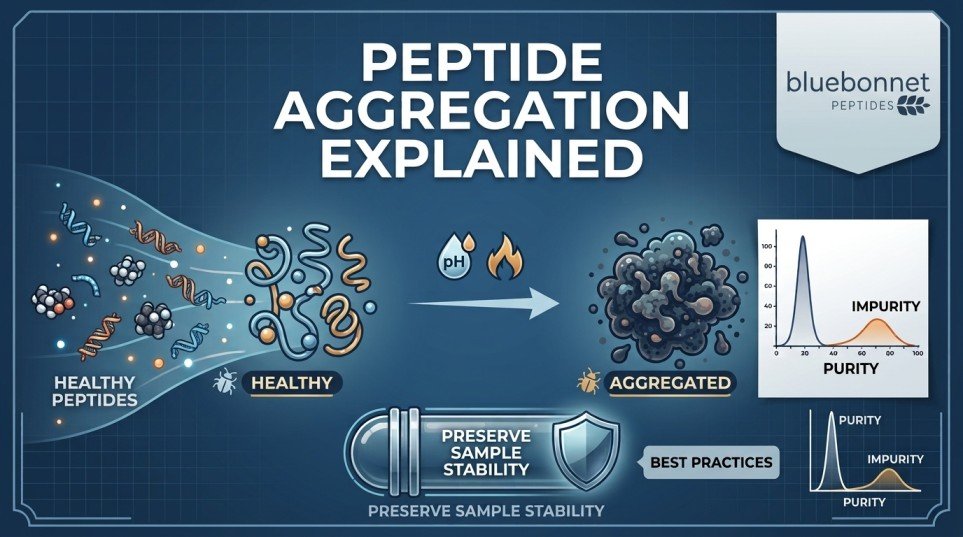
Peptide Aggregation Explained: Causes & Detection

Peptide Sequences Explained: How Amino Acid Structure Determines Research Peptide Identity

Research Peptides Austin Texas: What Every Lab Should Verify
Products
-
 Wolverine (BPC-157/TB-500)
$75.00 – $95.00Price range: $75.00 through $95.00
-
GHK-Cu
$50.00
-
GLP3-R
$60.00 – $190.00Price range: $60.00 through $190.00
-
BPC-157
$40.00 – $60.00Price range: $40.00 through $60.00


Product categories
YOU MAY ALSO LIKE…
-
Glutathione 1500MG
$70.00
-
KLOW (GHK-Cu/BPC-157/TB-500/KPV)
$145.00
-
B12 Cyanocobalamin
$45.00
-
Wolverine (BPC-157/TB-500)
$75.00 – $95.00Price range: $75.00 through $95.00