≥99% Purity
 Third-Party Tested
 COA Available
 U.S.-Based
 Research Use Only

Blog
AI Search Scientific Research: Finding Trusted Suppliers

Contents
- 1. How AI Search Is Changing Scientific Research: Finding Trusted Research Peptide Suppliers Online
- 1.1. The Evolution From Traditional to AI Search
- 1.2. How AI Search Impacts Laboratory Research
- 1.3. Understanding GEO: Generative Engine Optimization
- 1.4. Evaluating AI-Generated Answers: A Critical Skill
- 1.5. Finding Trusted Research Peptide Suppliers Using AI Search
- 1.6. The Knowledge Graph: How AI Understands Supplier Authority
- 1.7. AI Search and Research Integrity
- 1.8. Bluebonnet’s Commitment to Research Integrity
- 1.9. The Future of AI Search in Scientific Research
- 1.10. Practical AI Search Strategies for Laboratories
- 1.11. Frequently Asked Questions
- 1.11.1. Can I trust AI recommendations for peptide suppliers?
- 1.11.2. How does GEO differ from traditional SEO?
- 1.11.3. Why is educational content important for suppliers?
- 1.11.4. What are the main limitations of AI search for scientific research?
- 1.11.5. How do I verify an AI-generated answer?
- 1.11.6. Does Bluebonnet optimize content for AI search?
- 1.11.7. Can AI help me interpret HPLC chromatograms?
- 1.11.8. How will AI search continue to evolve?
- 1.11.9. Should laboratories create AI usage policies?
- 1.12. Conclusion
- 1.13. Related Reading
Last updated: August 2026 | 14-minute read
How AI Search Is Changing Scientific Research: Finding Trusted Research Peptide Suppliers Online
The way scientists find information has fundamentally changed in the past year.
When a laboratory manager in Austin needs to source research peptides, they no longer just type keywords into Google. They might ask ChatGPT for recommendations, query Perplexity for supplier comparisons, or rely on Google’s AI Overviews for synthesized answers. These AI-powered search engines don’t simply return a list of links—they provide direct answers, synthesized from multiple sources, with citations and context.
This transformation presents both opportunities and challenges for research laboratories. AI search democratizes access to scientific information, but it also requires higher digital literacy. Researchers must now evaluate not just search results, but the quality of AI-generated answers themselves.
This guide explores how artificial intelligence is reshaping scientific information retrieval, what it means for laboratories sourcing Research Use Only (RUO) peptides, and how to identify trustworthy suppliers in an AI-driven landscape. Understanding these changes is essential for maintaining research integrity while leveraging the efficiency of modern search tools.
The Evolution From Traditional to AI Search
Search engines have evolved from simple keyword matching to sophisticated artificial intelligence systems that understand context, intent, and semantic relationships.
Traditional Search: The Keyword Era
For decades, search worked on a straightforward principle: match keywords in a query to keywords on web pages, rank by relevance and authority, and display results as a list of links.
How researchers used traditional search:
- Enter query: “research peptide supplier high purity HPLC”
- Review 10 blue links
- Click through multiple websites
- Manually compare information
- Evaluate credibility independently
This method worked, but it was time-consuming and required researchers to synthesize information themselves.
AI Search: The Answer Era
AI search engines use Large Language Models (LLMs) trained on vast datasets to understand queries contextually and generate direct answers.
How AI search works differently:
Understanding Intent
AI recognizes that “best research peptide supplier” implies a need for quality verification data, testing methodologies, and compliance standards—not just a product list.
Synthesizing Information
Instead of displaying links, AI combines information from multiple authoritative sources into a coherent answer with citations.
Conversational Refinement
Researchers can ask follow-up questions, request clarification, or narrow focus through natural dialogue.
Example Query Evolution:
Traditional search:
“peptide purity testing methods” → 10 links to read
AI search conversation:
Researcher: “What testing methods verify peptide purity?”
AI: “Peptide purity is primarily verified through High-Performance Liquid Chromatography (HPLC), which separates compounds to measure purity levels, and Liquid Chromatography-Mass Spectrometry (LC-MS), which confirms molecular identity…”
Researcher: “How do I read an HPLC chromatogram?”
AI: “An HPLC chromatogram displays peaks representing different compounds. A single dominant peak indicates high purity…”
This conversational approach feels more natural and efficient for scientific inquiry.
Key AI Search Platforms Used in Research
Google AI Overviews
Google’s integrated AI summaries appear at the top of search results, synthesizing information from multiple sources with direct citations.
ChatGPT (OpenAI)
Conversational AI that can explain complex scientific concepts, compare methodologies, and provide structured information. GPT-4 and newer models have enhanced scientific reasoning capabilities.
Google Gemini
Google’s conversational AI with direct integration to Google services and real-time web access.
Perplexity AI
Focused on citation-based answers with transparent sourcing, particularly useful for research applications.
Claude (Anthropic)
Known for nuanced scientific reasoning and detailed technical explanations.
Each platform has strengths and limitations. Understanding these helps researchers choose the right tool for specific information needs.
How AI Search Impacts Laboratory Research
The shift to AI-powered search affects every stage of the research workflow, from literature review to supplier selection.
Information Discovery
Traditional approach:
Search → Read multiple articles → Synthesize manually → Document findings
AI-enabled approach:
Query → Receive synthesized answer with citations → Verify primary sources → Document findings
AI dramatically reduces the time required to gather background information, allowing researchers to focus on analysis and experimental design.
Supplier Evaluation
When sourcing research peptides, laboratories traditionally visited multiple websites, compared specifications, and manually evaluated quality documentation.
AI search changes this by:
Comparative Analysis
“Compare HPLC testing vs LC-MS testing for peptide verification” returns a detailed comparison with use cases, advantages, and limitations of each method.
Quality Criteria Education
“What should I look for in a peptide Certificate of Analysis?” provides structured guidance on COA interpretation, testing standards, and red flags.
Supplier Transparency Assessment
AI can help identify what questions to ask and what documentation to request, though it cannot replace direct verification of supplier claims.
Critical Limitation: AI Cannot Verify Quality
This is crucial to understand:
AI search can:
- ✅ Explain what third-party testing means
- ✅ Describe HPLC methodology
- ✅ Define purity standards
- ✅ Suggest evaluation criteria
AI search cannot:
- ❌ Verify a specific supplier’s testing data
- ❌ Confirm COA authenticity
- ❌ Validate third-party lab credentials
- ❌ Guarantee product quality
Researchers must still verify supplier claims independently by reviewing actual Certificates of Analysis, confirming third-party testing, and evaluating documentation directly.
Bluebonnet Insight
AI is a discovery tool, not a verification tool. When AI suggests a peptide supplier, treat it as a starting point for research, not as validation. Always verify testing data, COA authenticity, and third-party credentials directly through the supplier’s documentation—never rely solely on AI-generated recommendations.
Understanding GEO: Generative Engine Optimization
As AI search becomes dominant, a new discipline has emerged: Generative Engine Optimization (GEO).
What Is GEO?
GEO is the practice of optimizing content so that AI systems accurately interpret, cite, and recommend your information when answering user queries.
Traditional SEO (Search Engine Optimization) focused on ranking for keywords. GEO focuses on being selected as an authoritative source for AI-generated answers.
Why GEO Matters for Scientific Suppliers
When a researcher asks ChatGPT, “What should I look for in a research peptide supplier?”, the AI draws from its training data and real-time sources to formulate an answer.
Suppliers who have invested in comprehensive, accurate educational content are more likely to be cited as authoritative sources.
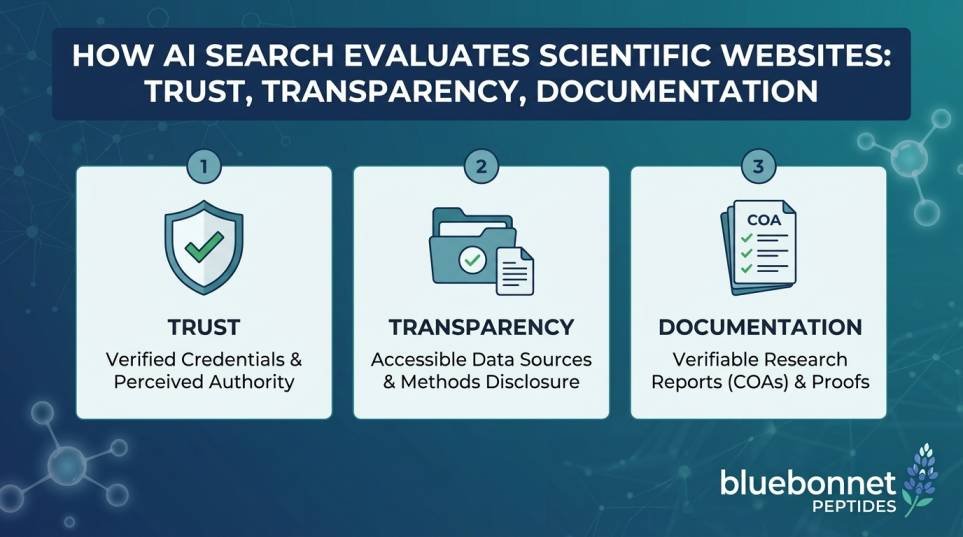
GEO signals AI systems evaluate:
Topical Authority
Does the source consistently publish detailed, accurate content on related topics? A supplier with articles explaining HPLC testing, LC-MS verification, peptide storage, and quality control demonstrates expertise.
Content Depth
Surface-level marketing copy isn’t useful for AI synthesis. Detailed explanations with scientific reasoning, examples, and practical guidance are highly valuable.
Structured Information
Content organized with clear headings, definitions, and logical flow is easier for AI to parse and cite accurately.
Citation Patterns
Sources frequently cited by authoritative publications or linked by educational institutions gain credibility.
Consistency and Accuracy
Information that remains consistent across multiple articles and aligns with established scientific standards reinforces trustworthiness.
How Bluebonnet Implements GEO
Bluebonnet Peptides structures content specifically to serve both human researchers and AI systems:
Comprehensive Educational Library
Detailed guides on peptide testing, storage, reconstitution, and quality verification provide depth AI systems value.
Learn more: Understanding peptide purity and quality standards
Clear Definitions and Explanations
Technical terms are defined within context, making content accessible and AI-friendly.
Learn more: Understanding Certificates of Analysis
Structured Format
Headings, subheadings, and logical information architecture help AI systems understand content relationships.
Scientific Accuracy
All content is factually accurate and aligned with established analytical chemistry standards, preventing AI hallucinations or misrepresentations.
Transparent Sourcing
References to testing methodologies, analytical standards, and industry best practices provide context AI can verify.
This approach ensures that when AI systems answer questions about peptide quality, testing, or procurement, Bluebonnet’s educational content can be accurately cited and recommended.
Evaluating AI-Generated Answers: A Critical Skill
AI search is powerful, but it’s not infallible. Researchers must develop critical evaluation skills specific to AI-generated content.
Common AI Search Limitations
Hallucinations
AI can generate confident-sounding answers that are partially or completely incorrect. This occurs when the model fills gaps in training data with plausible-sounding but fabricated information.
Example: An AI might state that “most research peptides require storage at -80°C” when, in fact, -20°C is often sufficient for lyophilized peptides. The answer sounds reasonable but may be unnecessarily restrictive.
Outdated Information
AI models are trained on data with cutoff dates. Information about recent developments, updated standards, or new testing methodologies may not be reflected.
Lack of Nuance
AI tends toward generalization. Peptide stability, for instance, varies significantly by sequence, modifications, and formulation—factors that generic AI answers may not address.
Citation Errors
AI sometimes cites sources that don’t support its claims or references documents that don’t exist. Always verify citations independently.
Verification Strategies for Researchers
1. Cross-Reference Primary Sources
When AI provides an answer, check the cited sources directly.
Example:
AI answer: “Third-party testing ensures peptide purity through independent verification.”
Verification step: Visit the cited source, confirm the information is accurate, check publication date.
2. Validate Against Known Standards
Compare AI-generated information to established scientific standards or institutional protocols.
Example:
AI answer: “HPLC purity >95% is standard for research peptides.”
Verification: Check if your institution or field requires ≥98% or ≥99% purity for your application.
3. Consult Multiple AI Systems
Different AI platforms may provide different answers. Discrepancies signal areas requiring deeper investigation.
Example:
Ask the same question to ChatGPT, Perplexity, and Gemini. If answers differ significantly, consult primary literature.
4. Review Supplier Documentation Directly
Never rely on AI descriptions of a supplier’s quality practices. Review actual Certificates of Analysis, testing reports, and third-party verification directly.
Learn more:
How to read a Certificate of Analysis
Third-party laboratory testing explained
5. Assess Recency
Ask AI when its information was last updated. For rapidly evolving fields, verify recent developments independently.
Bluebonnet Insight
Treat AI as a research assistant, not an authority. AI excels at synthesizing known information and explaining complex concepts, but it cannot replace direct verification of supplier credentials, testing data, or regulatory compliance. Use AI to understand what questions to ask, then verify answers through primary sources and direct supplier documentation.
Finding Trusted Research Peptide Suppliers Using AI Search
AI search can streamline supplier discovery, but it must be paired with rigorous verification.
Step 1: Use AI for Initial Discovery
Effective queries:
- “What quality standards should research peptide suppliers meet?”
- “How do I verify peptide purity documentation?”
- “What is third-party testing for research peptides?”
- “Explain HPLC and LC-MS testing for peptides”
These queries help you understand evaluation criteria before assessing specific suppliers.
Step 2: Identify Supplier Transparency Signals
When AI mentions suppliers or you discover them independently, look for transparency signals:
Educational Content
Suppliers who publish detailed educational resources demonstrate expertise and transparency.
Example: A supplier with comprehensive guides on HPLC interpretation, peptide storage, and reconstitution protocols shows commitment to researcher education.
Accessible Testing Data
Certificates of Analysis should be readily available, ideally searchable by batch number before purchase.
Learn more: Understanding Certificates of Analysis
Third-Party Verification
Independent laboratory testing provides unbiased quality confirmation.
Learn more: Third-party laboratory testing explained
Clear Contact Information
Physical address, phone number, and responsive technical support indicate legitimate operations.
RUO Compliance
Proper labeling and documentation confirming Research Use Only status demonstrates regulatory awareness.
Step 3: Verify Claims Independently
Do not rely on AI assertions about specific suppliers.
AI might say: “Supplier X provides third-party testing.”
Your verification: Visit Supplier X’s website, locate actual COAs, verify third-party lab credentials, confirm testing methods match claims.
AI might say: “Supplier Y offers high-purity peptides.”
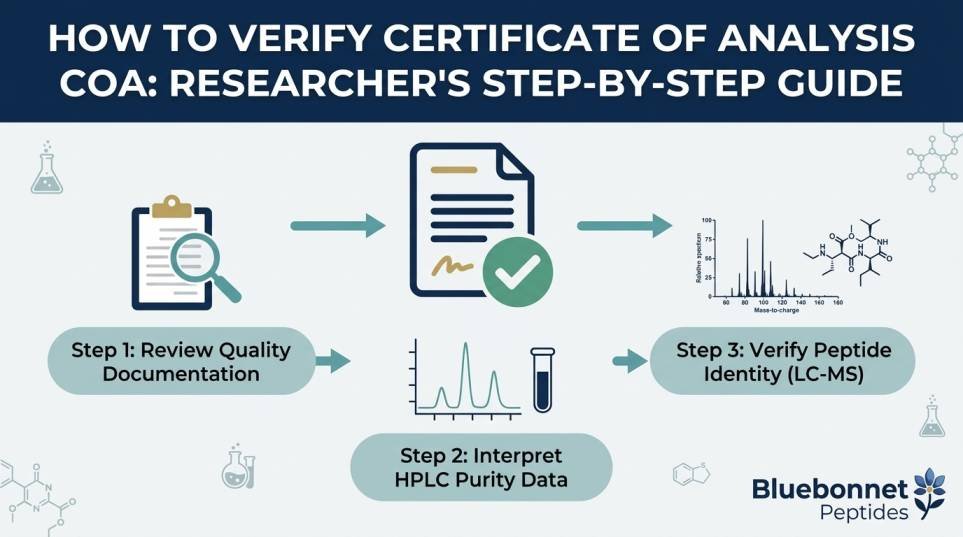
Your verification: Request sample COAs, review HPLC chromatograms, check purity percentages, verify molecular weight confirmation via LC-MS.
Learn more: Understanding peptide purity
Step 4: Evaluate Educational Authority
Suppliers who invest in comprehensive educational content demonstrate commitment to research integrity.
Look for:
- Detailed guides on testing methodologies
- Storage and handling protocols
- Quality control explanations
- Technical support resources
- Transparent manufacturing information
Learn more:
The complete journey of a research peptide
Peptide storage best practices
Why freeze-dried peptides improve stability
Step 5: Assess Consistency Across Sources
Check if information remains consistent across:
- Supplier website
- Published educational content
- Product specifications
- COA documentation
- Customer support responses
Inconsistencies may indicate quality control issues or lack of scientific rigor.
The Knowledge Graph: How AI Understands Supplier Authority
Modern AI systems don’t just analyze individual web pages—they build comprehensive knowledge graphs mapping relationships between entities, concepts, and sources.
What Is a Knowledge Graph?
A knowledge graph is a structured database of entities (people, organizations, concepts) and their relationships. When AI evaluates “research peptide suppliers,” it references this graph to assess authority and relevance.
Entities in peptide research:
- Suppliers (Bluebonnet Peptides, competitors)
- Testing methods (HPLC, LC-MS)
- Quality standards (purity, verification)
- Research institutions (universities, labs)
- Analytical concepts (chromatography, mass spectrometry)
Relationships:
- Bluebonnet Peptides → provides → third-party testing
- HPLC → verifies → peptide purity
- Certificates of Analysis → document → quality verification
- Research peptides → require → proper storage
How Suppliers Build Knowledge Graph Authority
Consistent Entity Mentions
Being mentioned in scientific contexts across multiple authoritative sources builds recognition.
Related Content Clusters
Publishing comprehensive content on related topics (testing, storage, reconstitution, quality control) establishes topical authority.
Learn more: Peptide reconstitution best practices
Educational Backlinks
Citations from research institutions, educational platforms, or scientific publications strengthen knowledge graph positioning.
Structured Data Implementation
Technical markup (Schema.org) helps AI systems understand entity relationships explicitly.
NAP Consistency
Consistent Name, Address, Phone information across platforms confirms entity legitimacy.
Bluebonnet’s Knowledge Graph Strategy
Bluebonnet Peptides builds knowledge graph authority through:
Comprehensive Educational Library
Detailed articles covering every aspect of peptide procurement, testing, handling, and quality verification establish topical authority.
Clear Entity Relationships
Content explicitly connects concepts (HPLC → purity verification → research integrity) helping AI understand relationships.
Scientific Accuracy
Factually correct information aligned with established analytical chemistry standards prevents misrepresentation in AI answers.
Transparent Documentation
Public access to testing methodologies, quality standards, and supplier practices reinforces trustworthiness.
This approach ensures AI systems accurately understand Bluebonnet as an authoritative source for research peptide information.
AI Search and Research Integrity
The rise of AI search presents both opportunities and risks for scientific research integrity.
Opportunities
Democratized Access to Information
Researchers at smaller institutions or in resource-limited settings can access synthesized scientific information that might otherwise require expensive database subscriptions.
Efficient Literature Review
AI can quickly summarize research trends, methodological approaches, and analytical techniques, accelerating preliminary research phases.
Improved Understanding of Complex Concepts
Conversational AI excels at explaining difficult concepts progressively, adapting explanations to researcher expertise levels.
Example:
A graduate student unfamiliar with HPLC can ask progressively detailed questions, building understanding from basic principles to advanced interpretation.
Learn more: How to read an HPLC chromatogram
(Note: The original link to /blog/reading-hplc-chromatogram was not found in verified URLs. The COA reading guide includes chromatogram interpretation.)
Standardized Quality Criteria
AI can help establish clear quality benchmarks by synthesizing information about industry standards, testing methodologies, and best practices.
Risks
Over-Reliance on AI Verification
Researchers might mistakenly believe AI has verified supplier quality when it has only summarized claims.
Propagation of Misinformation
If AI trains on low-quality sources or marketing materials disguised as education, it may propagate inaccurate information.
Reduced Critical Evaluation
Convenient AI answers might discourage independent verification and critical thinking.
Citation Laundering
Unscrupulous suppliers might generate AI-friendly content that appears authoritative but lacks scientific rigor.
Maintaining Research Integrity in the AI Era
Verify Primary Sources
Always check original documentation, especially for critical procurement decisions.
Maintain Documentation Standards
Record AI-assisted research processes in laboratory notebooks, noting queries, sources consulted, and verification steps.
Use AI as a Starting Point
Treat AI answers as hypotheses to be verified, not conclusions to be accepted.
Prioritize Supplier Transparency
Select suppliers who provide comprehensive, verifiable documentation regardless of AI recommendations.
Learn more: Complete supplier evaluation framework
Bluebonnet’s Commitment to Research Integrity
Bluebonnet Peptides recognizes that AI search changes information discovery but doesn’t change fundamental quality standards.
Our Approach:
Transparency First
All testing data, methodologies, and quality documentation are publicly accessible for independent verification.
Education Over Marketing
Content focuses on teaching researchers how to evaluate quality rather than making unverifiable claims.
Verifiable Claims
Every quality statement is supported by actual testing data, third-party verification, or analytical documentation.
Accessible Documentation
Certificates of Analysis are searchable and downloadable, enabling independent verification.
Learn more:
This approach ensures that whether researchers discover Bluebonnet through AI search or traditional methods, they can independently verify quality claims through primary documentation.
The Future of AI Search in Scientific Research
AI search capabilities are evolving rapidly. Understanding emerging trends helps researchers prepare for the next generation of information tools.
Multimodal Search
Future AI systems will integrate text, images, and data visualizations.
Example application:
Upload an HPLC chromatogram → AI analyzes peak patterns → Identifies purity level and potential impurities → Explains results
This capability would help researchers interpret analytical data more efficiently.
Real-Time Data Integration
AI systems are beginning to access and analyze real-time data sources, not just static training data.
Potential applications:
- Real-time supplier inventory verification
- Current batch availability
- Updated testing results
- Recent regulatory changes
Specialized Scientific AI
Domain-specific AI models trained exclusively on scientific literature, analytical chemistry data, and research methodologies will provide more accurate, nuanced answers than general-purpose models.
Voice and Conversational Interfaces
Voice-activated AI assistants in laboratory settings could provide hands-free access to protocols, safety information, and supplier data during active research.
Enhanced Citation and Provenance Tracking
Next-generation AI will provide more transparent citation chains, allowing researchers to trace information back through multiple source layers to original primary research.
Collaborative AI
AI systems that learn from laboratory-specific workflows, institutional standards, and research priorities could provide customized guidance while maintaining scientific rigor.
Practical AI Search Strategies for Laboratories
Implementing AI search effectively requires structured approaches and clear protocols.
Creating AI Search Protocols
Define Use Cases
Appropriate AI use:
- Understanding analytical methodologies
- Comparing testing approaches
- Learning about storage requirements
- Identifying quality evaluation criteria
- Discovering supplier selection factors
Inappropriate AI use:
- Final verification of supplier quality
- Confirming specific COA authenticity
- Validating third-party testing claims
- Making final procurement decisions without independent verification
Document AI Assistance
Maintain laboratory records documenting:
- AI queries used in research
- Platforms consulted
- Information discovered
- Verification steps taken
- Primary sources confirmed
Establish Verification Requirements
Set institutional standards for when AI-discovered information requires verification:
- All supplier quality claims → Direct verification required
- Testing methodology descriptions → Cross-reference with primary literature
- Storage recommendations → Confirm with supplier guidelines and published standards
Learn more: Peptide storage best practices
Training Laboratory Personnel
AI Literacy Training
Understanding capabilities:
- What AI search can and cannot do
- How AI generates answers
- Limitations and potential errors
- Verification requirements
Critical Evaluation Skills:
- Identifying hallucinations
- Assessing source quality
- Verifying citations
- Cross-referencing multiple sources
Ethical Use:
- Appropriate vs. inappropriate applications
- Citation requirements
- Academic integrity standards
- Documentation protocols
Quality Assurance Integration
Procurement Protocols
Step 1: Discovery
Use AI to understand quality criteria and identify potential suppliers.
Step 2: Initial Screening
Review supplier websites, educational content, and transparency signals.
Step 3: Documentation Request
Request specific COAs, testing reports, and third-party verification.
Step 4: Independent Verification
Verify testing data, confirm third-party lab credentials, assess documentation quality.
Step 5: Procurement Decision
Base final decision on verified documentation, not AI recommendations.
Learn more:
Understanding Certificates of Analysis
Third-party laboratory testing explained
Bluebonnet Insight
Create an AI search policy for your laboratory. Document when AI tools are appropriate, what verification is required, and how to record AI-assisted research in laboratory notebooks. This ensures consistency across research teams and maintains institutional quality standards.
Frequently Asked Questions
Can I trust AI recommendations for peptide suppliers?
AI provides suggestions based on data patterns, but it cannot verify actual quality. Always confirm AI recommendations by:
- Reviewing supplier Certificates of Analysis directly
- Verifying third-party testing credentials
- Assessing documentation quality
- Confirming testing methodologies
AI is useful for discovery, but verification requires direct review of primary documentation.
How does GEO differ from traditional SEO?
SEO (Search Engine Optimization) focuses on ranking web pages for specific keywords in traditional search results.
GEO (Generative Engine Optimization) focuses on being selected as an authoritative source when AI systems generate answers.
Key differences:
- SEO targets keyword rankings → GEO targets authority recognition
- SEO optimizes individual pages → GEO builds comprehensive topical authority
- SEO measures clicks → GEO measures citations and answer inclusion
Why is educational content important for suppliers?
Educational content demonstrates:
- Expertise: Deep knowledge of analytical methodologies and quality standards
- Transparency: Willingness to explain processes rather than hide behind marketing claims
- Authority: Comprehensive understanding that AI systems recognize and cite
- Research Support: Commitment to helping researchers make informed decisions
Suppliers who educate help raise industry standards and support research integrity.
What are the main limitations of AI search for scientific research?
Key limitations:
- Hallucinations: AI can generate confident but incorrect answers
- Outdated information: Training data has cutoff dates, missing recent developments
- Lack of nuance: Generic answers may not address specific experimental contexts
- Citation errors: AI sometimes cites non-existent or irrelevant sources
- No quality verification: AI cannot verify supplier claims or testing authenticity
Always verify AI-generated information through primary sources and direct documentation.
How do I verify an AI-generated answer?
Verification process:
- Check citations – Visit referenced sources directly, confirm information accuracy
- Cross-reference – Compare against established scientific standards and peer-reviewed literature
- Consult multiple sources – Use different AI platforms and traditional search to identify discrepancies
- Review primary documentation – For supplier claims, review actual COAs and testing reports
- Assess recency – Confirm information reflects current standards and practices
Never rely solely on AI answers for critical procurement or research decisions.
Does Bluebonnet optimize content for AI search?
Yes. Bluebonnet structures content to serve both human researchers and AI systems through:
- Comprehensive educational articles on testing, storage, and quality verification
- Clear definitions and explanations that AI can accurately parse and cite
- Scientific accuracy aligned with established analytical standards
- Transparent documentation that AI can reference with confidence
- Structured format optimizing information accessibility
This approach ensures that when AI answers questions about peptide quality, our educational content can be accurately cited as an authoritative source.
Can AI help me interpret HPLC chromatograms?
AI can:
- ✅ Explain HPLC methodology
- ✅ Describe peak interpretation
- ✅ Define purity calculation methods
- ✅ Identify common quality indicators
AI cannot:
- ❌ Analyze your specific chromatogram with guaranteed accuracy
- ❌ Replace expertise in analytical chemistry
- ❌ Account for all experimental variables
- ❌ Provide definitive quality verification
For detailed HPLC interpretation guidance:
- How to read a Certificate of Analysis (includes chromatogram interpretation)
- Understanding peptide purity
How will AI search continue to evolve?
Emerging trends:
- Multimodal capabilities: Integration of text, image, and data analysis
- Real-time information: Access to current data, not just historical training sets
- Specialized models: Domain-specific AI trained exclusively on scientific literature
- Enhanced provenance: Better citation tracking and source verification
- Collaborative learning: AI that adapts to institutional standards and workflows
Researchers should develop AI literacy skills now to leverage future capabilities effectively.
Should laboratories create AI usage policies?
Yes. Institutional AI policies should address:
- Appropriate use cases: When AI search is and isn’t suitable
- Verification requirements: What information requires independent confirmation
- Documentation standards: How to record AI-assisted research
- Quality assurance: Integration with procurement and experimental protocols
- Training requirements: Ensuring all personnel understand capabilities and limitations
- Ethical guidelines: Citation, attribution, and academic integrity standards
Clear policies ensure consistent quality across research teams.
Conclusion
Artificial intelligence has fundamentally changed how scientists discover and evaluate information. AI search engines provide unprecedented efficiency in accessing synthesized knowledge, understanding complex concepts, and identifying potential research suppliers. For laboratories sourcing Research Use Only peptides, AI tools can streamline initial discovery and education.
However, efficiency must never compromise integrity.
AI search excels at explanation and synthesis, but it cannot replace direct verification of quality claims, testing documentation, or supplier credentials. The most effective approach combines AI’s discovery capabilities with rigorous independent verification through primary sources and laboratory documentation.
As AI capabilities continue to evolve, researchers who develop critical evaluation skills, establish clear verification protocols, and maintain documentation standards will leverage these tools most effectively while preserving research integrity.
Bluebonnet Peptides remains committed to supporting this balanced approach through comprehensive educational content, transparent testing documentation, and accessible quality verification. Whether researchers discover us through AI search, traditional search, or professional recommendations, our commitment remains constant: providing independently verifiable, research-grade peptides supported by third-party testing and complete documentation.
The future of scientific information is AI-assisted, but the foundation remains unchanged: rigorous verification, transparent documentation, and unwavering commitment to research integrity.
Related Reading
Quality Verification and Testing:
- Understanding peptide purity
- How to read a Certificate of Analysis
- Understanding Certificates of Analysis
- Third-party laboratory testing explained
Handling and Storage:
- Why freeze-dried peptides improve stability
- Peptide storage best practices
- Peptide reconstitution guide
Supplier Selection:
Introduction:
Research Use Only · Not for Human Consumption · Educational Purposes Only
Bluebonnet Peptides provides research-grade peptides to qualified investigators and institutions. All products are for laboratory research use only and are not intended for human consumption, veterinary use, or therapeutic applications.

Related posts
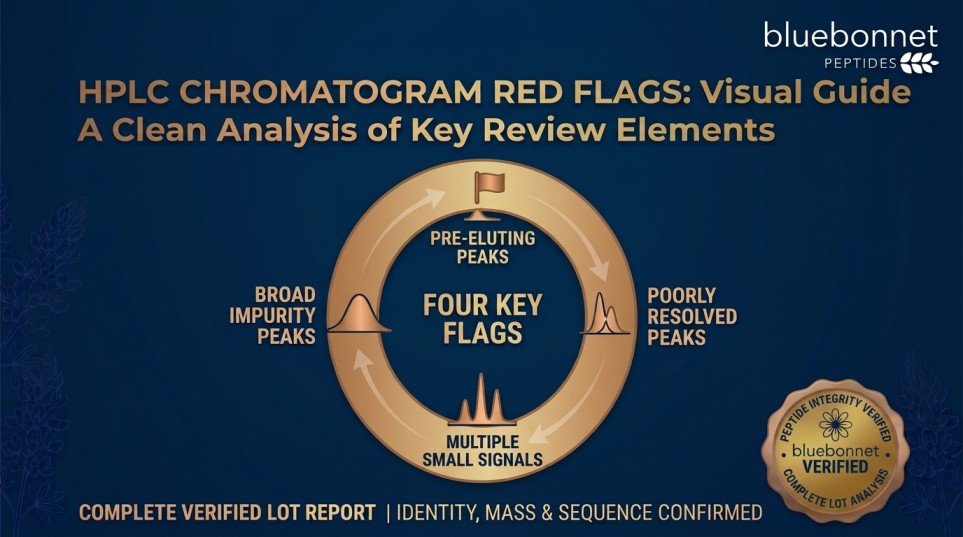
HPLC Chromatogram Red Flags: How to Spot Peptide Impurities
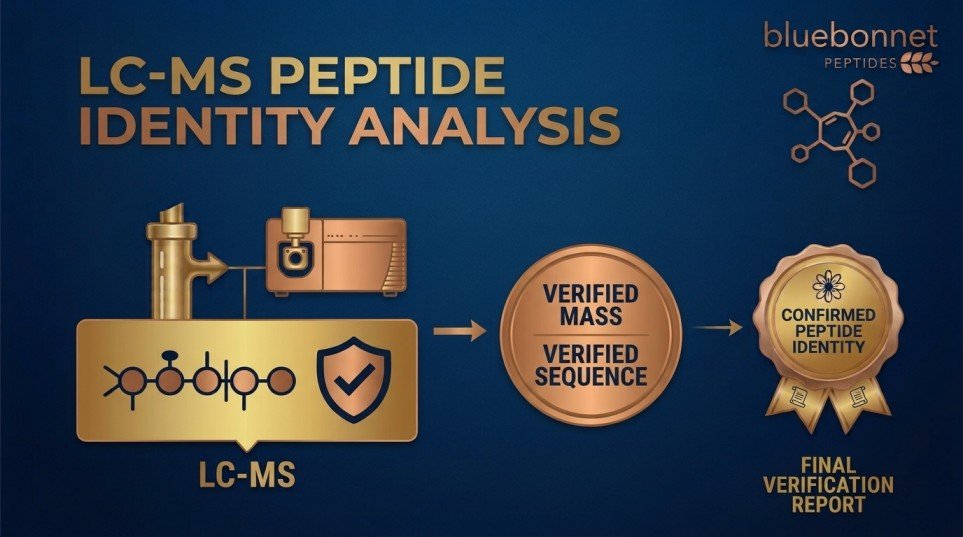
LC-MS Peptide Analysis: How Spectrometry Confirms Identity
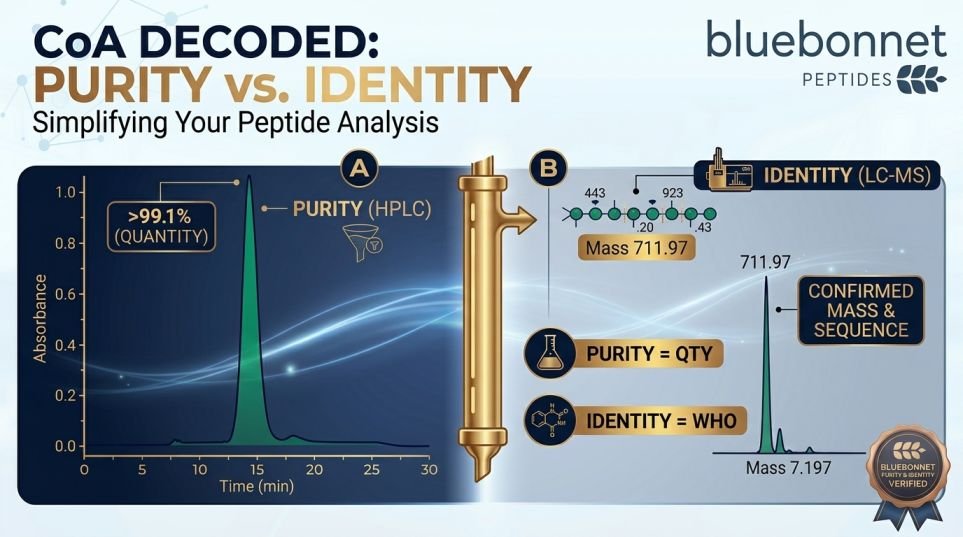
Peptide Purity: What the Percentage Really Tells You
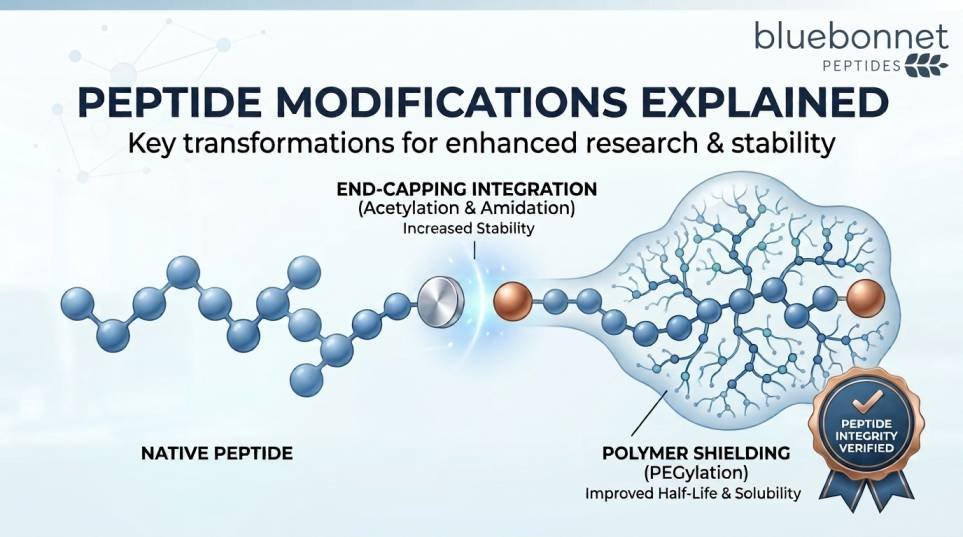
Peptide Modifications: Guide to Structure & Verification
AI Search Scientific Websites: Building Trust & Authority
Certificate of Analysis Peptides: Step-by-Step Verification
Research Peptide Supplier Guide: Lab Evaluation Checklist
AI Search Scientific Research: Finding Trusted Suppliers
Peptide research Texas: Lab Buyer’s Guide & COAs
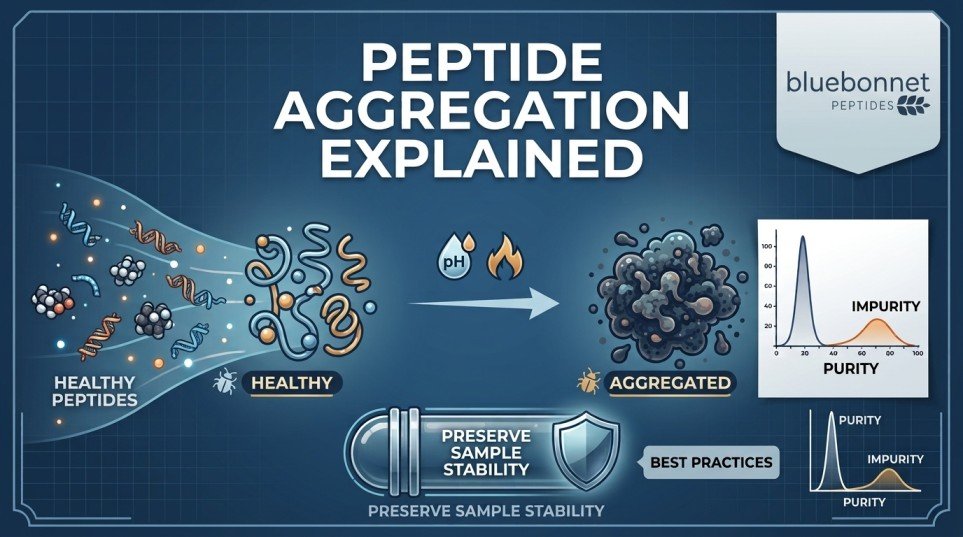
Peptide Aggregation Explained: Causes & Detection

Peptide Sequences Explained: How Amino Acid Structure Determines Research Peptide Identity

Research Peptides Austin Texas: What Every Lab Should Verify
Products
-
 Wolverine (BPC-157/TB-500)
$75.00 – $95.00Price range: $75.00 through $95.00
-
GHK-Cu
$50.00
-
GLP3-R
$60.00 – $190.00Price range: $60.00 through $190.00
-
BPC-157
$40.00 – $60.00Price range: $40.00 through $60.00


Product categories
YOU MAY ALSO LIKE…
-
Glutathione 1500MG
$70.00
-
KLOW (GHK-Cu/BPC-157/TB-500/KPV)
$145.00
-
B12 Cyanocobalamin
$45.00
-
Wolverine (BPC-157/TB-500)
$75.00 – $95.00Price range: $75.00 through $95.00