≥99% Purity
 Third-Party Tested
 COA Available
 U.S.-Based
 Research Use Only



Last updated: September 2026 | 12-minute read
You receive two vials from different suppliers. Both are labeled “BPC-157.” The labels look professional. The pricing is similar. But are you actually receiving the same peptide sequence?
The answer depends entirely on something most researchers don’t think to verify: the exact amino acid sequence.
A peptide’s sequence — the precise order of amino acids that compose it — is its molecular identity. It’s not just a detail. It’s the fundamental definition of what the peptide actually is. Two peptides with similar names but different sequences are chemically distinct compounds with different molecular weights, different analytical signatures, and potentially different research characteristics.
Yet sequence information is often missing from product descriptions, inadequately documented on Certificates of Analysis, or assumed rather than verified. This creates a critical gap between what researchers think they’re ordering and what they actually receive.
Understanding peptide sequences transforms how you evaluate research materials. Instead of relying on product names alone, you can verify molecular identity through sequence notation, calculate expected molecular weights, interpret analytical testing results, and recognize when documentation is incomplete or potentially inaccurate.
This comprehensive guide explains what peptide sequences are, how amino acid order determines molecular identity, how sequences are written and interpreted, why sequence affects analytical verification, and what documentation researchers should expect when procuring sequence-defined research peptides.
Whether you’re a principal investigator designing experiments, a graduate student learning research methods, or a laboratory manager implementing procurement standards, this article provides the foundation for understanding peptide identity at the molecular level — where precision matters most.
What Is a Peptide Sequence?
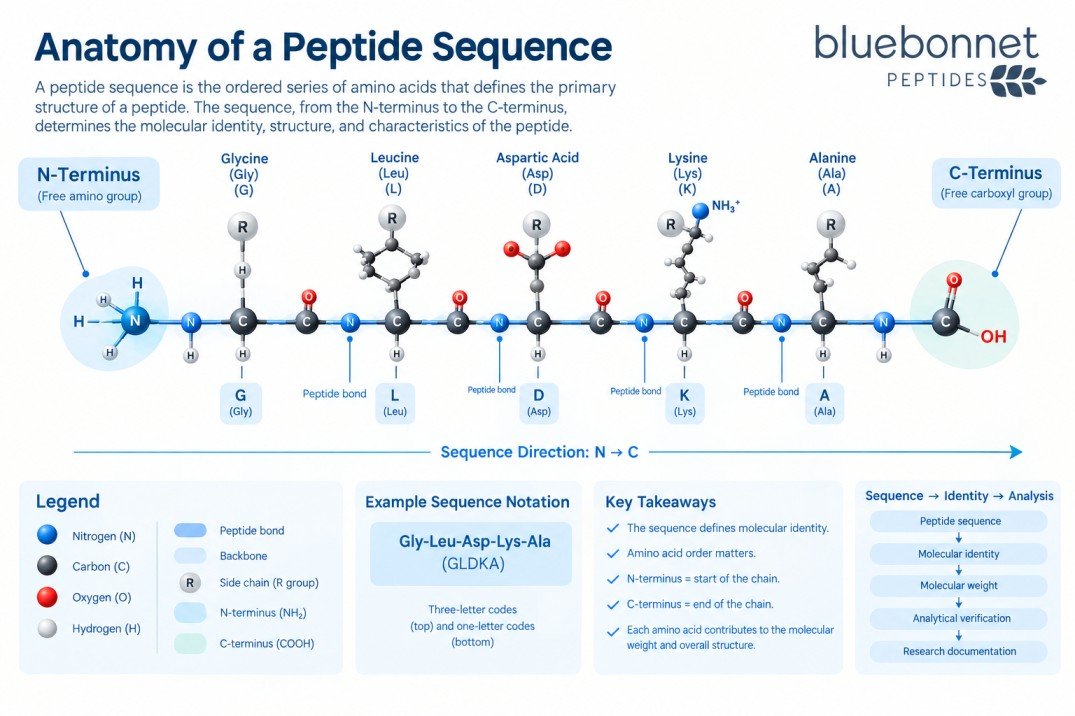
A peptide sequence is the ordered series of amino acids that defines the primary structure of a peptide.
The Building Blocks: Amino Acids
Peptides are chains of amino acids connected by peptide bonds.
Amino acids are organic molecules containing:
- An amino group (NH₂)
- A carboxyl group (COOH)
- A hydrogen atom
- A variable side chain (R group) that gives each amino acid its unique properties
The 20 standard amino acids differ in their side chains, which determine:
- Chemical properties (polar, nonpolar, charged)
- Size and structure
- Hydrophobicity or hydrophilicity
- Reactivity
- Biological characteristics
Examples:
- Glycine (Gly, G): Smallest amino acid, side chain is just hydrogen
- Leucine (Leu, L): Hydrophobic, branched side chain
- Aspartic acid (Asp, D): Negatively charged, acidic
- Lysine (Lys, K): Positively charged, basic
- Cysteine (Cys, C): Contains sulfur, can form disulfide bonds
Each amino acid contributes specific mass and chemical properties to the complete peptide.
Peptide Bonds: Linking Amino Acids
Peptide bonds connect amino acids into chains.
Formation: A peptide bond forms when the carboxyl group of one amino acid reacts with the amino group of another amino acid, releasing a water molecule (condensation reaction).
Result: A covalent bond linking the carbon of one amino acid to the nitrogen of the next, creating the peptide backbone.
Characteristics:
- Stable covalent linkage
- Partial double-bond character (restricts rotation)
- Creates planar structure at each bond
- Directional (N-terminus to C-terminus)
The sequence of peptide bonds creates the linear polymer we call a peptide.
Directionality: N-Terminus and C-Terminus
Peptide chains have direction.
N-Terminus (Amino Terminus):
- The beginning of the peptide chain
- Contains a free amino group (NH₂ or NH₃⁺)
- By convention, sequences are written starting from the N-terminus
- Corresponds to the first amino acid synthesized
C-Terminus (Carboxyl Terminus):
- The end of the peptide chain
- Contains a free carboxyl group (COOH or COO⁻)
- By convention, sequences are written ending at the C-terminus
- Corresponds to the last amino acid added during synthesis
Why directionality matters: The sequence Gly-Leu-Asp is chemically different from Asp-Leu-Gly, even though both contain the same amino acids. Order determines structure, which determines molecular identity.
Analogy: Just as “CAT” and “TAC” are different words despite containing the same letters, peptide sequences with different amino acid orders are different molecules despite containing the same amino acids.
Sequence Notation: How Sequences Are Written
Peptides are written using standardized amino acid codes.
Three-Letter Code: Each amino acid has a three-letter abbreviation.
Example: Gly-Glu-Pro-Pro-Pro-Gly-Lys-Pro-Ala-Asp-Asp-Ala-Gly-Leu-Val
One-Letter Code: Each amino acid has a single-letter abbreviation (more compact).
Same sequence in one-letter code: GEPPPGKPADDAGLV
Standard conventions:
- Sequences are written N-terminus to C-terminus (left to right)
- Three-letter codes are separated by hyphens
- One-letter codes are written continuously without spaces
- Modifications may be indicated with additional notation
Why standardization matters: Consistent notation allows researchers globally to identify and verify exact peptide structures. The sequence is the universal molecular identifier — independent of trade names, product numbers, or supplier-specific terminology.
Related Reading:
Why Amino Acid Order Matters
The sequence determines everything about a peptide’s molecular identity.
Sequence Defines Molecular Weight
Each amino acid contributes specific molecular mass.
Calculating molecular weight from sequence:
- Step 1: Sum the molecular weights of all amino acids in the sequence
- Step 2: Subtract water molecules lost during peptide bond formation (Number of peptide bonds = Number of amino acids – 1)
- Step 3: The result is the theoretical molecular weight
Example: Simple tripeptide Gly-Leu-Asp
Amino acid molecular weights:
- Glycine: 75.07 Da
- Leucine: 131.17 Da
- Aspartic acid: 133.10 Da
- Sum: 339.34 Da
- Peptide bonds formed: 2 (connecting 3 amino acids)
- Water molecules released: 2 × 18.01 Da = 36.02 Da
- Peptide molecular weight: 339.34 – 36.02 = 303.32 Da
Why this matters: The theoretical molecular weight calculated from sequence can be compared to observed molecular weight from LC-MS analysis. This comparison confirms whether the peptide you received matches the expected sequence.
Sequence Changes Create Different Compounds
Changing even one amino acid creates a molecularly distinct peptide.
Example comparison:
- Peptide A: Gly-Leu-Asp-Lys-Ala
- Peptide B: Gly-Leu-Asp-Arg-Ala
Only one amino acid differs (Lys vs. Arg at position 4), but:
- Molecular weight differs
- Chemical properties differ (side chain structure different)
- Hydrophobicity differs
- Charge characteristics differ
- Analytical behavior differs
These are not interchangeable compounds.
If your research protocol requires Peptide A and you receive Peptide B, you’re not working with the intended material — even if the difference seems minor.
Deletion Sequences and Truncations
Synthesis errors can create incomplete sequences.
Deletion sequence: A peptide missing one or more amino acids from the intended sequence, typically due to synthesis coupling failures.
Example:
- Intended sequence: Gly-Glu-Pro-Pro-Pro-Gly-Lys-Pro-Ala-Asp-Asp-Ala-Gly-Leu-Val
- Deletion sequence: Gly-Glu-Pro-Pro-[missing Pro]-Gly-Lys-Pro-Ala-Asp-Asp-Ala-Gly-Leu-Val
The deletion sequence:
- Has different molecular weight
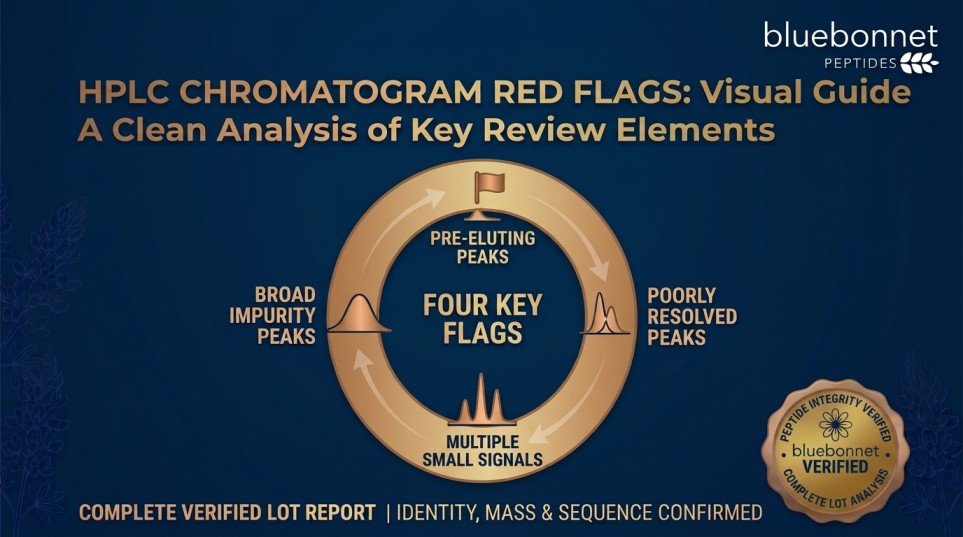
- Appears as impurity peak on HPLC
- May have different properties
- Is not the target peptide
Why this appears in documentation: High-quality HPLC analysis reveals deletion sequences as separate peaks (impurities). The purity percentage indicates how much of the material is the correct full-length sequence versus deletion sequences and other impurities.
Substitutions Change Identity
Amino acid substitutions create different peptides.
Substitution: An incorrect amino acid incorporated at a specific position during synthesis.
Example:
- Intended: Ala-Lys-Gly-Pro-Asp
- Substitution error: Ala-Arg-Gly-Pro-Asp
The substitution of arginine for lysine changes:
- Molecular weight
- Side chain structure
- Chemical properties
- The fundamental identity of the peptide
Detection: LC-MS reveals molecular weight discrepancy. If observed molecular weight doesn’t match calculated weight from intended sequence, substitution, deletion, or other structural error is likely.
Sequence Affects Analytical Behavior
Different sequences behave differently in analytical methods.
HPLC retention time: Peptide hydrophobicity (influenced by amino acid composition and order) affects how strongly the peptide interacts with the reverse-phase column, determining retention time.
Example:
- Peptides rich in hydrophobic amino acids (Leu, Ile, Val, Phe) elute later
- Peptides rich in polar amino acids (Ser, Thr, Asn, Gln) elute earlier
- Charged amino acids (Asp, Glu, Lys, Arg) affect retention based on ionization state
LC-MS ionization: Sequence composition affects how efficiently peptides ionize in mass spectrometry.
Factors:
- Basic amino acids (Lys, Arg, His) promote positive ionization
- Acidic amino acids (Asp, Glu) can complicate positive-mode ionization
- Sequence length affects charge state distribution
Implication: Analytical data interpretation requires knowing the expected sequence. Without sequence information, you cannot verify whether analytical results match expectations.
How Sequence Relates to Molecular Weight Verification
Understanding the sequence-to-molecular-weight relationship enables verification of peptide identity.
Calculating Expected Molecular Weight
Researchers can calculate theoretical molecular weight from sequence.
Resources:
- Online peptide property calculators
- Molecular weight databases
- Manual calculation using amino acid mass tables
Process:
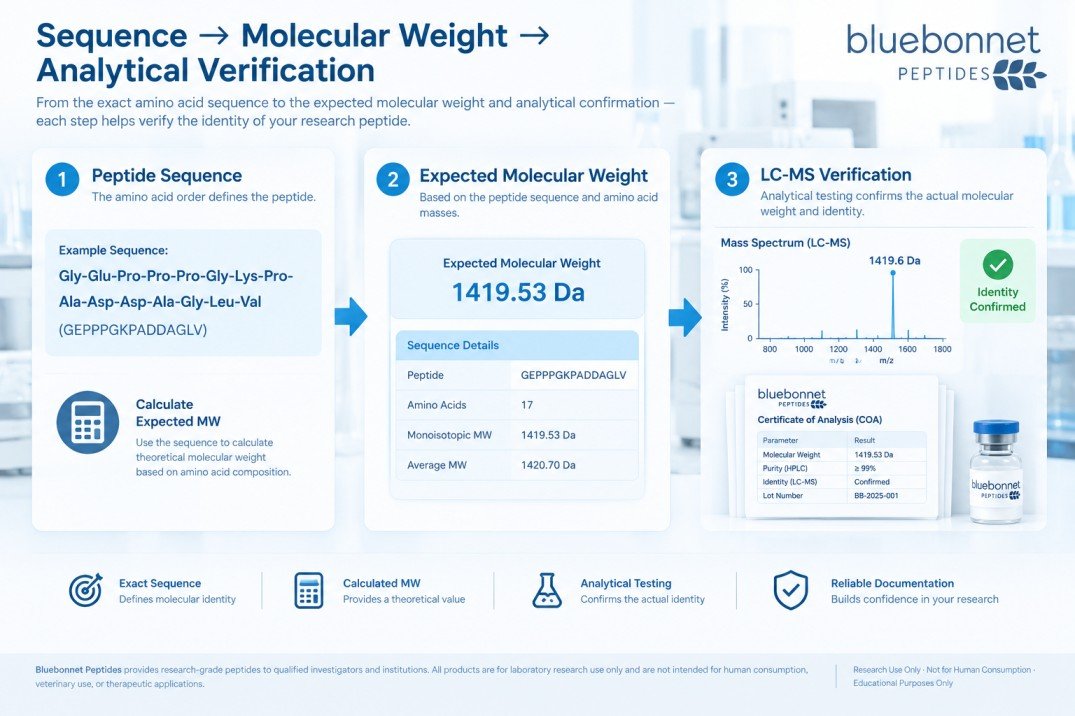
- Step 1: Identify complete sequence — Example: BPC-157 sequence (15 amino acids): Gly-Glu-Pro-Pro-Pro-Gly-Lys-Pro-Ala-Asp-Asp-Ala-Gly-Leu-Val
- Step 2: Sum amino acid molecular weights
- Step 3: Subtract water for peptide bond formation (14 peptide bonds for 15 amino acids = 14 × 18.01 Da)
- Step 4: Result is theoretical monoisotopic molecular weight
For BPC-157: Calculated molecular weight ≈ 1419.53 Da
Comparing Calculated vs. Observed Molecular Weight
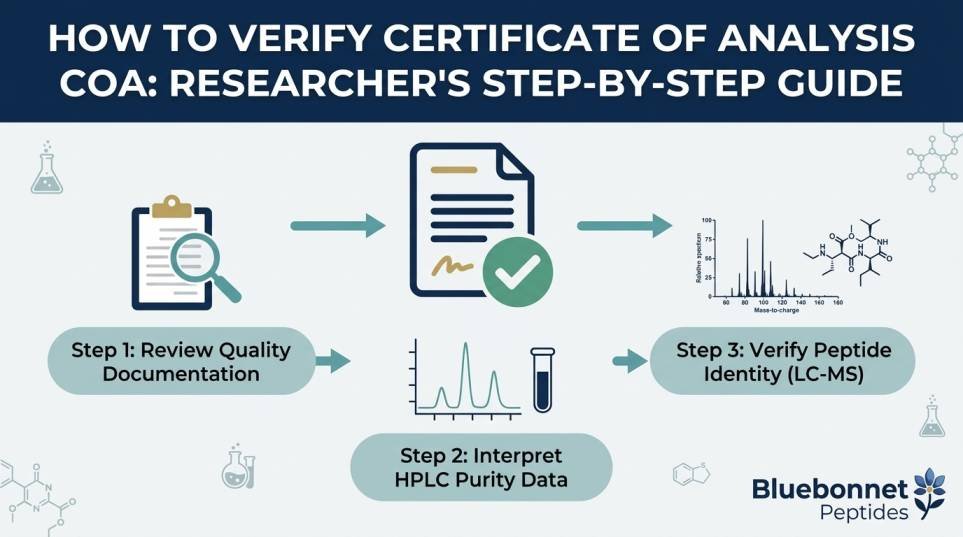
LC-MS provides observed molecular weight.
Verification:
If observed molecular weight matches calculated weight within acceptable tolerance (±0.5-1 Da for peptides <2000 Da):
- ✅ Identity confirmed — the peptide likely matches the intended sequence
If observed molecular weight differs significantly:
- ⚠️ Identity questionable — peptide may have:
- Deletion sequence (lower molecular weight)
- Substitution error
- Unexpected modification
- Wrong peptide entirely
Example verification:
- Peptide: BPC-157
- Calculated MW: 1419.53 Da
- Observed MW (LC-MS): 1419.6 Da
- Difference: 0.07 Da
- Conclusion: ✅ Molecular weight confirms identity consistent with expected sequence
Example discrepancy:
- Peptide: Claimed as “Peptide X”
- Calculated MW (from stated sequence): 1856.2 Da
- Observed MW (LC-MS): 1743.8 Da
- Difference: 112.4 Da
- Conclusion: ⚠️ Significant discrepancy suggests wrong sequence, deletion, or mislabeling
Why Sequence Information Must Accompany Documentation
Molecular weight verification requires knowing the expected sequence.
Without sequence information:
- You cannot calculate expected molecular weight
- You cannot interpret LC-MS data meaningfully
- You cannot verify whether the material matches the description
- You rely entirely on supplier labeling without independent confirmation
With sequence information:
- You can independently calculate expected molecular weight
- You can verify LC-MS results against expectations
- You can identify discrepancies suggesting quality or labeling issues
- You have molecular-level verification of identity
Best practice: Request or verify sequence information for all sequence-defined research peptides. Compare calculated molecular weight to COA LC-MS data. This provides independent identity confirmation beyond product labeling.
Related Reading:
Sequence Notation in Research Documentation
Proper documentation includes complete sequence information in standardized notation.
What Quality Documentation Should Include
For sequence-defined peptides, documentation should provide:
Complete sequence:
- Full amino acid sequence in three-letter or one-letter code
- N-terminus to C-terminus notation
- Any modifications clearly indicated
Molecular weight:
- Calculated theoretical molecular weight
- Observed molecular weight from LC-MS
- Acceptable tolerance noted
Sequence-specific information:
- Sequence length (number of amino acids)
- Any unusual amino acids or modifications
- Disulfide bonds if applicable
Example of complete documentation:
- Product: BPC-157
- Sequence: Gly-Glu-Pro-Pro-Pro-Gly-Lys-Pro-Ala-Asp-Asp-Ala-Gly-Leu-Val
- One-letter code: GEPPPGKPADDAGLV
- Length: 15 amino acids
- Calculated MW: 1419.53 Da
- Observed MW (LC-MS): 1419.6 Da
- Purity (HPLC): 99.1%
- Batch: BB-BPC157-2025-04
This complete documentation enables verification at every level.
Common Documentation Deficiencies
Inadequate sequence documentation:
Missing sequence entirely:
- Product labeled with name only, no sequence provided
- Risk: No way to verify molecular identity independently
Vague sequence description:
- “Proprietary sequence” or “Modified sequence” without details
- Risk: Cannot verify identity or calculate expected molecular weight
Incorrect notation:
- Sequence written C-terminus to N-terminus (backwards), or using non-standard abbreviations
- Risk: Confusion, potential for misinterpretation
Sequence doesn’t match molecular weight:
- Sequence provided, but LC-MS molecular weight inconsistent with that sequence
- Risk: Indicates possible mislabeling, documentation error, or quality issue
Red Flags in Sequence Documentation
Warning signs suggesting inadequate documentation or potential issues:
No sequence provided for sequence-defined peptide: If a peptide is defined by its sequence (as most research peptides are), that sequence should be documented.
Molecular weight doesn’t match claimed sequence: Calculate expected molecular weight from provided sequence. If LC-MS shows significantly different value, question identity.
Sequence changes between batches: If different batches show different sequences, either synthesis is inconsistent (major quality issue) or documentation is unreliable.
Generic “peptide” without identification: Products labeled vaguely without specific molecular identification.
Contradictory information: Product name suggests one sequence, but documentation indicates different composition.
Response to red flags: Contact supplier for clarification. Request complete sequence and analytical data. If supplier cannot or will not provide sequence information for a sequence-defined peptide, consider this a critical documentation deficiency.
Bluebonnet Insight
Sequence information is not proprietary — it’s fundamental molecular identity. For sequence-defined peptides, the sequence is the definition of what the compound is. Suppliers unwilling to provide sequence information are essentially asking researchers to accept unidentified materials. This is scientifically unacceptable.
Quality suppliers provide complete sequence notation alongside analytical data, enabling researchers to independently verify molecular identity through calculated versus observed molecular weights. This transparency separates research-grade suppliers from those offering inadequately characterized materials.
When evaluating suppliers, assess whether sequence information is:
- Provided clearly and completely
- Consistent with analytical data (LC-MS molecular weight)
- Documented in standardized notation
- Available before purchase, not after
Sequence transparency is identity transparency. Research integrity requires both.
Practical Example: Sequence Determines Identity
Understanding sequence principles through concrete example clarifies why sequence matters.
Hypothetical Educational Example
Consider two similar but distinct peptide sequences:
Peptide A:
- Sequence: Ala-Gly-Leu-Asp-Lys
- Length: 5 amino acids
Peptide B:
- Sequence: Ala-Gly-Leu-Asp-Arg
- Length: 5 amino acids (only position 5 differs)
Calculating Molecular Weight Differences
Peptide A (with Lysine at position 5):
Molecular weights:
- Alanine (Ala): 89.09 Da
- Glycine (Gly): 75.07 Da
- Leucine (Leu): 131.17 Da
- Aspartic acid (Asp): 133.10 Da
- Lysine (Lys): 146.19 Da
- Total: 574.62 Da
- Minus 4 water molecules (4 peptide bonds): 574.62 – 72.04 = 502.58 Da
Peptide B (with Arginine at position 5):
Molecular weights:
- Alanine (Ala): 89.09 Da
- Glycine (Gly): 75.07 Da
- Leucine (Leu): 131.17 Da
- Aspartic acid (Asp): 133.10 Da
- Arginine (Arg): 174.20 Da
- Total: 602.63 Da
- Minus 4 water molecules: 602.63 – 72.04 = 530.59 Da
Molecular Weight Difference
- Peptide A: 502.58 Da
- Peptide B: 530.59 Da
- Difference: 28.01 Da
This 28 Da difference corresponds to the mass difference between arginine and lysine side chains. LC-MS would clearly distinguish these peptides.
Implications for Research
If your protocol requires Peptide A (with Lys): And you receive Peptide B (with Arg), you have:
- Different molecular composition
- Different chemical properties (Arg has guanidinium group, Lys has primary amine)
- Different charge characteristics at physiological pH
- Potentially different research behavior
The peptides are not interchangeable simply because they’re similar.
Analytical Verification
LC-MS analysis would show:
- For Peptide A: Expected m/z peaks around 503.6 [M+H]⁺ (singly charged)
- For Peptide B: Expected m/z peaks around 531.6 [M+H]⁺ (singly charged)
This clear 28 Da difference enables definitive identification of which peptide you received.
Without sequence information and molecular weight verification: You might assume both are “the same” based on similar names or descriptions. Analytical testing combined with sequence knowledge prevents this error.
Educational Takeaway
Even single amino acid differences create molecularly distinct compounds. Sequence information combined with analytical verification (LC-MS) enables researchers to confirm they’re working with the intended material at the molecular level.
This is why documentation must include:
- Complete sequence
- Calculated molecular weight
- Observed molecular weight from LC-MS
- Confirmation these values match within acceptable tolerance
Related Reading:
Sequence Information in Procurement
Incorporating sequence verification into procurement processes improves quality assurance.
Questions to Ask Suppliers
When procuring sequence-defined peptides:
Is the complete amino acid sequence available?
- Expect: Yes, provided in three-letter or one-letter code
- Red flag: “Proprietary,” “Not disclosed,” vague descriptions
What is the calculated molecular weight from that sequence?
- Expect: Specific value based on sequence
- Red flag: No molecular weight provided, or value that doesn’t match sequence
Does the LC-MS observed molecular weight match the calculated value?
- Expect: Match within ±0.5-1 Da for peptides <2000 Da
- Red flag: Significant discrepancy without explanation
Is sequence information included on the Certificate of Analysis?
- Expect: Yes, for batch-specific documentation
- Red flag: COA lacks sequence information
Are there any modifications to the base sequence?
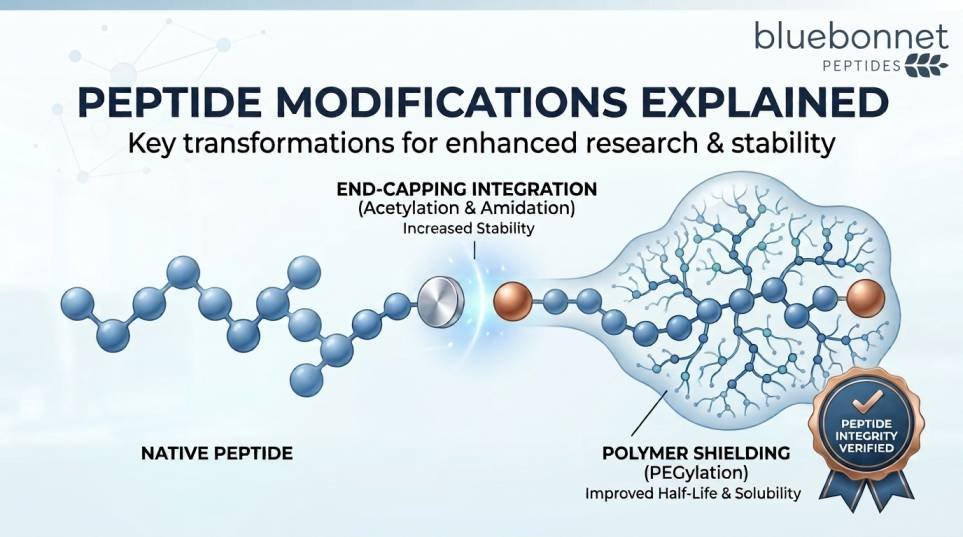
- Expect: Clear disclosure of acetylation, amidation, or other modifications
- Red flag: Vague “modified sequence” without specifics
How is sequence verified during manufacturing?
- Expect: LC-MS confirmation of molecular weight consistency with expected sequence
- Red flag: No molecular weight verification, reliance on synthesis protocol alone
Evaluating Sequence Documentation
When reviewing supplier documentation:
Check for completeness:
- ☐ Full sequence provided in standard notation
- ☐ Sequence length stated
- ☐ Calculated molecular weight from sequence
- ☐ Observed molecular weight from LC-MS
- ☐ Values match within acceptable range
- ☐ Any modifications clearly indicated
Verify consistency:
- ☐ Sequence matches product description
- ☐ Molecular weight matches sequence
- ☐ Batch-specific data (not generic)
- ☐ Same sequence across multiple batches (consistency)
Assess transparency:
- ☐ Information readily available (not hidden)
- ☐ Supplier willing to discuss sequence verification
- ☐ Documentation professional and complete
Suppliers providing complete, transparent sequence documentation demonstrate commitment to research-grade quality and researcher needs.
Laboratory Best Practice: Sequence Verification Protocol
Implement systematic sequence verification:
Upon receipt of sequence-defined peptide:
Step 1: Obtain documentation — Request or locate Certificate of Analysis and product specification sheet
Step 2: Identify sequence — Locate complete amino acid sequence in documentation
Step 3: Verify molecular weight calculation — Use online peptide calculator or manual calculation to confirm expected molecular weight from sequence
Step 4: Compare to LC-MS data — Review COA LC-MS section for observed molecular weight. Verify match with calculated value (within ±0.5-1 Da tolerance)
Step 5: Document verification — Record in laboratory records:
- Batch number
- Sequence
- Calculated MW
- Observed MW (from COA)
- Verification status (✅ Match confirmed or ⚠️ Discrepancy noted)
Step 6: Address discrepancies — If molecular weight doesn’t match sequence:
- Contact supplier for explanation
- Request clarification or replacement
- Quarantine material until resolved
This systematic approach:
- Confirms molecular identity before experimental use
- Creates documentation trail for research integrity
- Identifies quality or labeling issues early
- Supports reproducibility through verified materials
Related Reading:
Common Misconceptions About Peptide Sequences
Clarifying common misunderstandings improves sequence literacy.
Misconception 1: “Product Name = Molecular Identity”
Misunderstanding: If the product is labeled with a specific name, that’s sufficient identification.
Reality: Product names are labels, not molecular definitions. The sequence is the molecular identity.
Why this matters: Different suppliers may use the same product name for slightly different sequences, or use different names for the same sequence. Only sequence verification provides definitive identification.
Example: Multiple suppliers sell “BPC-157,” but without sequence verification, you cannot confirm all are identical. Sequence documentation eliminates ambiguity.
Misconception 2: “Close Enough Is Good Enough”
Misunderstanding: If a peptide is “similar” to the intended sequence (differs by one amino acid), it’s essentially the same.
Reality: Single amino acid differences create molecularly distinct compounds with different properties.
Why this matters: Research reproducibility requires using the same compound. “Similar” sequences are different compounds producing potentially different results.
Misconception 3: “Purity Percentage Confirms Identity”
Misunderstanding: If HPLC shows 99% purity, the peptide must be correct.
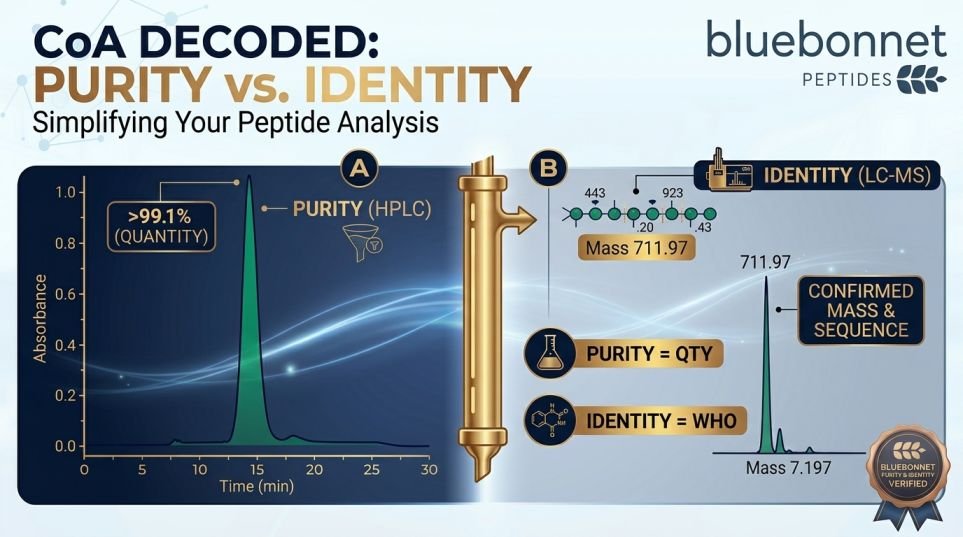
Reality: HPLC purity indicates how much of the material is the main compound versus impurities. It doesn’t confirm which compound the main peak represents.
Why this matters: You could have 99% pure wrong peptide. Purity and identity are separate verifications requiring different analytical methods (HPLC for purity, LC-MS for identity via molecular weight).
Misconception 4: “Sequence Doesn’t Affect Handling”
Misunderstanding: All peptides are stored and handled the same way regardless of sequence.
Reality: Sequence affects stability characteristics. Certain amino acids (Met, Cys, Trp) are more susceptible to oxidation. Sequence composition influences aggregation tendency, solubility, and degradation pathways.
Why this matters: Optimal storage and handling may vary based on sequence characteristics. Understanding sequence informs best practices for maintaining quality.
Related Reading:
Misconception 5: “Sequence Information Is Proprietary”
Misunderstanding: Sequences are trade secrets that suppliers shouldn’t disclose.
Reality: For sequence-defined peptides, the sequence is the fundamental molecular identity, not proprietary information. Withholding sequence information means withholding basic identification of what the material is.
Why this matters: Research requires knowing exactly what compounds you’re working with. Sequence opacity prevents this fundamental requirement and suggests inadequate quality standards.
Frequently Asked Questions
Q: What is a peptide sequence?
A: A peptide sequence is the ordered series of amino acids that compose a peptide, written from the N-terminus (beginning) to the C-terminus (end). The sequence defines the peptide’s molecular identity, structure, and properties. It’s typically written using either three-letter amino acid codes (Gly-Leu-Asp) or one-letter codes (GLD). The sequence is the fundamental definition of what the peptide chemically is — changing even one amino acid creates a molecularly different compound.
A: Amino acid order matters because it determines the peptide’s molecular weight, chemical properties, structure, and analytical behavior. The sequence Gly-Leu-Asp is chemically different from Asp-Leu-Gly even though both contain the same amino acids, just as “CAT” and “TAC” are different words. The specific order affects how the peptide folds, interacts with other molecules, behaves in analytical testing, and functions in research applications. Two peptides with different sequences are different compounds with different identities.
A: The N-terminus is the beginning of the peptide chain, containing a free amino group (NH₂ or NH₃⁺). By convention, peptide sequences are written starting from the N-terminus and proceeding toward the C-terminus (left to right). The N-terminus corresponds to the first amino acid synthesized during solid-phase peptide synthesis. Understanding N-terminus versus C-terminus is essential because peptide direction matters — sequences written backward represent different molecules than the intended structure.
A: The C-terminus is the end of the peptide chain, containing a free carboxyl group (COOH or COO⁻). By convention, sequences end at the C-terminus. During peptide synthesis, the C-terminus is typically the amino acid attached to the solid support first, with subsequent amino acids added sequentially toward the N-terminus. The C-terminus may be modified (amidated, for example) in some peptides, which affects molecular weight and should be clearly documented.
A: Each amino acid in the sequence contributes specific molecular mass. The peptide’s total molecular weight is calculated by summing the molecular weights of all amino acids and subtracting the mass of water molecules released during peptide bond formation (one water molecule per bond). Changing the sequence — adding, deleting, or substituting amino acids — changes the molecular weight. This relationship enables identity verification: if the observed molecular weight from LC-MS matches the calculated weight from the stated sequence, identity is confirmed.
A: Yes, absolutely. Product names are marketing labels, not chemical definitions. Different suppliers might use similar or identical names for peptides with slightly different sequences, modifications, or structures. Additionally, the same chemical sequence might be sold under different product names by different suppliers. This is why relying on product names alone is insufficient — researchers must verify the actual amino acid sequence and confirm it through analytical testing (molecular weight verification via LC-MS) rather than assuming the name accurately describes the molecular identity.
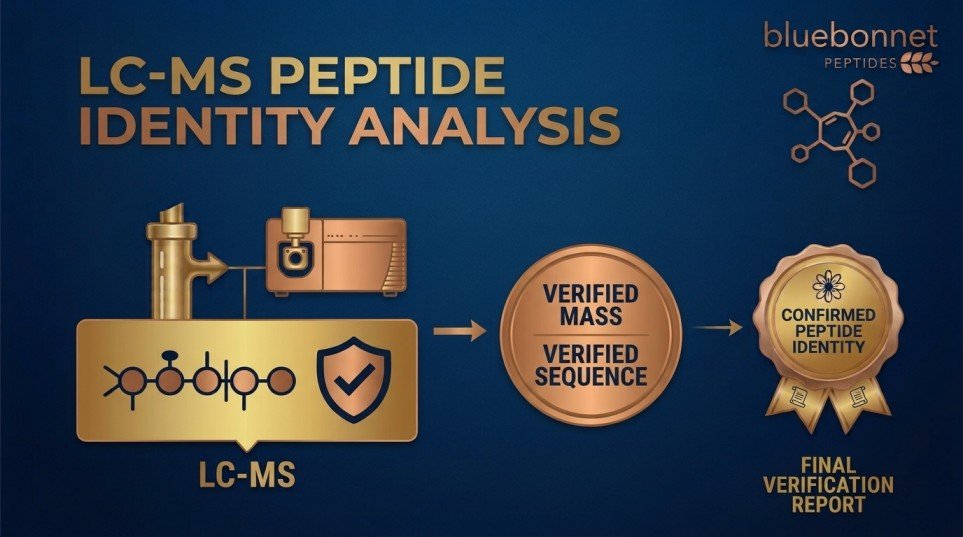
A: LC-MS (Liquid Chromatography-Mass Spectrometry) measures the peptide’s molecular weight. By calculating the expected molecular weight from the stated amino acid sequence and comparing it to the observed molecular weight from LC-MS analysis, researchers can verify whether the peptide matches the intended structure. If observed and calculated molecular weights match within acceptable tolerance (typically ±0.5-1 Da for peptides under 2000 Da), this confirms the sequence is correct. Significant discrepancies indicate potential sequence errors, deletions, substitutions, or mislabeling. LC-MS provides independent identity verification beyond supplier labeling.
A: Reviewing sequence information enables researchers to:
1. Verify molecular identity by calculating expected molecular weight and comparing to analytical data
2. Confirm they’re ordering the intended compound rather than relying solely on product names
3. Assess documentation quality — suppliers providing complete sequence information demonstrate transparency
4. Plan appropriate handling and storage based on sequence characteristics (presence of oxidation-prone amino acids, for example)
5. Enable reproducibility by documenting exact molecular structures in research protocols
6. Identify potential issues like sequence discrepancies or incomplete documentation before purchase
Sequence verification is fundamental quality assurance that protects research integrity and experimental reproducibility.
Final Thoughts
Peptide sequences are not technical details buried in documentation — they are the fundamental molecular definitions of what peptides are. Understanding sequences transforms peptide procurement from accepting supplier labels at face value to verifying molecular identity through documented chemistry.
The sequence tells you everything essential: which amino acids compose the peptide, in what order, with what directionality, creating what molecular weight and chemical properties. This information enables independent verification that the material you receive matches the material you intended to order.
Key principles for sequence literacy in research settings:
- Sequences define identity. Product names are labels; sequences are molecular definitions. Always verify sequence information rather than relying on names alone.
- Order matters absolutely. Changing amino acid sequence — even by a single position — creates a different compound with different molecular weight and properties. “Close” sequences are different molecules.
- Documentation should include complete sequences. Quality suppliers provide full amino acid sequences in standardized notation alongside analytical data. This transparency enables verification.
- Calculated versus observed molecular weight confirms identity. Compare the theoretical molecular weight from the stated sequence to the observed molecular weight from LC-MS. Matching values confirm identity; discrepancies indicate potential issues.
- Sequence affects everything. From molecular weight to analytical behavior to stability characteristics, sequence influences all aspects of how peptides behave and how they should be handled.
- Verification protects research integrity. Systematic sequence verification through documentation review and molecular weight comparison creates quality assurance that prevents working with incorrect materials.
The research landscape demands increasing rigor in materials characterization. Publications require detailed methods sections. Peer reviewers scrutinize material quality. Reproducibility concerns heighten attention to exact compound identity. In this environment, sequence literacy is essential research competency.
Researchers who understand sequences can evaluate supplier documentation critically, recognize incomplete or inadequate characterization, verify molecular identity independently, and maintain the molecular-level precision that rigorous research requires.
Suppliers who provide complete sequence documentation demonstrate commitment to transparency and research-grade quality. Those unwilling to disclose sequences for sequence-defined peptides create unnecessary opacity around fundamental molecular identity.
The choice is clear: work with documented, sequence-verified materials from transparent suppliers, or accept the research risk of inadequately characterized compounds.
Sequence matters. Documentation matters. Verification matters.
Know what you’re researching at the molecular level. Demand the sequence information and analytical verification that makes knowledge possible.
Your research integrity depends on it.
- Understanding what peptides are
- Understanding peptide purity
- Understanding Certificates of Analysis
- How to read a Certificate of Analysis
- Understanding batch-to-batch consistency
- Why freeze-dried peptides improve stability
- Peptide storage best practices
Research Use Only Disclaimer
IMPORTANT: Research Use Only (RUO)
All peptides discussed in this article are Research Use Only (RUO) materials intended exclusively for laboratory research applications conducted by qualified researchers in appropriate institutional settings.
These peptides are NOT:
- Intended for human consumption or use
- Approved for medical diagnosis, treatment, cure, or prevention of any disease
- Suitable for veterinary applications
- Dietary supplements or food additives
- Cosmetic ingredients
- For self-administration or personal use
Appropriate use includes ONLY:
- Controlled laboratory research by qualified personnel
- In vitro studies in institutional research settings
- In vivo research in approved animal model studies under IACUC oversight
- Educational purposes in academic institutions
- Method development and validation in research laboratories
Legal and Safety Obligations: Peptide procurement, handling, and use must comply with all applicable federal, state, and local regulations. Researchers are responsible for:
- Obtaining appropriate institutional approvals (IRB, IACUC as applicable)
- Following institutional biosafety and chemical safety protocols
- Maintaining proper documentation including sequence verification
- Ensuring personnel are properly trained
- Preventing unauthorized access or misuse
- Proper disposal according to institutional EH&S guidelines
Sequence Information and Documentation: Sequence information provided in this article is for educational purposes demonstrating molecular identity principles. Researchers must verify actual sequences and molecular weights for specific research materials through supplier-provided documentation and independent analytical verification.
By procuring or using research peptides, you acknowledge:
- Materials are Research Use Only
- You are a qualified researcher or acting under supervision of qualified personnel
- You will verify molecular identity through appropriate documentation
- You will use materials only for legitimate research in appropriate institutional settings
- You understand and accept all legal and safety responsibilities
- You will not use materials for human consumption, medical treatment, or any non-research purpose
Bluebonnet Peptides supplies Research Use Only materials exclusively to qualified research institutions and personnel. We do not supply peptides for human consumption, medical use, or any non-research applications.
Research Use Only · Not for Human Consumption · Educational Purposes Only