≥99% Purity
 Third-Party Tested
 COA Available
 U.S.-Based
 Research Use Only
Blog
Research Peptides Austin Texas: What Every Lab Should Verify


Contents
- 1. Where to Find High-Quality Research Peptides in Austin, Texas: A Researcher’s Guide
- 1.1. Austin’s Research Ecosystem: Why Demand for Verified Peptides Is Growing
- 1.2. The Truth About “Local” Peptide Suppliers
- 1.3. What Every Austin Laboratory Should Demand from a Supplier
- 1.4. How to Verify Supplier Documentation Before You Buy
- 1.5. Supplier Evaluation: Red Flags vs. Quality Indicators
- 1.6. Shipping Research Peptides to Austin: What the Texas Climate Demands
- 1.7. Questions to Ask Before Your First Order
- 1.8. Bluebonnet’s Standards for Austin Researchers
- 1.9. Frequently Asked Questions
- 1.9.1. Q: Are there research peptide suppliers physically located in Austin, Texas?
- 1.9.2. Q: How quickly can research peptides be delivered to Austin?
- 1.9.3. Q: What documentation should accompany my order?
- 1.9.4. Q: How do I verify a supplier’s “third-party tested” claim?
- 1.9.5. Q: What purity level do Austin research applications require?
- 1.9.6. Q: How should I store peptides in Austin’s climate?
- 1.9.7. Q: What should I do if my shipment arrives warm?
- 1.9.8. Q: Can UT Austin and other institutions order through institutional purchasing?
- 1.9.9. Q: Why do some suppliers sell the same peptide for significantly less?
- 1.9.10. Q: Does Bluebonnet Peptides ship to Austin?
- 1.10. Final Thoughts
- 1.11. Related Reading
Where to Find High-Quality Research Peptides in Austin, Texas: A Researcher’s Guide
Last updated: August 2026 | 13-minute read
Austin has quietly become one of the most important biotechnology hubs in the United States.
The University of Texas at Austin, the Dell Medical School, and a rapidly growing corridor of private biotech companies have turned Central Texas into a serious research market. And serious research demands serious materials.
But here’s what most procurement guides won’t tell you.
The best research peptide supplier for your Austin laboratory probably isn’t located in Austin. In fact, the question “where should I buy research peptides in Austin?” is really two questions disguised as one:
- Which suppliers meet the quality standards rigorous research demands?
- Which suppliers can reliably deliver those standards to a Central Texas address?
The first question is about verification. The second is about logistics. This guide answers both.
Whether your laboratory sits on the UT campus, in the Domain’s tech corridor, or anywhere else in the greater Austin area, the evaluation framework is the same. By the end of this guide, you’ll know exactly what to demand from a research peptide supplier, how to verify their claims before you spend a dollar, and how to protect your materials from the moment they leave the supplier’s facility to the moment they enter your freezer.
Austin’s Research Ecosystem: Why Demand for Verified Peptides Is Growing
Austin’s transformation into a life sciences hub didn’t happen overnight, but it accelerated dramatically over the past decade.
The University of Texas at Austin operates one of the largest research enterprises in the country, spanning pharmaceutical sciences, molecular biology, neuroscience, and chemical engineering. The Dell Medical School added a clinical and translational research layer. Around them, a dense network of startups, contract research organizations, and established biotech firms has grown throughout the metro area—from downtown Austin to Round Rock and the broader Central Texas corridor.
What this ecosystem shares is a dependence on reproducible chemistry.
Research Use Only (RUO) peptides support a wide range of that work: analytical method development, receptor binding studies, cell culture research, assay validation, and quality control reference standards. In every one of these applications, the peptide is either a variable you’re measuring or a tool you’re relying on. Either way, impurities and misidentified compounds don’t just waste money—they corrupt data.
That reality shapes how Austin institutions approach procurement
University laboratories typically require documented vendor qualification, Certificates of Analysis for every lot, and purchasing records that survive audit review.
Private biotech companies often add batch consistency requirements, because a multi-phase research program can’t tolerate a purity shift between Phase 1 and Phase 3 materials.
Contract research organizations face client-mandated documentation standards that make third-party verification non-negotiable.
The common thread: Austin’s research community doesn’t buy on price or proximity. It buys on documentation.
Related Reading
The Truth About “Local” Peptide Suppliers
Let’s address the obvious question directly: are there research peptide suppliers physically located in Austin?
A small number of companies in Texas distribute laboratory chemicals, and some carry peptide products. But the research peptide industry doesn’t work like the restaurant supply business. Here’s why physical proximity matters far less than researchers assume.
Peptides require controlled environments at every stage.
A legitimate peptide supplier operates synthesis facilities, purification labs, analytical testing equipment, lyophilizers, and climate-controlled storage. These operations don’t function out of retail storefronts. They ship from centralized, purpose-built facilities—which means nearly every reputable RUO peptide supplier in the country is fundamentally a shipping operation, whether they’re located in Austin, Boston, or San Diego.
The supplier’s zip code doesn’t determine quality. Their processes do.
What location actually affects is logistics
Transit time. Shorter distance means less time in a truck, which means less exposure to temperature fluctuation.
Shipping cost. Regional shipments are cheaper to insulate, refrigerate, and expedite.
Delivery reliability. Fewer transfer points means fewer opportunities for a package to sit on a hot loading dock.
Here’s the practical conclusion: a US-based supplier with rigorous testing, proper cold-chain packaging, and expedited shipping serves an Austin laboratory better than a “local” distributor with unknown sourcing and no verifiable documentation.
Bluebonnet Insight
Reframe the question. Instead of asking “Who sells peptides near me?” ask “Who can prove what’s in the vial, and can they get it to Austin without degrading it?” Those two criteria—verification and cold-chain logistics—will eliminate 90% of unsuitable suppliers immediately, whether they’re across town or across the country.
What Every Austin Laboratory Should Demand from a Supplier
Vendor qualification at serious research institutions comes down to a short list of non-negotiables. If a supplier can’t produce every item below, move on.
1. Independent Third-Party Testing
This is the single most important criterion, and it’s the one suppliers most often fake.
Any manufacturer can run its own HPLC and print its own results. That’s not verification—that’s self-reporting. Independent third-party testing means an accredited laboratory with no financial relationship to the manufacturer analyzes the batch and issues its own report.
Why it matters
- The testing lab has no incentive to inflate purity numbers
- Accredited labs (ISO 17025, A2LA) are audited for competence and methodology
- Results can be independently confirmed by contacting the lab directly
- The data is defensible if your research is ever questioned or audited
If a supplier’s COA doesn’t name the testing laboratory, you don’t have third-party testing. You have a marketing document.
Related Reading
2. HPLC Purity Verification
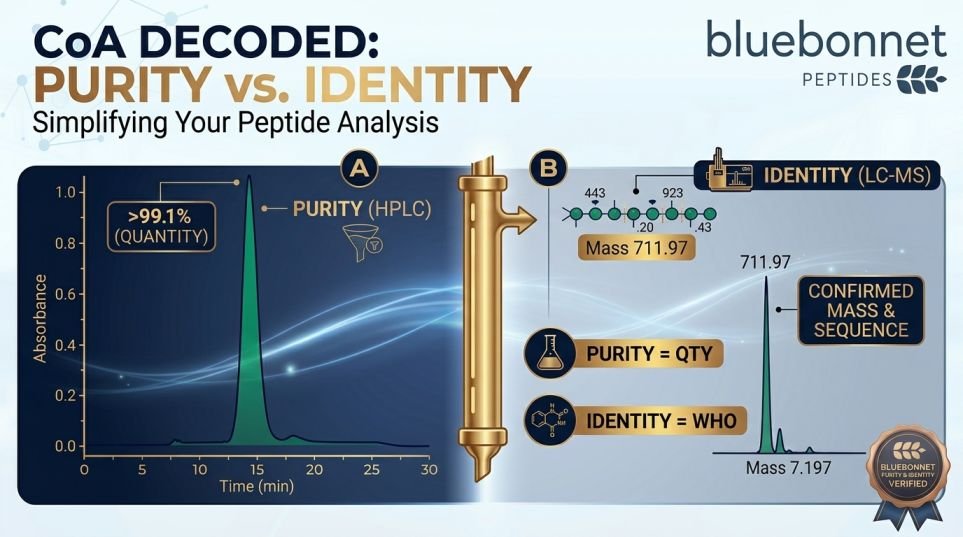
High-Performance Liquid Chromatography is the industry standard for measuring peptide purity. The technique separates the target peptide from synthesis byproducts, deletion sequences, and degradation products, producing a chromatogram that shows exactly what proportion of the sample is the intended compound.
For research applications, the standard is ≥98% purity, with ≥99% expected for publication-grade work.
What to look for
- A purity percentage tied to a specific lot number
- The actual chromatogram, not just a number on a page
- A single dominant peak (multiple significant peaks indicate impurities)
- Testing performed on the final lyophilized product, not just pre-lyophilization solution
A purity claim without a chromatogram is a claim you can’t verify. Reputable suppliers publish both.
Related Reading
- HPLC Testing for Peptides: A Comprehensive Guide
- Understanding Peptide Purity: What Does 99%+ Really Mean?
3. LC-MS Identity Confirmation
HPLC tells you how pure the sample is. It doesn’t tell you what the sample is.
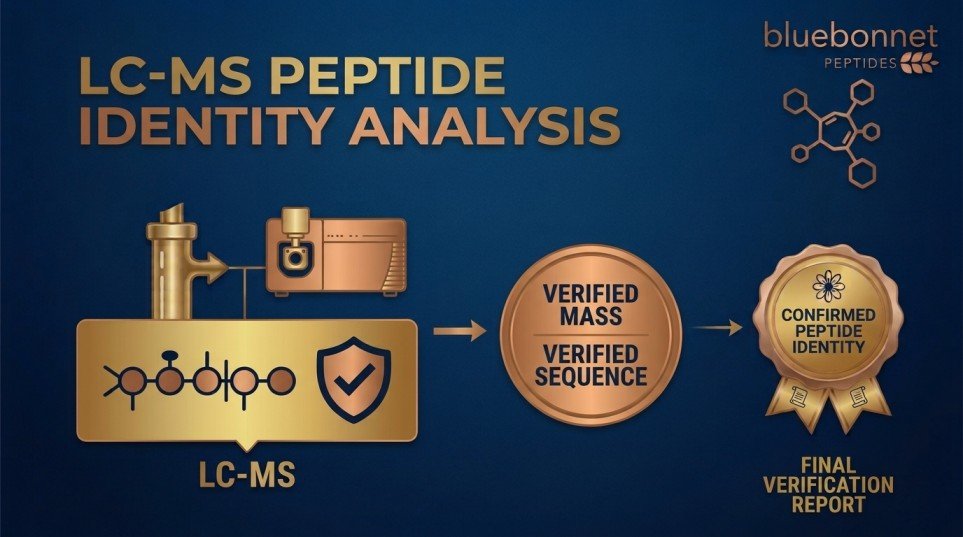
Liquid Chromatography-Mass Spectrometry (LC-MS) confirms molecular identity by measuring the compound’s molecular weight and matching it against the expected value for the target sequence. This catches the failure mode HPLC can’t: a perfectly pure vial of the wrong peptide.
Why it matters
- Mislabeled or mis-synthesized sequences pass HPLC purity checks undetected
- Mass spec confirms the compound in the vial matches the compound on the label
- It detects unexpected modifications, truncations, or adducts
Purity without identity is meaningless. Demand both.
4. Batch-Specific Certificates of Analysis
A Certificate of Analysis (COA) is the official quality record for a specific production lot. Not a generic template. Not a sample document. A lot-specific record whose batch number matches the label on your vial.
A complete COA includes
- Product name and lot/batch number
- Manufacturing and analysis dates
- The testing laboratory’s name, accreditation, and contact information
- HPLC purity percentage with chromatogram
- Mass spectrometry results (observed vs. expected molecular weight)
- Appearance description and, ideally, water content
- Pass/fail specifications and an authorized signature
Related Reading
5. Batch-to-Batch Consistency
Single experiments tolerate small variations. Longitudinal research programs don’t.
If your Austin laboratory runs a twelve-month study, you’ll likely order the same peptide multiple times. Batch-to-batch consistency—verified through consistent QC testing across production runs—is what makes results from month one comparable to results from month twelve.
Ask suppliers directly: What specifications do you hold across batches, and what happens to batches that fall outside them?
Learn more:
Understand how batch-to-batch consistency affects longitudinal research programs.
How to Verify Supplier Documentation Before You Buy
Documentation review takes fifteen minutes and prevents months of compromised research. Here’s the verification protocol Austin laboratories should run before adding any supplier to their approved vendor list.
Step 1: Request a sample COA before ordering
Any legitimate supplier will provide a representative COA on request—many publish their full COA library publicly. Refusal or hesitation is disqualifying.
Step 2: Verify the testing laboratory independently
Take the laboratory name from the COA and confirm
- The lab exists and is searchable online
- Its accreditation is current (check the A2LA or ISO 17025 directories)
- It’s a genuinely independent entity, not a subsidiary sharing the supplier’s address
You can verify their active credentials directly through the A2LA Accreditation Directory
Step 3: Match the numbers
When your order arrives, confirm the lot number on the vial matches the lot number on the COA exactly. A mismatched COA documents a different batch than the one in your freezer.
Step 4: Read the chromatogram, not just the percentage
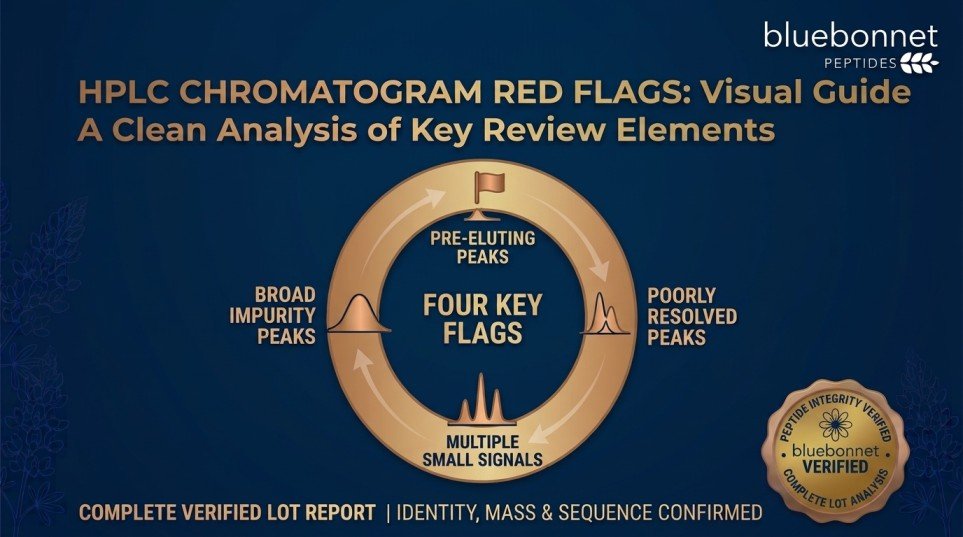
A “99% purity” claim means little without the underlying data. Look for a single dominant peak with minimal secondary peaks. Watch for telltale problems: broad or shouldered main peaks, significant early-eluting peaks, or a noisy baseline.
Step 5: Confirm the date
Testing should be recent relative to the manufacturing date. A COA generated years before your purchase raises questions about inventory age and storage history.
Learn more:
Step-by-step guidance on how to read a Certificate of Analysis.
Laboratory Best Practice: Build a vendor file for each approved supplier containing: sample COAs, accreditation verification screenshots, correspondence about testing methodology, and receiving inspection records for every order. For university laboratories, this file is your audit protection. For private labs, it’s your due-diligence record when results are questioned.
Supplier Evaluation: Red Flags vs. Quality Indicators
Use this comparison when screening any research peptide supplier serving the Austin market.
RED FLAGS — Walk away
- No named third-party testing laboratory
- Generic COAs without lot-specific batch numbers
- Purity claims without published chromatograms
- No mass spectrometry identity confirmation
- “Same-day shipping” on synthesized peptides (indicates skipped QC)
- Prices dramatically below market (indicates lower purity grades or skipped testing)
- Any language implying human use, therapeutic benefit, or dosing guidance
- No physical address or verifiable business presence
QUALITY INDICATORS — Proceed with confidence
- Named, accredited independent testing lab on every COA
- Publicly accessible COA library searchable by lot number
- HPLC chromatograms and LC-MS spectra published with results
- Purity ≥98% with ≥99% available for research-grade material
- Documented synthesis, purification, and lyophilization processes
- Temperature-controlled packaging with expedited shipping options
- Clear “Research Use Only” labeling and compliance language
- Responsive technical support that answers process questions directly
Bluebonnet Insight
Price is a data point, not a decision. When one supplier charges 40% less than the market for the “same” peptide, ask what was removed from the process to reach that price. The answer is almost always one of three things: purification depth, independent testing, or lyophilization quality. Each one transfers cost from the supplier’s budget to your research integrity.
Shipping Research Peptides to Austin: What the Texas Climate Demands
Austin’s climate creates a specific logistics challenge that suppliers—and receiving laboratories—must plan around.
From May through September, Central Texas temperatures routinely exceed 95°F, and packages sitting in delivery vehicles or on loading docks can experience significantly higher internal temperatures. Lyophilized peptides are more stable than solutions, but “more stable” doesn’t mean invulnerable. Sustained heat exposure accelerates degradation even in freeze-dried material, and humidity threatens any vial whose seal is less than perfect.
What proper shipping to Texas looks like
- Insulated packaging: Expanded polystyrene or equivalent thermal insulation, minimum 1-inch wall thickness
- Cold packs: Frozen gel packs sized to transit duration; dry ice for extended or international transit
- Desiccant: Silica gel packets inside the shipper to control moisture from condensation
- Expedited transit: Overnight or 2-day service to minimize total exposure time
- Strategic ship days: Monday through Wednesday departures so packages don’t sit in warehouses over weekends
Receiving protocol for Austin laboratories
When a shipment arrives, inspect it within 15 minutes
- Touch the exterior of the shipper—it should feel cool
- Open immediately and check cold pack status (partially frozen or very cold is acceptable; warm and liquid in summer is a problem)
- Inspect vials for cracks, seal integrity, and proper labeling
- Examine the lyophilized cake—it should be fluffy, white to off-white, and intact, not collapsed, sticky, or discolored
- Confirm lot numbers match your order and COA
- Transfer to -20°C storage within 30 minutes
If you find warm packaging, melted cold packs, clumped powder, or a collapsed cake: photograph everything, contact the supplier within 24 hours, and do not use the material in critical experiments until the issue is resolved.
Learn more:
- Lyophilization explained: why freeze-dried peptides improve research stability
- Peptide storage best practices: maximizing stability before and after reconstitution
- Peptide reconstitution guide for laboratory researchers
Bluebonnet Insight
Let the package rest before you open the vials. A shipment arriving cold into an air-conditioned Austin lab will collect condensation the moment warm room air hits cold glass. Moisture is the enemy of lyophilized powder. Allow sealed vials to equilibrate to room temperature for 15–30 minutes before opening—this single habit prevents one of the most common and most avoidable causes of peptide degradation.
Questions to Ask Before Your First Order
The fastest way to evaluate a supplier is to ask direct questions and grade the answers. Evasive responses are answers too.
Question 1: Who performs your third-party testing, and are they accredited?
Good answer: A specific laboratory name, accreditation body, and an invitation to verify. Bad answer: “Our quality lab” or no answer.
Question 2: Can I see the COA for the exact lot I’ll receive before I order?
Good answer: Yes, with a lot number reserved for your order. Bad answer: A generic sample that doesn’t correspond to any batch.
Question 3: What purity do you guarantee, and what happens to batches that miss specification?
Good answer: ≥99% research-grade, with failed batches re-purified or discarded—never discounted into inventory. Bad answer: Vague ranges or “industry standard” deflections.
Question 4: How do you package shipments to Texas in summer?
Good answer: Insulated shippers, cold packs, expedited service, Monday–Wednesday ship schedule. Bad answer: “Standard shipping.”
Question 5: Where does synthesis and purification occur?
Good answer: Specific facilities, ISO-certified, with preparative HPLC purification. Bad answer: “Various partners” with no detail.
Question 6: What documentation ships with each order?
Good answer: Lot-specific COA, storage guidelines, SDS, and packing documentation. Bad answer: “Everything you need.”
Learn More
Bluebonnet’s Standards for Austin Researchers
Bluebonnet Peptides was built around a simple premise: researchers shouldn’t have to trust us—they should be able to verify us.
For laboratories across Austin and Central Texas, that commitment translates into specific, auditable practices at every stage:
Testing and verification
- Every batch purified by preparative HPLC to ≥99% for research-grade material
- Every batch analyzed by an independent, accredited third-party laboratory
- HPLC purity and LC-MS identity confirmation on every lot
- Lot-specific COAs published in a public library, accessible before you order
Learn More
Quality process
- Controlled lyophilization with water content verification and reconstitution testing
- Type I borosilicate vials sealed under inert atmosphere
- Batch documentation maintained from raw materials through final packaging
Shipping to Texas
- Insulated, temperature-controlled packaging with cold packs and desiccant
- Expedited service with Monday–Wednesday departure scheduling
- Receiving and storage guidance included with every order
Education and transparency
- A full educational library covering testing methodology, COA interpretation, storage, and handling—because an informed customer is the best quality-control partner we have
We don’t ask Austin researchers to take our word for anything. We publish the evidence and let the documentation speak.
Because research demands verification, not promises.
Frequently Asked Questions
Q: Are there research peptide suppliers physically located in Austin, Texas?
A: A small number of Texas companies distribute laboratory chemicals, but nearly all reputable RUO peptide suppliers operate centralized synthesis and testing facilities and ship nationwide. Physical proximity matters far less than verification and cold-chain logistics. A US-based supplier with independent third-party testing, published COAs, and proper insulated, expedited shipping will serve an Austin laboratory better than a local distributor with unverifiable sourcing.
Q: How quickly can research peptides be delivered to Austin?
A: With expedited domestic shipping, most orders reach Austin addresses within 1–3 business days. Responsible suppliers ship early in the week (Monday–Wednesday) so packages don’t sit in transit hubs over the weekend, and use insulated packaging with cold packs to protect material against Central Texas heat during final-mile delivery.
Q: What documentation should accompany my order?
A: At minimum: a lot-specific Certificate of Analysis with HPLC chromatogram and LC-MS confirmation, storage and handling guidelines, and packing documentation matching the lot numbers on your vials. Institutional purchasers at Austin universities should also expect Safety Data Sheets and invoices suitable for procurement audit trails.
Q: How do I verify a supplier’s “third-party tested” claim?
A: Three steps. First, the COA must name the testing laboratory—an unnamed lab is not third-party testing. Second, confirm the laboratory exists and holds current ISO 17025 or A2LA accreditation through the accrediting body’s public directory. Third, confirm the lab is genuinely independent of the supplier. Reputable suppliers welcome this scrutiny; resistant ones fail it.
Q: What purity level do Austin research applications require?
A: For analytical method development, assay work, and publication-grade research, ≥99% purity verified by HPLC is the appropriate standard. Lower grades (crude 60–85%, desalted 85–95%) introduce impurities that create confounding variables. If a supplier offers “90% purity at a discount,” they’re offering you a different product—not a deal.
Q: How should I store peptides in Austin’s climate?
A: Store lyophilized peptides at -20°C for working stock or -80°C for long-term archive, in a manual-defrost freezer away from the door. Keep vials sealed with desiccant, protected from light. Austin’s ambient heat and humidity make disciplined cold storage non-negotiable—never leave vials at room temperature during processing, and allow cold vials to equilibrate before opening to prevent condensation.
Q: What should I do if my shipment arrives warm?
A: Photograph the packaging, cold packs, and vials immediately. Contact the supplier within 24 hours with documentation. Do not use the material in critical experiments until the supplier resolves the issue—reputable suppliers will re-test, replace, or refund shipments with verified temperature excursions. This is exactly why expedited shipping and proper cold-chain packaging matter for Texas destinations.
Q: Can UT Austin and other institutions order through institutional purchasing?
A: Most established RUO suppliers accommodate institutional purchase orders, vendor registration, and W-9/documentation requirements common to university procurement systems. Confirm the supplier can meet your institution’s vendor onboarding requirements before placing the first order—this prevents payment delays and compliance complications.
Q: Why do some suppliers sell the same peptide for significantly less?
A: Price gaps almost always trace to one of three removed costs: purification depth (lower purity grades), independent testing (self-reported results instead of third-party verification), or lyophilization quality (high residual moisture, collapsed cakes). The savings transfer directly into experimental risk. For reproducible research, the hidden cost of cheap peptides is measured in failed assays and repeated work, not dollars.
Q: Does Bluebonnet Peptides ship to Austin?
A: Yes. Bluebonnet ships nationwide from the United States with insulated, temperature-controlled packaging, cold packs, desiccant, and expedited service scheduled for early-week departure. Every order includes a lot-specific, third-party-verified Certificate of Analysis, and our full COA library is publicly accessible before purchase.
Final Thoughts
Austin’s research community has earned its reputation. The work happening at UT Austin, the Dell Medical School, and the city’s growing biotech corridor depends on materials that perform exactly as documented.
Finding high-quality research peptides in Austin comes down to two disciplines
Demand verification. Third-party testing, HPLC chromatograms, LC-MS identity confirmation, and lot-specific COAs are not premium features. They are the baseline for research that survives scrutiny.
Demand logistics that respect the material. Texas heat is unforgiving. Insulated packaging, cold-chain shipping, expedited transit, and disciplined receiving protocols protect your investment between the supplier’s freezer and yours.
The supplier’s address matters less than their evidence. A verifiable COA from an accredited independent laboratory tells you more than any storefront ever could.
Your research deserves peptides whose quality you can prove—not peptides whose quality you’re asked to assume.
Related Reading
- How to Choose a Research Peptide Supplier
- Third-Party Peptide Testing Explained
- Certificates of Analysis: What They Are and Why They Matter
- Understanding Peptide Purity: What Does 99%+ Really Mean?
- How to Read a Certificate of Analysis
- The Journey of a Research Peptide: Manufacturing to Laboratory
- Lyophilization Explained: Why Freeze-Dried Peptides Improve Research Stability
- Peptide Storage Best Practices
- Peptide Reconstitution Guide for Laboratory Researchers
Research Use Only · Not for Human Consumption · Educational Purposes Only
Bluebonnet Peptides provides research-grade peptides to qualified investigators and institutions. All products are for laboratory research use only and are not intended for human consumption, veterinary use, or therapeutic applications. Nothing in this article constitutes medical advice, and no product referenced herein is intended to diagnose, treat, cure, or prevent any disease.

Related posts
HPLC Chromatogram Red Flags: How to Spot Peptide Impurities
LC-MS Peptide Analysis: How Spectrometry Confirms Identity
Peptide Purity: What the Percentage Really Tells You
Peptide Modifications: Guide to Structure & Verification
AI Search Scientific Websites: Building Trust & Authority
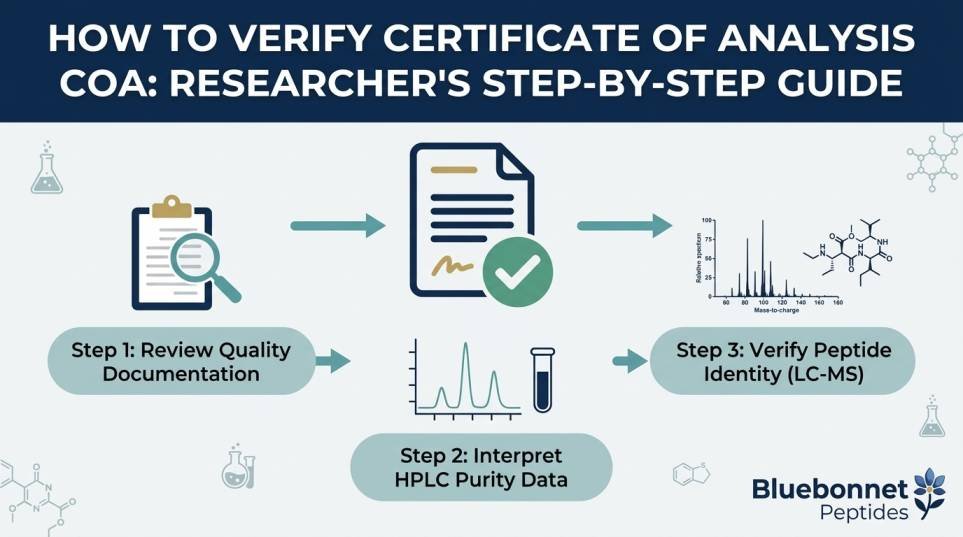
Certificate of Analysis Peptides: Step-by-Step Verification
Research Peptide Supplier Guide: Lab Evaluation Checklist
AI Search Scientific Research: Finding Trusted Suppliers
Peptide research Texas: Lab Buyer’s Guide & COAs
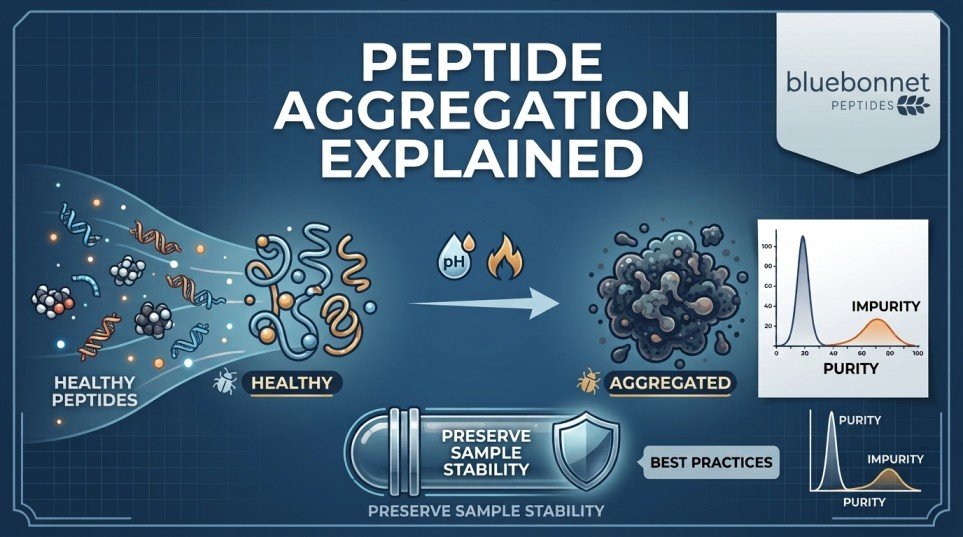
Peptide Aggregation Explained: Causes & Detection

Peptide Sequences Explained: How Amino Acid Structure Determines Research Peptide Identity
Research Peptides Austin Texas: What Every Lab Should Verify
Products
-
 Wolverine (BPC-157/TB-500)
$75.00 – $95.00Price range: $75.00 through $95.00
Wolverine (BPC-157/TB-500)
$75.00 – $95.00Price range: $75.00 through $95.00
-
GHK-Cu
$50.00
-
GLP3-R
$60.00 – $190.00Price range: $60.00 through $190.00
-
BPC-157
$40.00 – $60.00Price range: $40.00 through $60.00


Product categories
YOU MAY ALSO LIKE…
-
Glutathione 1500MG
$70.00
-
KLOW (GHK-Cu/BPC-157/TB-500/KPV)
$145.00
-
B12 Cyanocobalamin
$45.00
-
Wolverine (BPC-157/TB-500)
$75.00 – $95.00Price range: $75.00 through $95.00