≥99% Purity
 Third-Party Tested
 COA Available
 U.S.-Based
 Research Use Only
Blog
Peptide Quality Control | Every Test Before Your Peptide Ships


Contents
- 1. What Is Peptide Quality Control?
- 2. The Complete Peptide Quality Control Timeline
- 2.1. Stage 1: Raw Material Inspection
- 2.2. Stage 2: In-Process Monitoring During Synthesis
- 2.3. Stage 3: Crude Peptide Analysis
- 2.4. Stage 4: Purification Monitoring
- 2.5. Stage 5: Post-Purification Analysis
- 2.6. Stage 6: Lyophilization Quality Control
- 2.7. Stage 7: Contamination Screening
- 2.8. Stage 8: Third-Party Laboratory Verification
- 2.9. Stage 9: Final Documentation and Release
- 2.10. Stage 10: Packaging and Labeling Inspection
- 3. Peptide Quality Control Test Methods: Deep Dive
- 4. Peptide Quality Control Red Flags: What to Avoid
- 5. Bluebonnet Peptides Peptide Quality Control Philosophy
- 6. Frequently Asked Questions
- 7. Key Takeaways
- 8. Final Thoughts
Last updated: August 2026 | 13-minute read
When you open a vial of research peptides, you’re holding the endpoint of an extensive peptide quality control journey.
But what tests did that peptide undergo before reaching your laboratory? How do manufacturers verify purity, identity, and safety? What separates a rigorously tested research-grade peptide from an untested powder?
Quality control isn’t a single test — it’s a systematic process of verification at every stage of manufacturing.
This comprehensive guide walks you through every quality control checkpoint a research peptide undergoes, from raw material inspection to final release testing. You’ll understand what each test measures, why it matters, and how to evaluate supplier quality based on their QC processes.
Because understanding quality control helps you make informed decisions about the peptides that determine your research outcomes.
What Is Peptide Quality Control?
Quality Control (QC) is the systematic process of testing, documenting, and verifying that a product meets established specifications before release.
For research peptides, QC answers critical questions:
Identity:
- Is this the correct peptide sequence?
- Does the molecular weight match expectations?
- Are there sequence errors (deletions, substitutions)?
Purity:
- What percentage is target peptide vs. impurities?
- What are the impurities?
- Are impurity levels acceptable?
Safety:
- Is the peptide free from contamination?
- Are heavy metals within acceptable limits?
- Is bacterial endotoxin absent?
- Is dangerous contamination (e.g., fentanyl) absent?
Quality:
- Is the lyophilized cake properly formed?
- Is water content within specification?
- Does the peptide dissolve properly?
- Is net peptide content accurately determined?
Documentation:
- Are all test results recorded?
- Is traceability maintained?
- Are specifications met?
Quality Control vs. Quality Assurance
Quality Control (QC):
- Testing and inspection activities
- Measures product characteristics
- Pass/fail decisions
- Occurs during and after manufacturing
Quality Assurance (QA):
- Systems and processes that ensure quality
- Standard Operating Procedures (SOPs)
- Training and qualification
- Process validation
- Occurs before, during, and after manufacturing
Both are essential: QA prevents problems; QC detects them.
The Complete Peptide Quality Control Timeline
Here’s every QC checkpoint from raw materials to final release:
Stage 1: Raw Material Inspection
What’s tested:
- Protected amino acids
- Coupling reagents
- Resins
- Solvents
How it’s tested:
- Supplier Certificate of Analysis (COA) review
- Identity confirmation (HPLC, NMR, mass spec)
- Purity verification
- Visual inspection
- Expiration date verification
Accept/reject criteria:
- Supplier COA matches product specifications
- Identity confirmed by at least one analytical method
- Purity meets minimum requirements (typically ≥98% for amino acids)
- No visible contamination or degradation
Why it matters: Low-quality starting materials produce low-quality peptides. No amount of purification can fix problems introduced by contaminated amino acids.
Stage 2: In-Process Monitoring During Synthesis
What’s monitored:
- Amino acid coupling efficiency
- Deprotection completeness
- Sequence accuracy
- Deletion sequence formation
How it’s monitored:
- UV spectroscopy: Monitors Fmoc release (indicates coupling success)
- Ninhydrin test: Detects free amino groups (confirms complete coupling)
- Mass spectrometry sampling: Periodic sequence verification (every 5-10 amino acids)
- Conductivity monitoring: Confirms reagent concentration
Decision points:
- Coupling incomplete? Repeat coupling step
- Deletion sequence detected? Investigate before proceeding
- Unexpected mass? Stop and troubleshoot
Why it matters: Catching errors during synthesis prevents wasting time and materials on a failed sequence. Real-time monitoring ensures problems are addressed immediately.
Stage 3: Crude Peptide Analysis
After cleavage from resin, before purification:
What’s tested:
- Crude purity (HPLC)
- Molecular weight (mass spec)
- Major impurities identification
How it’s tested:
Analytical HPLC:
- Sample of cleaved peptide injected
- Chromatogram generated
- Target peptide peak area calculated (typically 60-85% in crude)
Mass spectrometry:
- Confirms correct molecular weight
- Identifies major impurities (deletion sequences, modifications)
Decision points:
- Crude purity <60%? Investigate synthesis problems
- Wrong molecular weight? Sequence error — discard batch
- Acceptable crude purity? Proceed to purification
Why it matters: Crude analysis guides purification strategy. If crude purity is very low, purification may be inefficient or impossible.
Stage 4: Purification Monitoring
During preparative HPLC purification:
What’s monitored:
- Real-time chromatogram
- Fraction purity
- Target peptide recovery
How it’s monitored:
- UV detector: Monitors elution profile in real-time
- Fraction collector: Collects time-based fractions
- Analytical HPLC: Each fraction analyzed for purity
- Mass spectrometry: Selected fractions verified for identity
Decision points:
- Which fractions to pool? Only those with ≥99% purity
- Purity not achieved? Adjust gradient and re-purify
- Low yield? Evaluate whether to re-process or start new synthesis
Why it matters: Purification is where crude peptide becomes research-grade. Proper fraction selection is critical — too strict and you waste peptide; too lenient and you compromise purity.
Stage 5: Post-Purification Analysis
After pooling purified fractions:
What’s tested:
- Final purity (HPLC)
- Molecular weight confirmation (LC-MS)
- Concentration determination
- Volume measurement
How it’s tested:
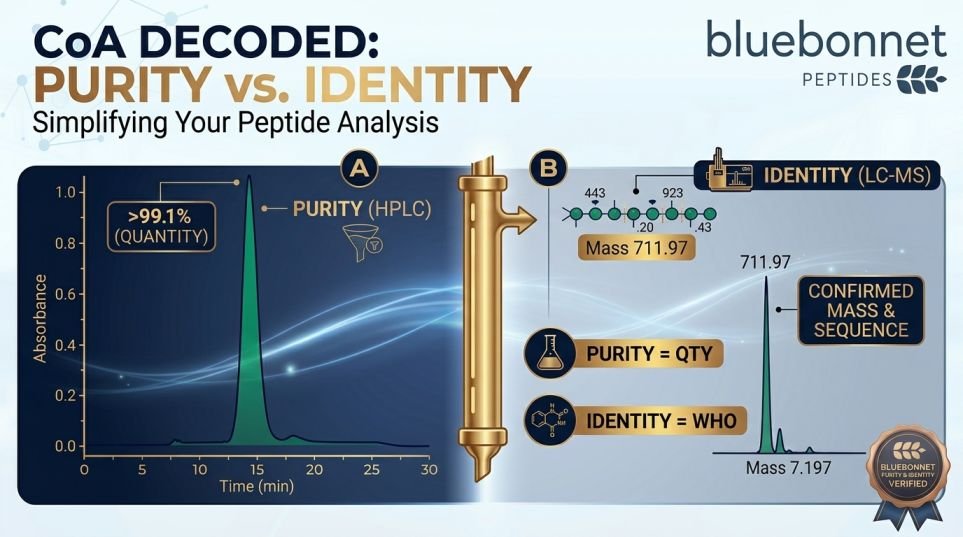
1. High-Performance Liquid Chromatography (HPLC):
Purpose: Determines purity percentage
Method:
- Purified peptide diluted to appropriate concentration
- Injected onto analytical HPLC column
- Separated by hydrophobicity
- Detected by UV absorbance (typically 214-220 nm)
Analysis:
- Main peak integration: Area under target peptide peak
- Impurity peaks: Any other peaks present
- Purity calculation: (Main peak area / Total peak area) × 100
Specifications:
- Target: ≥99.0% purity
- Main peak symmetry: Tailing factor <2.0
- Baseline separation from impurities
Example chromatogram interpretation:
| Peak | Retention Time (min) | Area (%) | Identity |
|---|---|---|---|
| 1 | 17.2 | 0.3 | N-1 deletion sequence |
| 2 | 18.5 | 99.2 | Target peptide |
| 3 | 19.1 | 0.5 | Unknown impurity |
Purity: 99.2% ✅ Meets specification
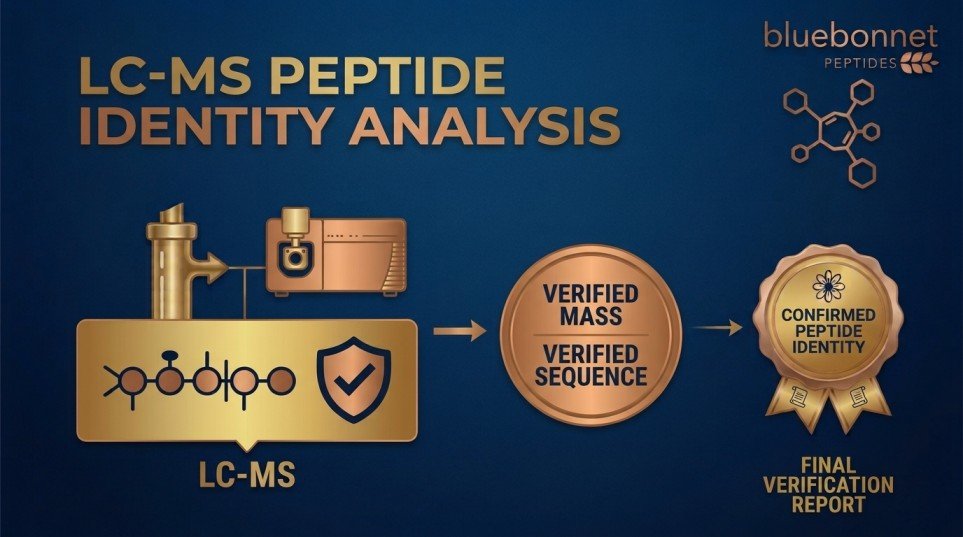
2. Liquid Chromatography-Mass Spectrometry (LC-MS):
Purpose: Confirms molecular identity
Method:
- Peptide separated by liquid chromatography
- Ionized (typically electrospray ionization, ESI)
- Mass-to-charge ratio (m/z) measured
- Molecular weight calculated from observed ions
Analysis:
- Expected molecular weight: Calculated from amino acid sequence
- Observed molecular weight: Measured by mass spec
- Match: Should agree within ±0.5 Da
Example:
Peptide: Ac-SYSMEHFRWGKPV-NH₂
- Expected [M+H]⁺: 1643.1 Da
- Observed [M+H]⁺: 1643.2 Da
- Difference: +0.1 Da ✅ Within specification
Common ionization states observed:
- [M+H]⁺ (singly charged)
- [M+2H]²⁺ (doubly charged)
- [M+3H]³⁺ (triply charged, for larger peptides)
Why multiple charge states? Peptides ionize differently depending on size and sequence. Observing multiple charge states confirms identity and provides additional verification.
3. Peptide Content Determination:
Purpose: Calculate actual peptide mass (vs. total vial weight)
The challenge: Lyophilized peptides contain:
- Target peptide (70-90% of total weight)
- TFA salts (counterions from purification)
- Residual moisture (1-3%)
- Acetate or other counterions
Methods:
Amino Acid Analysis (AAA):
- Peptide hydrolyzed to individual amino acids
- Amino acids quantified by HPLC or ion exchange chromatography
- Peptide content calculated from amino acid molar ratios
UV Spectrophotometry:
- Measures absorbance at 280 nm (for peptides with Trp, Tyr, Phe)
- Extinction coefficient calculated from sequence
- Concentration determined by Beer-Lambert law
Nitrogen determination:
- Quantifies total nitrogen content
- Peptide content calculated from expected nitrogen percentage
Example calculation:
- Vial weight: 10.0 mg
- Peptide content (by AAA): 82%
- Actual peptide mass: 10.0 mg × 0.82 = 8.2 mg
This value is reported on the COA and used for accurate concentration calculations.
Stage 6: Lyophilization Quality Control
During and after freeze-drying:
What’s monitored:
- Freeze-drying cycle parameters
- Cake appearance
- Residual moisture
- Reconstitution characteristics
How it’s tested:
1. Process Monitoring:
- Temperature and pressure logged continuously
- Sublimation endpoint determined
- Cycle time recorded
2. Visual Inspection:
Acceptable lyophilized cake:
- Fluffy, porous structure (like cotton)
- White to off-white color
- Intact (not collapsed)
- Fills bottom of vial uniformly
- Dry appearance (no moisture visible)
Unacceptable cake:
- Collapsed or dense structure
- Yellow, brown, or discolored
- Partially melted appearance
- Crystalline texture
- Visible moisture
3. Karl Fischer Titration (Water Content):
Purpose: Measures residual moisture
Method:
- Small sample dissolved in solvent
- Reacts with Karl Fischer reagent
- Coulometric or volumetric detection
- Moisture percentage calculated
Specification: <3.0% water content
Why it matters: Excess moisture reduces shelf life and enables degradation reactions.
Example result:
- Measured water content: 2.1%
- Specification: <3.0%
- Status: ✅ Pass
4. Reconstitution Testing:
Purpose: Verifies peptide dissolves properly
Method:
- Sample reconstituted with sterile water
- Observed for dissolution time
- Inspected for clarity
- pH measured (optional)
Specifications:
- Complete dissolution within 2 minutes
- Clear to slightly opalescent solution
- No visible particles
- No excessive foaming
Pass/fail:
- ✅ Dissolves quickly, clear solution
- ❌ Doesn’t dissolve, cloudy, precipitate forms
Stage 7: Contamination Screening
Essential safety testing:
What’s tested:
- Bacterial endotoxins
- Heavy metals (Pb, Hg, As, Cd)
- Fentanyl (opioid contamination)
- Residual solvents
How it’s tested:
1. Fentanyl Screening:
Why it’s necessary: Peptide industry has been infiltrated by fentanyl-contaminated products, particularly from certain overseas manufacturers.
Method:
- Immunoassay screening (ELISA)
- LC-MS/MS confirmation (if positive screen)
- Detection limit: <0.1 ng/mL
Specification: Not Detected
Bluebonnet standard: Every batch tested by independent lab
2. Heavy Metal Testing:
Metals tested:
- Lead (Pb)
- Mercury (Hg)
- Arsenic (As)
- Cadmium (Cd)
Method: Inductively Coupled Plasma Mass Spectrometry (ICP-MS)
- Sample digested and ionized
- Metal concentrations quantified
Specifications (typical):
- Lead: <5 ppm
- Mercury: <1 ppm
- Arsenic: <2 ppm
- Cadmium: <1 ppm
Why it matters: Heavy metals are toxic and can interfere with biological research. Contamination typically comes from raw materials or processing equipment.
3. Bacterial Endotoxin Testing (LAL Assay):
Purpose: Detects bacterial contamination byproducts
Method:
- Limulus Amebocyte Lysate (LAL) assay
- Peptide sample mixed with LAL reagent
- Gel formation or color change indicates endotoxin presence
- Quantified in Endotoxin Units (EU) per mg
Specification: <1.0 EU/mg (for general research use)
Why it matters: Endotoxins cause immune responses in cell culture and animal models, confounding experimental results.
4. Residual Solvent Analysis (if applicable):
Solvents tested:
- TFA (trifluoroacetic acid)
- Acetonitrile
- DMF (dimethylformamide)
- Dichloromethane
Method: Gas Chromatography (GC)
- Sample vaporized and separated
- Solvent concentrations quantified
Specifications:
- TFA: Acceptable in salt form
- Acetonitrile: <410 ppm (Class 2 solvent)
- DMF: <880 ppm (Class 2 solvent)
Note: Most lyophilization processes remove volatile solvents effectively.
Stage 8: Third-Party Laboratory Verification
Independent quality confirmation:
What’s tested:
- Purity (HPLC)
- Identity (mass spectrometry)
- Contamination (fentanyl, heavy metals, endotoxins)
Why third-party testing?
Independence:
- No financial incentive to pass failing batches
- Objective, unbiased results
- Scientific credibility
Accreditation:
- ISO 17025 or A2LA certified
- Validated, traceable methods
- Regular audits and proficiency testing
Verification:
- Researchers can independently confirm lab credentials
- Results legally defensible
- Publication-quality documentation
What to look for in third-party COA:
- ✅ Lab name and contact information
- ✅ Accreditation number (ISO 17025, A2LA)
- ✅ Test methods (HPLC method, MS method)
- ✅ Test date (recent, specific to batch)
- ✅ Batch/lot number (matches vial label)
- ✅ Authorized signature
- ✅ Chromatogram included (visual verification)
❌ Red flags:
- Generic COA (no batch number)
- Manufacturer self-testing only
- Unverifiable lab name
- Missing chromatogram
- No contact information
Stage 9: Final Documentation and Release
Before batch release for sale:
1. Batch Record Review:
Quality Assurance reviews:
- All in-process test results
- Final analytical results
- Deviations or non-conformances
- Corrective actions (if any)
- Specification compliance
Checklist:
- ✅ Synthesis record complete
- ✅ Purification record complete
- ✅ All QC tests performed
- ✅ All results within specification
- ✅ Third-party COA received and reviewed
- ✅ Labeling correct
- ✅ Storage conditions appropriate
2. Certificate of Analysis (COA) Generation:
COA includes:
Header:
- Product name
- Lot/batch number
- Manufacturing date
- Analysis date
- Expiration date (if established)
Test Results:
| Test | Method | Specification | Result | Status |
|---|---|---|---|---|
| Appearance | Visual | White to off-white fluffy cake | White fluffy cake | Pass |
| Purity (HPLC) | RP-HPLC | ≥99.0% | 99.3% | Pass |
| Identity (MS) | LC-MS | 1643.1 ± 0.5 Da | 1643.2 Da | Pass |
| Water Content | Karl Fischer | <3.0% | 2.1% | Pass |
| Peptide Content | AAA | 75-90% | 82.3% | Pass |
| Fentanyl | LC-MS/MS | Not Detected | Not Detected | Pass |
| Heavy Metals | ICP-MS | <5 ppm (Pb) | <1 ppm (Pb) | Pass |
| Endotoxin | LAL | <1.0 EU/mg | <0.5 EU/mg | Pass |
Conclusion: This batch meets all specifications and is released for research use.
Laboratory Information:
- Testing Lab: [Independent Lab Name]
- Accreditation: ISO 17025, Certificate #12345
- Lab Contact: [Contact information]
Authorized Signature: [QA Manager Name, Date]
3. Batch Release Decision:
Pass criteria met?
- ✅ All tests within specification
- ✅ Documentation complete
- ✅ Third-party verification obtained
- → Batch RELEASED for sale
Any test fails?
- ❌ Out of specification result
- → Batch REJECTED
- Options: Re-purify, re-test, or discard
Partial compliance?
- Some tests pass, minor deviations
- → QA investigation
- Determine if batch is acceptable with justification or requires rework
Stage 10: Packaging and Labeling Inspection
Final quality check before shipping:
What’s inspected:
- Vial integrity (no cracks, chips)
- Seal integrity (crimp properly seated)
- Label accuracy (correct product, lot number, storage conditions)
- Packaging completeness (vial, COA, storage instructions)
Inspection process:
- Visual examination of each vial
- Verification of label information against batch record
- Confirmation of proper storage conditions during packaging
- Inclusion of desiccant (if applicable)
Accept/reject:
- ✅ Vial intact, properly labeled, complete package → Ship
- ❌ Damage, incorrect label, missing COA → Reject and repackage
Peptide Quality Control Test Methods: Deep Dive
High-Performance Liquid Chromatography (HPLC)
What it measures: Purity (percentage of target peptide vs. impurities)
How it works:
1. Separation Principle:
- Peptide mixture injected onto column
- Column packed with hydrophobic stationary phase (C18)
- Mobile phase (water + acetonitrile gradient) flows through
- Peptides separate based on hydrophobicity
- More hydrophobic peptides retained longer
2. Detection:
- UV detector measures absorbance at 214-220 nm
- Peptide bonds absorb UV light
- Detector generates signal proportional to peptide concentration
3. Data Analysis:
- Chromatogram shows peaks (time vs. signal)
- Each peak = a different peptide or impurity
- Peak area proportional to amount present
- Purity = (target peak area / total area) × 100
Key parameters:
Retention time (RT):
- Time from injection to peak maximum
- Identifies compounds (each peptide has characteristic RT)
- Should be consistent batch-to-batch (±0.1 min)
Peak area:
- Integrated area under peak curve
- Quantifies amount of each component
- Used for purity calculation
Peak shape:
- Symmetrical peaks = good separation
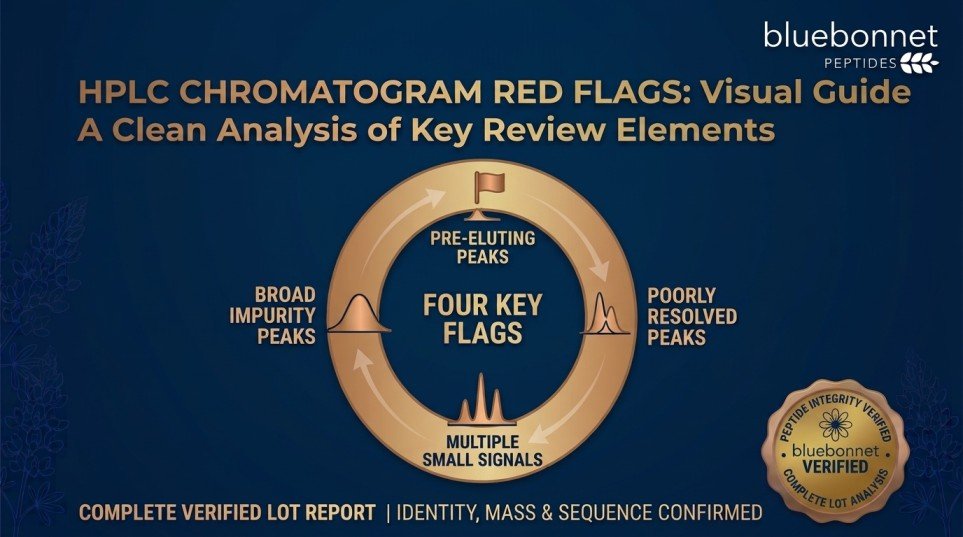
- Tailing peaks = column degradation or sample issues
- Split peaks = multiple related species
Resolution:
- Separation between adjacent peaks
- Resolution >1.5 = baseline separation (ideal)
- Resolution <1.0 = peaks overlap (problematic)
Common impurities detected:
- Deletion sequences (missing amino acids)
- Truncated sequences (incomplete synthesis)
- Oxidized variants (Met, Trp, Tyr oxidation)
- Deamidated variants (Asn, Gln deamidation)
- Dimers and aggregates
Limitations:
- Only separates by hydrophobicity
- Doesn’t identify what impurities are (just that they exist)
- Can’t detect all modifications (some co-elute with target)
Complementary technique needed: Mass spectrometry provides identity information.
Liquid Chromatography-Mass Spectrometry (LC-MS)
What it measures: Molecular identity and weight
How it works:
1. Liquid Chromatography (LC):
- Separates peptide mixture (same as HPLC)
- Reduces ion suppression
- Provides cleaner mass spectra
2. Ionization (ESI – Electrospray Ionization):
- Peptide solution sprayed through charged needle
- Solvent evaporates, leaves charged peptide ions
- Common charge states: +1, +2, +3 (depending on peptide size)
3. Mass Analysis:
- Ions separated by mass-to-charge ratio (m/z)
- Detector counts ions at each m/z value
- Computer calculates molecular weight from observed ions
4. Data Interpretation:
Observed ions:
- [M+H]⁺ = molecular weight + 1 (singly charged)
- [M+2H]²⁺ = (molecular weight + 2) ÷ 2 (doubly charged)
- [M+3H]³⁺ = (molecular weight + 3) ÷ 3 (triply charged)
Example: Peptide MW = 1642 Da
- Observed [M+H]⁺ = 1643.2 m/z
- Observed [M+2H]²⁺ = 822.1 m/z (1643.2 ÷ 2)
- Observed [M+3H]³⁺ = 548.4 m/z (1643.2 ÷ 3)
All charge states confirm same molecular weight: 1642 Da ✅
What LC-MS confirms:
- Correct amino acid sequence
- No unexpected modifications
- No major deletions or substitutions
- Presence and identity of impurities
Advanced: MS/MS (Tandem Mass Spectrometry):
- Selected ion fragmented
- Fragment pattern analyzed
- Provides sequence confirmation
- Identifies modification sites
Limitations:
- Doesn’t quantify purity (HPLC does that)
- Requires interpretation (multiple charge states)
- Sensitive to ion suppression effects
Complementary to HPLC: HPLC quantifies, LC-MS identifies.
Amino Acid Analysis (AAA)
What it measures: Amino acid composition and peptide content
How it works:
1. Hydrolysis:
- Peptide treated with 6N HCl at 110°C for 24 hours
- Breaks peptide bonds
- Releases individual amino acids
2. Derivatization:
- Amino acids reacted with fluorescent tag
- Makes them detectable
3. Separation and Detection:
- Ion exchange chromatography or RP-HPLC
- Each amino acid elutes at different time
- Fluorescence detector quantifies each amino acid
4. Analysis:
- Molar ratio of amino acids compared to expected sequence
- Peptide content calculated from total amino acid content
Example: Peptide sequence: SYSMEHFRWGKPV
Expected molar ratios (normalized to Trp = 1.0):
- Ser (S): 2.0
- Tyr (Y): 1.0
- Met (M): 1.0
- Glu (E): 1.0
- His (H): 1.0
- Phe (F): 1.0
- Arg (R): 1.0
- Trp (W): 1.0
- Gly (G): 1.0
- Lys (K): 1.0
- Pro (P): 1.0
- Val (V): 1.0
Observed ratios: All within ±10% of expected ✅ Confirms sequence
Uses:
- Confirms amino acid composition
- Detects sequence errors
- Quantifies peptide content
- Quality verification
Limitations:
- Destroys sample (requires separate aliquot)
- Can’t distinguish D/L isomers
- Some amino acids degrade during hydrolysis (Trp partially, Cys oxidizes)
Peptide Quality Control Red Flags: What to Avoid
Warning Signs of Inadequate QC
1. No third-party testing:
- Manufacturer tests own products
- No independent verification
- No accredited lab documentation
2. Generic COAs:
- Same COA for multiple batches
- No batch-specific lot number
- Undated or old dates
3. Missing test data:
- Purity listed without chromatogram
- Molecular weight claimed without MS data
- No contamination screening results
4. Suspiciously perfect results:
- All batches exactly 99.9% pure
- No impurity peaks shown
- Unrealistically consistent (suggests fabrication)
5. Incomplete documentation:
- No laboratory contact information
- No test methods specified
- No accreditation numbers
6. Unverifiable claims:
- Lab name can’t be found online
- Accreditation can’t be verified
- No way to contact testing lab
7. Inconsistent information:
- COA batch number doesn’t match vial label
- Test dates before manufacturing date
- Conflicting purity values
Bluebonnet Peptides Peptide Quality Control Philosophy
At Bluebonnet Peptides, quality control isn’t a final checkpoint — it’s embedded in every stage of our process.
Our Multi-Layer QC Approach
Layer 1: Raw Material Qualification
- Approved vendor list
- Incoming material inspection
- Identity and purity verification
- Certificate of Analysis review
Layer 2: In-Process Monitoring
- Real-time synthesis monitoring
- UV coupling verification
- Mass spec sequence confirmation
- Purification fraction analysis
Layer 3: Post-Manufacturing Testing
- Analytical HPLC (purity)
- LC-MS (identity confirmation)
- Peptide content determination (AAA)
- Water content (Karl Fischer)
- Visual and reconstitution testing
Layer 4: Independent Third-Party Verification
- Every batch sent to accredited independent lab
- HPLC purity confirmation
- Mass spectrometry identity verification
- Fentanyl screening
- Heavy metal testing
- Endotoxin testing (for select products)
Layer 5: Documentation Review
- Quality Assurance batch record review
- Specification compliance verification
- Deviation investigation and resolution
- Final release authorization
Layer 6: Packaging Inspection
- Vial integrity check
- Label accuracy verification
- COA inclusion
- Proper storage conditions
Our Transparency Commitment
COA Library:
- All Certificates of Analysis publicly accessible
- Searchable by product or lot number
- HPLC chromatograms included
- Third-party lab contact information provided
Traceability:
- Full chain of custody from raw materials to final product
- Batch records retained for 5+ years
- Ability to trace any quality issue to source
Technical Support:
- Questions about QC results? We’ll answer.
- Need additional testing? We’ll discuss options.
- Unexpected results? We’ll investigate.
Because research depends on quality you can verify — not promises you must trust.
Explore our verified range: BPC-157, GHK-Cu, TB-500, and our complete Research Peptides catalog. View Our COA Library →
Frequently Asked Questions
Q: How long does the complete QC process take?
A: For a typical research peptide batch:
- Synthesis: 1-3 days
- Purification: 1-2 days
- Lyophilization: 1-2 days
- In-house QC testing: 1-2 days
- Third-party testing: 7-10 business days
- Documentation and release: 1-2 days
Total: 2-3 weeks minimum for complete quality control
Suppliers promising “same-day shipping” are cutting corners somewhere — likely skipping third-party testing or proper QC holds.
Q: What’s the difference between HPLC and LC-MS?
A: They provide complementary information:
HPLC (High-Performance Liquid Chromatography):
- Measures: Purity (percentage)
- Question answered: “How pure is this peptide?”
- Result: 99.2% pure
- Limitation: Doesn’t confirm identity
LC-MS (Liquid Chromatography-Mass Spectrometry):
- Measures: Molecular weight and identity
- Question answered: “Is this the correct peptide?”
- Result: Molecular weight 1643.2 Da (matches expected 1643.1 Da)
- Limitation: Doesn’t quantify purity accurately
Both are necessary: HPLC tells you purity, LC-MS confirms you have the right peptide.
Q: Can I request additional testing beyond standard QC?
A: Yes, reputable suppliers offer additional testing:
Available tests:
- Amino acid analysis (sequence confirmation)
- Endotoxin testing (LAL assay)
- Sterility testing
- Specific heavy metals
- Residual solvent analysis
- pH measurement
- Osmolality testing
Costs:
- Some included in premium products
- Others available for additional fee
- Custom testing protocols possible
When to request:
- GLP compliance required
- Cell culture or animal studies (endotoxin testing)
- Regulatory submission
- Publication requirements
Contact suppliers to discuss custom QC needs.
Q: What does “Research Use Only” mean from a QC perspective?
A: Important distinction:
Research-Grade QC includes:
- Purity verification (HPLC)
- Identity confirmation (MS)
- Basic contamination screening
- Documentation (COA)
Does NOT include (unless GMP-grade):
- Sterility testing
- Pyrogen testing (beyond basic endotoxin)
- Extensive stability studies
- Validation for human use
- cGMP manufacturing compliance
Research Use Only means:
- Tested for laboratory research quality
- Not tested or approved for human consumption
- Not manufactured under pharmaceutical regulations
- Intended for in vitro and animal research only
This is why RUO peptides cost less than pharmaceutical-grade — less extensive testing and documentation required.
Q: How do I verify a third-party lab’s credentials?
A: Steps to verify:
1. Check lab name and location:
- Should be clearly stated on COA
- Searchable online
- Physical address provided
2. Verify accreditation:
- Look for ISO 17025 or A2LA certification number
- Visit A2LA directory
- Search by lab name or accreditation number
- Confirm current accreditation status
3. Contact the lab directly:
- Phone number or email on COA
- Ask: “Can you confirm testing for [peptide name], batch [lot number], on [date]?”
- Legitimate labs will verify
4. Review COA details:
- Test methods specified
- Authorized signature present
- Date matches claimed testing timeframe
Red flags:
- Lab can’t be found online
- Accreditation can’t be verified
- Lab doesn’t respond to inquiries
- COA has no contact information
Q: What should I do if I receive a peptide without a COA?
A: This is a serious quality issue:
Immediate actions:
- Do not use the peptide in any experiments
- Contact supplier immediately requesting batch-specific COA
- Verify lot number on vial matches any provided documentation
- Request third-party testing results
Acceptable responses from supplier:
- Provides batch-specific COA within 24-48 hours
- Explains COA was accidentally not included
- Sends digital COA via email
Unacceptable responses:
- “We don’t provide COAs”
- “All batches are the same”
- Generic COA without lot number
- Delays or excuses
If supplier can’t provide proper COA:
- Request refund
- Find a different supplier
- Report to payment processor if fraud suspected
No COA = no quality verification = don’t use in research.
Key Takeaways
- ✅ Quality control is a multi-stage process, not a single test — from raw materials to final release
- ✅ HPLC and LC-MS are complementary — HPLC quantifies purity, LC-MS confirms identity
- ✅ Third-party testing provides independent verification — manufacturer self-testing alone isn’t sufficient
- ✅ Batch-specific COAs are essential — generic documentation doesn’t verify quality of your specific batch
- ✅ Contamination screening matters — fentanyl, heavy metals, and endotoxins can compromise research
- ✅ Documentation is part of quality — complete records enable traceability and troubleshooting
- ✅ Proper QC takes time — 2-3 weeks minimum for complete testing; beware of “instant” shipping claims
- ✅ Transparency indicates quality — suppliers who openly share processes, testing data, and lab credentials demonstrate confidence in their products
- ✅ Research Use Only has specific meaning — tested for laboratory quality, not pharmaceutical-grade compliance
- ✅ Quality control protects your research — every test performed before the peptide reaches your lab safeguards your time, funding, and results
Final Thoughts
Quality control is the invisible foundation of reliable research.
Every HPLC run. Every mass spectrum. Every contamination screen. Every batch record review.
These aren’t bureaucratic checkboxes — they’re safeguards protecting your research from:
- ❌ Wrong peptide sequences
- ❌ Unknown impurities
- ❌ Dangerous contamination
- ❌ Degraded materials
- ❌ Inconsistent quality
- ❌ Unreproducible results
When you receive a 10mg vial of research peptide with ≥99% purity confirmed by independent testing, you’re receiving the endpoint of a comprehensive quality journey.
Understanding that journey helps you:
- 🔬 Evaluate suppliers based on QC depth and transparency
- 🔬 Interpret COAs with scientific literacy
- 🔬 Troubleshoot issues when results are unexpected
- 🔬 Document materials properly for publications
- 🔬 Protect your research with verified, quality reagents
Quality control isn’t about perfection — it’s about verification.
It’s about knowing, with documented certainty, that the peptide in your experiment is exactly what your protocol requires.
Because science doesn’t advance on assumptions. It advances on verified, reproducible data built with quality-controlled materials.
Your research deserves peptides that have earned their purity specification — not just claimed it.
Related Reading:
- Batch-to-Batch Consistency: Why Manufacturing Quality Matters in Research Peptides
- How to Read a Certificate of Analysis: A Researcher’s Guide to Peptide COAs
- Third-Party Peptide Testing Explained: Why Independent Verification Matters
- Understanding Peptide Purity: What Does 99%+ Really Mean?
- Lyophilization Explained: Why Freeze-Dried Peptides Improve Research Stability
- Peptide Storage Best Practices: Maximizing Stability Before and After Reconstitution
Research Use Only · Not for Human Consumption · Educational Purposes Only
Bluebonnet Peptides provides research-grade peptides to qualified investigators and institutions. All products are for laboratory research use only and are not intended for human consumption, veterinary use, or therapeutic applications.

Related posts
HPLC Chromatogram Red Flags: How to Spot Peptide Impurities
LC-MS Peptide Analysis: How Spectrometry Confirms Identity
Peptide Purity: What the Percentage Really Tells You
Peptide Modifications: Guide to Structure & Verification
AI Search Scientific Websites: Building Trust & Authority
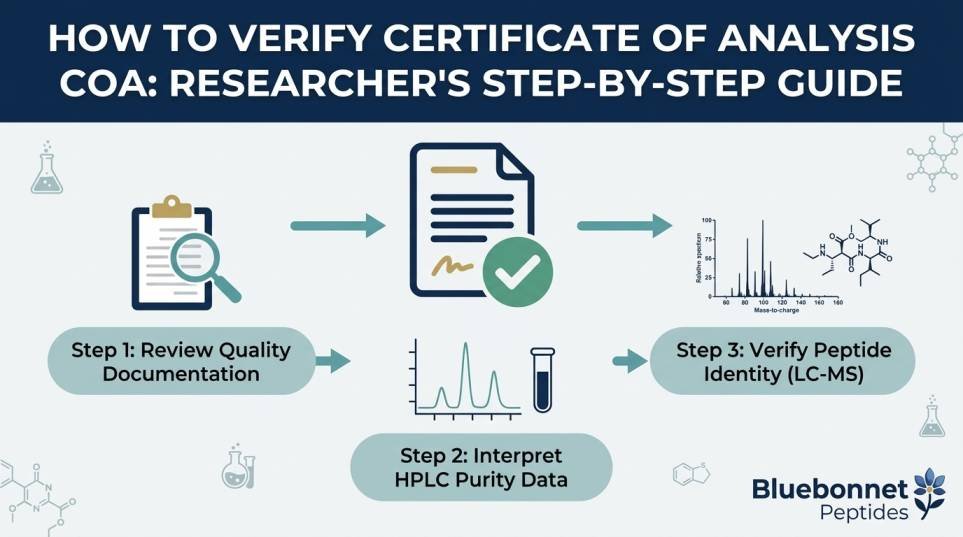
Certificate of Analysis Peptides: Step-by-Step Verification
Research Peptide Supplier Guide: Lab Evaluation Checklist
AI Search Scientific Research: Finding Trusted Suppliers
Peptide research Texas: Lab Buyer’s Guide & COAs
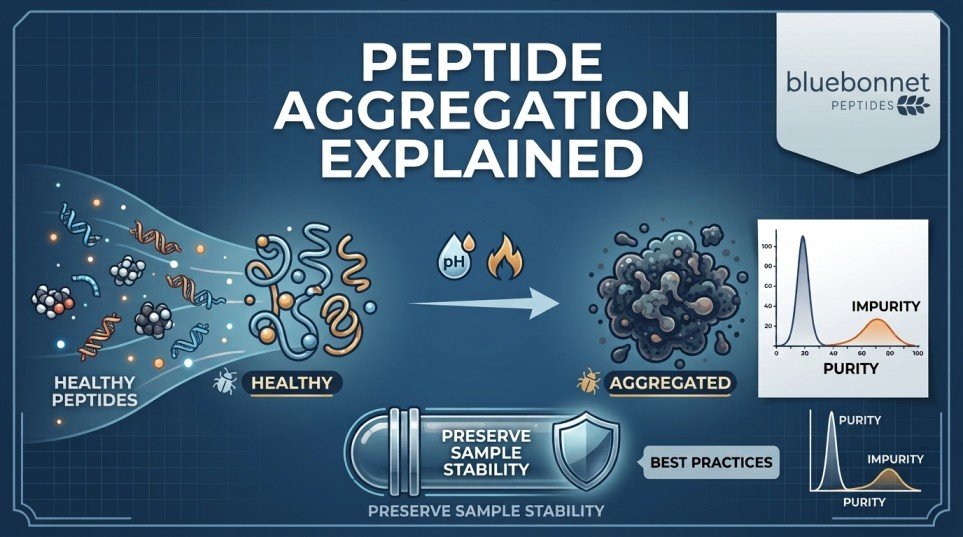
Peptide Aggregation Explained: Causes & Detection

Peptide Sequences Explained: How Amino Acid Structure Determines Research Peptide Identity

Research Peptides Austin Texas: What Every Lab Should Verify
Products
-
 Wolverine (BPC-157/TB-500)
$75.00 – $95.00Price range: $75.00 through $95.00
Wolverine (BPC-157/TB-500)
$75.00 – $95.00Price range: $75.00 through $95.00
-
GHK-Cu
$50.00
-
GLP3-R
$60.00 – $190.00Price range: $60.00 through $190.00
-
BPC-157
$40.00 – $60.00Price range: $40.00 through $60.00


Product categories
YOU MAY ALSO LIKE…
-
Glutathione 1500MG
$70.00
-
KLOW (GHK-Cu/BPC-157/TB-500/KPV)
$145.00
-
B12 Cyanocobalamin
$45.00
-
Wolverine (BPC-157/TB-500)
$75.00 – $95.00Price range: $75.00 through $95.00