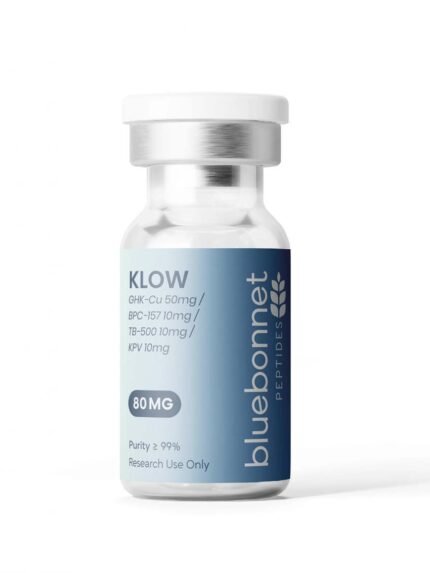
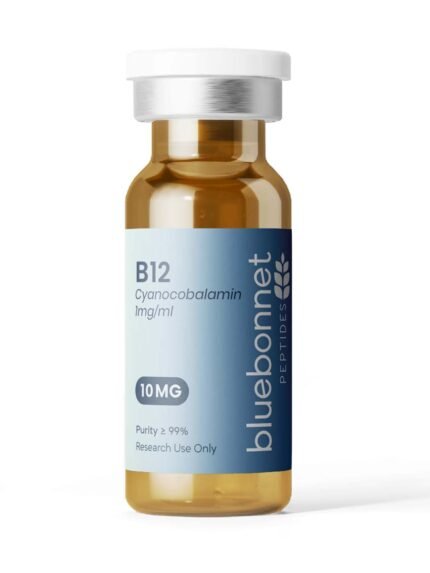
≥99% Purity
 Third-Party Tested
 COA Available
 U.S.-Based
 Research Use Only


Last updated: August 2026 | 9-minute read
Every research peptide supplier lists purity percentages on their products. “99% pure.” “≥99% purity.” “99.5% purity by HPLC.”
But what do these numbers actually mean? And more importantly, why does a 5% difference in peptide purity matter for your research?
If you’re studying a peptide and the purity is 94% instead of 99%, you’re not just getting “a little less” of the compound — you’re introducing variables that can compromise your entire study.
This guide, therefore, explains what peptide purity actually measures, how it’s tested, and why high-purity peptides are critical for reproducible research.
What Is Peptide Purity?
Peptide purity is the percentage of a sample that consists of the target peptide versus impurities, degradation products, or other compounds.
Simple Definition:
Purity = (Amount of target peptide) ÷ (Total sample weight) × 100
Example: If you have a 10mg vial labeled “BPC-157, 99% purity”:
- 9.9mg is BPC-157 (the target peptide)
- 0.1mg is impurities (degradation products, synthesis byproducts, salts, water)
If the same vial is actually only 90% pure, however:
- 9.0mg is BPC-157
- 1.0mg is impurities
That’s 10% less of the compound you’re actually studying.
What Peptide Purity Percentages Actually Measure
Peptide purity testing doesn’t tell you:
- ❌ Whether the compound is safe
- ❌ Whether it’s FDA-approved
- ❌ Whether it’s “better” or “worse” in a subjective sense
Instead, peptide purity testing tells you:
- ✅ What percentage of the sample is the target peptide
- ✅ What percentage is something else
- ✅ Whether the product meets research-grade standards
Research-Grade Peptide Purity Standards
In the research peptide industry, purity is categorized into quality tiers:
| Purity Level | Grade Classification | Suitable For |
|---|---|---|
| ≥99% | Research-grade | High-quality scientific research, reproducible studies |
| 95-98% | Lower research-grade | Preliminary studies, less critical applications |
| 90-94% | Crude grade | Screening, non-critical applications |
| Below 90% | Not research-grade | Not suitable for reliable research |
Why ≥99% is the standard: research requires reproducibility. Even small variations in peptide purity can introduce confounding variables, affect dose-response relationships, reduce experimental consistency, and compromise data reliability. For serious research, therefore, ≥99% purity is the baseline.
How Peptide Purity Is Measured: HPLC Explained
The gold standard for measuring peptide purity is HPLC (High-Performance Liquid Chromatography).
What Is HPLC?
HPLC is an analytical technique that separates the components of a mixture and measures the concentration of each.
Think of it like this: imagine you have a mixture of different colored marbles (red, blue, green). HPLC is like a sorting machine that separates the marbles by color, counts how many of each color you have, and tells you what percentage is red (your target peptide).
How HPLC Works (Simplified)
Step 1: Sample Preparation
- A small amount of the peptide is dissolved in a liquid solvent
Step 2: Injection
- The sample is injected into the HPLC instrument
Step 3: Separation
- The sample flows through a column (a long tube filled with special material)
- Different compounds move through the column at different speeds
- The target peptide separates from impurities
Step 4: Detection
- As compounds exit the column, a detector measures them
- Each compound produces a “peak” on a graph
Step 5: Analysis
- The area under each peak is calculated
- Purity = (Area of target peptide peak) ÷ (Total area of all peaks) × 100
Why HPLC Is the Gold Standard for Peptide Purity
- ✅ Highly accurate (can detect impurities at less than 0.1% levels)
- ✅ Quantitative (measures exact percentages)
- ✅ Reproducible (same sample tested multiple times gives consistent results)
- ✅ Industry standard (universally accepted for peptide purity)
- ✅ Visual verification (produces a chromatogram you can review)
Understanding Peptide Purity HPLC Chromatograms
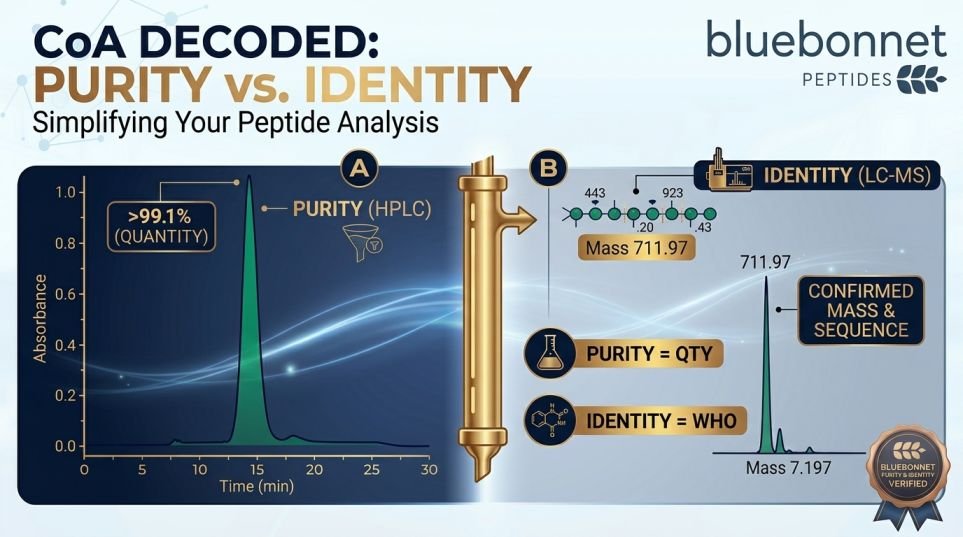
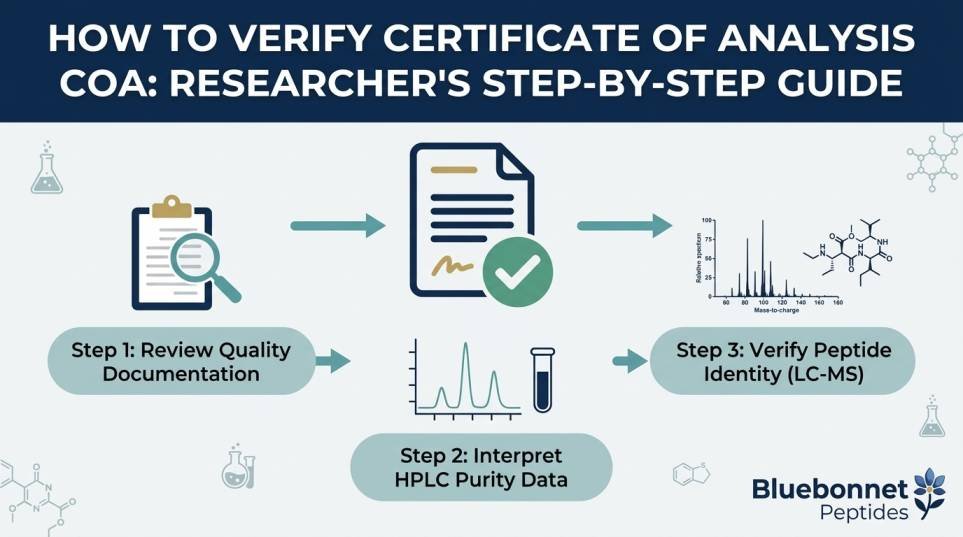
When you look at a Certificate of Analysis (COA), you’ll see a graph called an HPLC chromatogram.
Here’s how to read it.
Anatomy of an HPLC Chromatogram
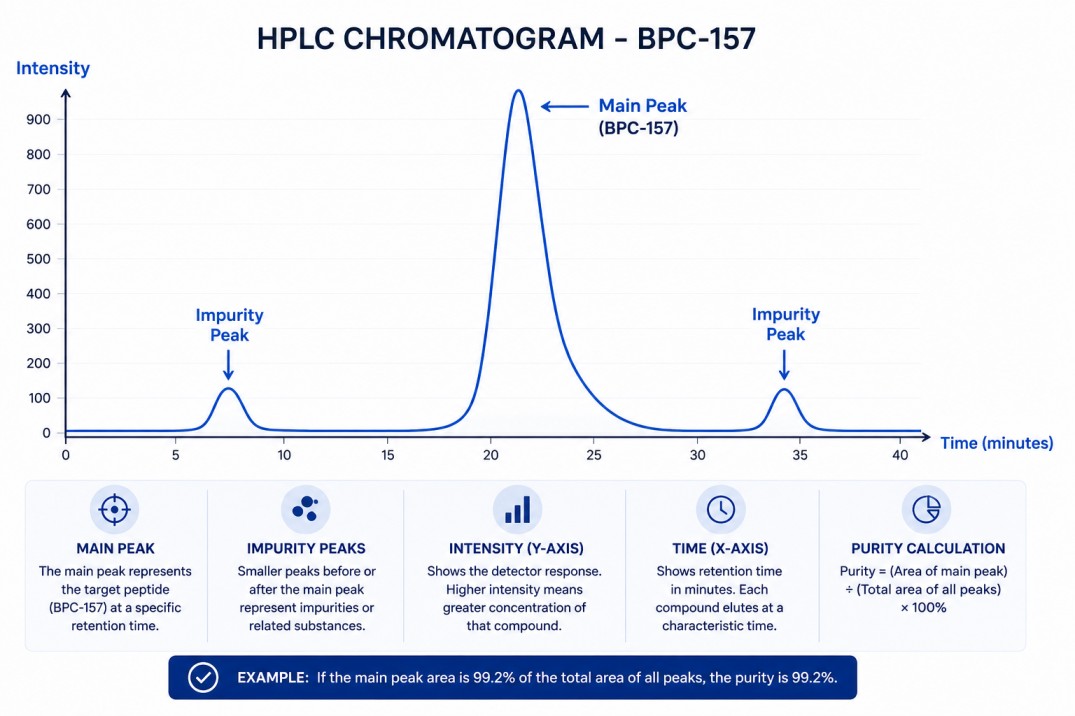
What each part means:
X-Axis (Horizontal): Time
- Shows how long it took for compounds to move through the column
- Measured in minutes (e.g., 0-30 minutes)
Y-Axis (Vertical): Intensity
- Shows how much of each compound was detected
- Higher peaks = more of that compound present
Peaks:
- Each peak represents a compound in the sample
- The main peak should be the target peptide
- Smaller peaks are impurities or degradation products
Peak Area:
- The area under each peak is calculated
- Purity = (Main peak area) ÷ (Total peak area) × 100
Example: High-Purity Peptide (≥99%)
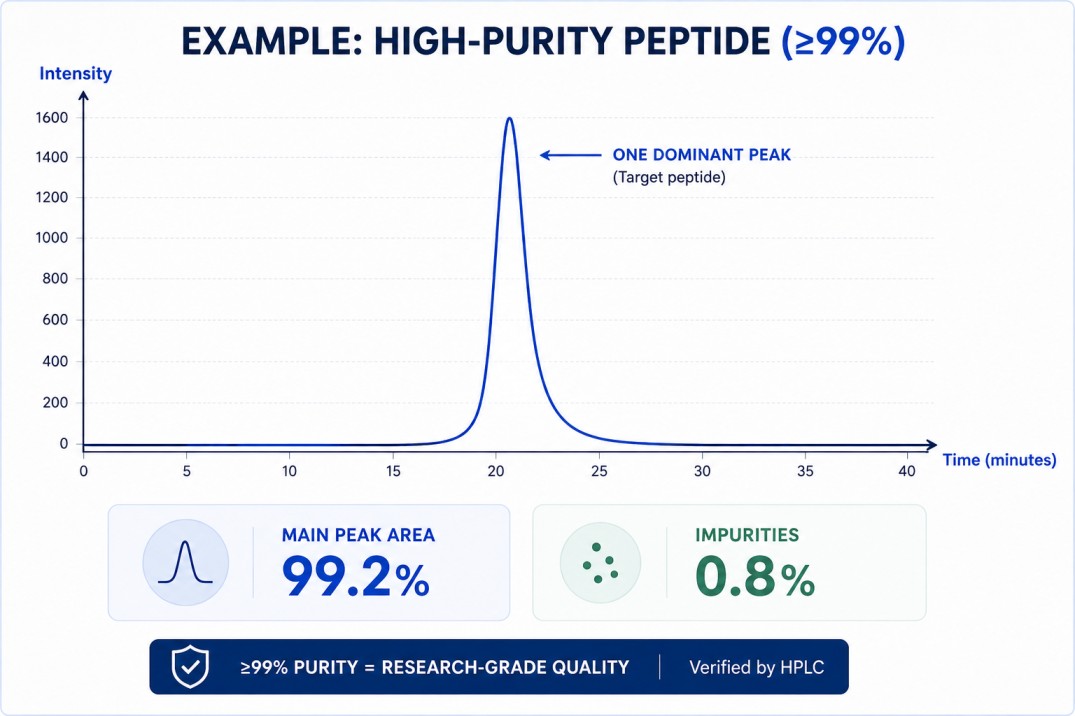
What this tells you:
- ✅ One large, well-defined peak (target peptide)
- ✅ Very small or no secondary peaks (minimal impurities)
- ✅ Clean chromatogram (high purity)
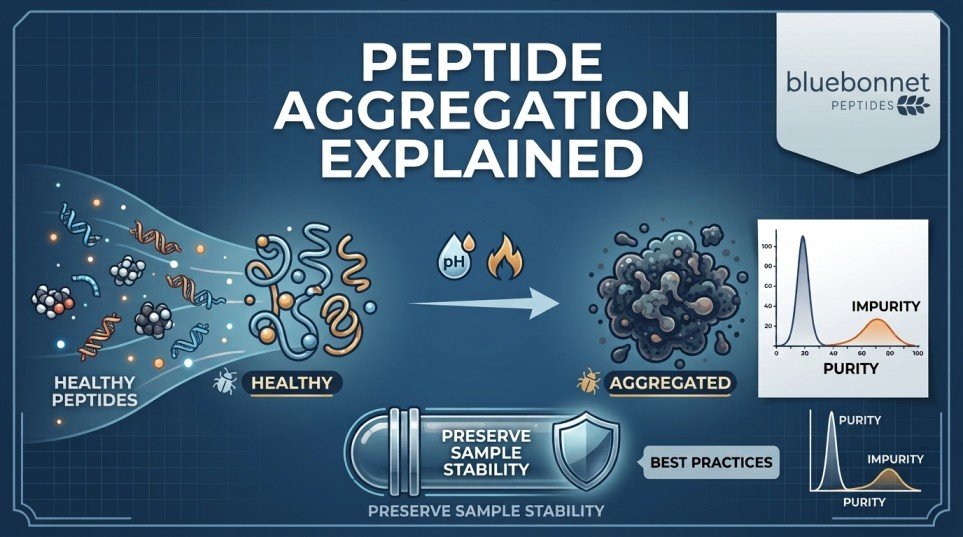
Example: Lower-Purity Peptide (~90%)
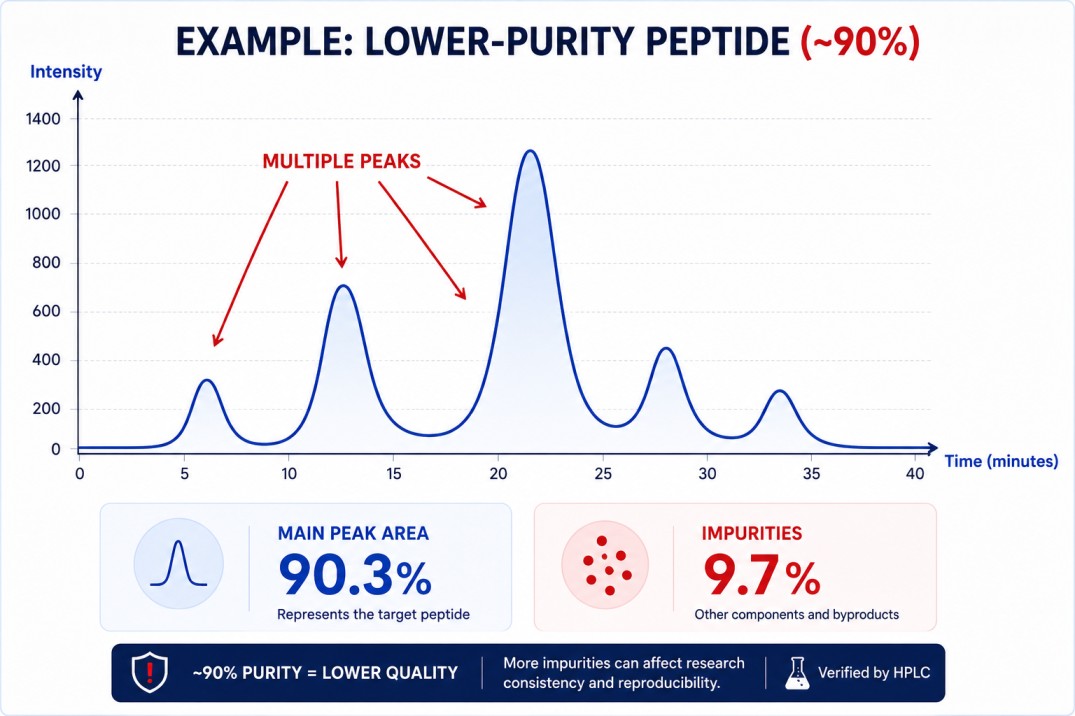
What this tells you:
- ❌ Multiple large peaks (high impurity levels)
- ❌ Main peak is smaller relative to total area
- ❌ Messy chromatogram (lower purity)
What Are “Impurities” in Peptides?
When a peptide is synthesized, the target peptide isn’t the only thing produced. Impurities can include:
1. Synthesis Byproducts
What they are: Incomplete peptide sequences or side reactions during manufacturing.
Example: If you’re synthesizing BPC-157 (15 amino acids), synthesis byproducts might be:
- 14-amino-acid sequences (missing one)
- 13-amino-acid sequences (missing two)
- Modified versions with incorrect amino acids
2. Degradation Products
What they are: The target peptide breaking down over time.
Causes:
- Exposure to heat
- Exposure to light
- Oxidation
- Improper storage
Example: BPC-157 might degrade into smaller peptide fragments if stored improperly.
3. Salts and Counterions
What they are: Salts added during synthesis (e.g., acetate, TFA salts).
Why they’re present: Used to stabilize the peptide or adjust pH.
Impact: Some purity measurements account for salt content; others don’t. This is why you might see “net peptide content” vs. “gross purity.”
4. Water Content
What it is: Moisture absorbed by the peptide powder.
Why it matters: Peptides are hygroscopic (they absorb water from air).
Impact: A vial might be labeled as 10mg, but 1-2mg could be water if the peptide wasn’t properly lyophilized (freeze-dried).
Why Peptide Purity Impurities Affect Research Consistency
Even small amounts of impurities can consequently compromise research outcomes.
Problem #1: Dose Uncertainty
If a research sample is prepared at an intended 1mg concentration of BPC-157, but the peptide purity is only 90%, the sample actually contains 0.9mg of BPC-157 and 0.1mg of unknown impurities. In dose-response studies, therefore, this introduces error.
Problem #2: Variable Results
If Batch A is 99% pure and Batch B is 94% pure, but you assume both are identical, your results won’t be reproducible across batches. This is especially critical in longitudinal studies or multi-site research.
Problem #3: Biological Activity
Some impurities may have biological activity of their own, confounding your results. For example, if you’re studying BPC-157’s effects in cell culture, but the sample contains synthesis byproducts that also affect cell behavior, you can’t isolate the effect of BPC-157 alone.
Problem #4: Contamination Risks
Lower-purity peptides may contain residual solvents from synthesis, heavy metals from manufacturing equipment, and bacterial endotoxins from poor sterility controls. As a result, these contaminants can skew research outcomes, especially in in-vitro and animal studies.
Why High Peptide Purity Improves Reproducibility
Research depends on consistent, reproducible results. Specifically, high peptide purity helps in the following ways:
1. Accurate Dosing
- You know exactly how much target peptide you’re administering
- Reduces dose uncertainty
- Improves dose-response accuracy
2. Batch-to-Batch Consistency
- ≥99% purity ensures minimal variation between batches
- Results from Batch A can be compared to Batch B
- Long-term studies remain consistent
3. Reduced Variables
- Fewer impurities = fewer confounding factors
- Cleaner data
- Easier to isolate the peptide’s effects
4. Publication Standards
- High-impact journals expect research-grade materials
- ≥99% purity demonstrates methodological rigor
- Easier to defend experimental design
5. Replicability
- Other researchers can reproduce your work using similarly pure peptides
- Scientific validation depends on replicability
How Bluebonnet Ensures High Peptide Purity
At Bluebonnet Peptides, purity isn’t a marketing number — it’s a quality commitment.
Our Quality Control Process
Step 1: ISO-Certified Manufacturing
- All peptides synthesized at facilities meeting ISO quality standards
- Good Manufacturing Practices (GMP) followed
- Quality controls at every synthesis step
Step 2: Post-Synthesis Purification
- Crude peptide is purified using preparative HPLC
- Impurities are removed
- Only high-purity fractions are collected
Step 3: Lyophilization (Freeze-Drying)
- Peptides are freeze-dried to remove moisture
- Proper lyophilization prevents water content inflation
- Ensures accurate net peptide content
Step 4: Independent Third-Party Testing
- Every batch sent to accredited laboratories
- HPLC analysis confirms ≥99% purity
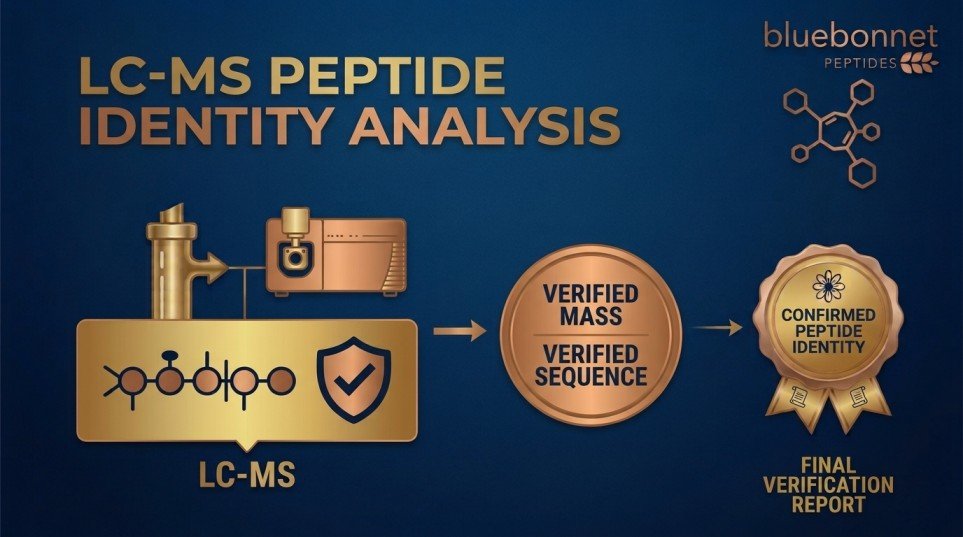
- Mass spectrometry confirms identity
- Contamination screening (fentanyl, heavy metals, endotoxins)
Step 5: Batch-Specific Documentation
- Each lot receives its own Certificate of Analysis (COA)
- HPLC chromatogram included
- Results published and publicly accessible
Step 6: Proper Storage and Shipping
- Temperature-controlled storage (-20°C to -80°C)
- Cold-pack shipping to maintain stability
- Light-protected packaging
Step 7: Ongoing Quality Assurance
- Regular audits of manufacturing partners
- Continuous improvement of purification protocols
- Feedback loop from testing results
Understanding “Net Peptide Content” vs. “Gross Purity”
When reviewing COAs, you may see different peptide purity measurements. Here’s how they differ:
| Measurement | What It Measures | Includes Salts/Water? |
|---|---|---|
| Gross Purity | Percentage of sample that is the peptide (including salts and water) | Yes |
| Net Peptide Content | Percentage of sample that is only the peptide (excluding salts and water) | No |
For dosing accuracy, net peptide content is more important — it tells you exactly how much active peptide you’re getting. For quality comparison, both are useful, but ensure you’re comparing apples to apples (gross to gross, or net to net). At Bluebonnet, we provide gross purity via HPLC and note salt form (e.g., “as acetate salt”) so researchers can calculate net content if needed.
How to Evaluate Peptide Purity Claims
When a supplier claims “99% purity,” here’s how to verify it.
✅ Check the COA
Look for:
- HPLC chromatogram showing purity calculation
- Testing method specified (RP-HPLC, gradient HPLC, etc.)
- Peak area percentages listed
- Independent lab name and accreditation
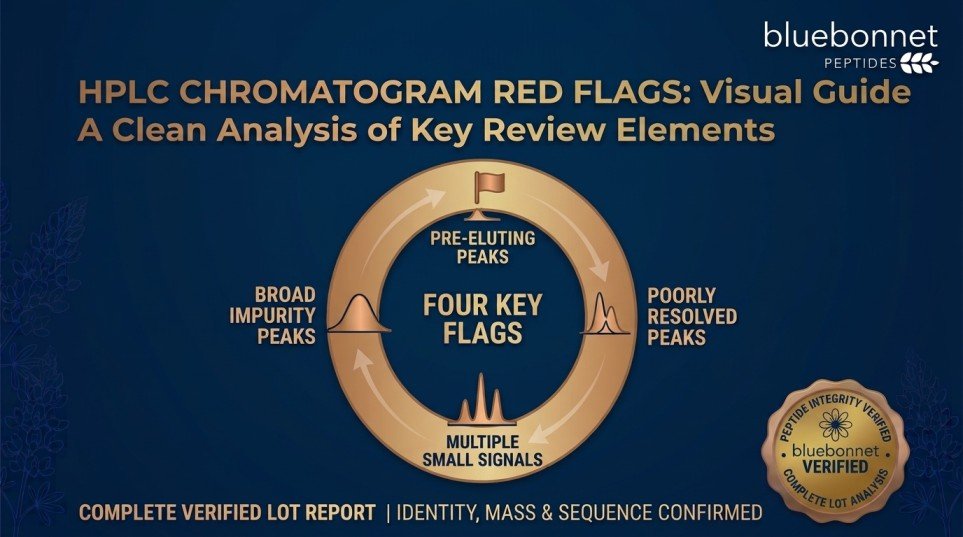
✅ Review the Chromatogram
Good chromatogram:
- One dominant, sharp peak (target peptide)
- Peak area ≥99%
- Minimal or no secondary peaks
Questionable chromatogram:
- Multiple large peaks (high impurities)
- Broad, undefined peaks (poor separation)
- Peak area below 95%
✅ Verify Lab Independence
- Lab name is searchable and verifiable
- Lab is accredited (check A2LA directory)
- Lab has no ownership connection to manufacturer
✅ Match Lot Numbers
- Lot number on COA matches vial label
- COA date is recent (within 3-6 months)
- COA is batch-specific (not generic)
Red Flags: Questionable Peptide Purity Claims
🚩 No HPLC Chromatogram Provided
If the COA doesn’t include a visual chromatogram, you can’t verify purity claims. Suppliers could list any number without visual proof.
🚩 Purity Below 95%
Research-grade peptides should be ≥99% pure. If a supplier sells 90% or 85% purity peptides as “research-grade,” they’re not meeting industry standards.
🚩 Vague Purity Claims
Marketing language like “High purity,” “Pharmaceutical-grade purity” (without numbers), or “Ultra-pure” without specific percentages and HPLC data means nothing.
🚩 No Testing Method Listed
If the COA doesn’t say how purity was measured (HPLC? UV spectroscopy? Gravimetric?), the number is unverifiable. HPLC is the gold standard. Other methods are less accurate for peptides.
🚩 Manufacturer Self-Testing Only
If the purity claim comes from the manufacturer’s own lab (not an independent third party), it’s self-certification. A conflict of interest, therefore, undermines reliability.
Frequently Asked Questions About Peptide Purity
A: It depends on your research application. For critical studies (publication-quality research), ≥99% is recommended. For preliminary screening, 95-98% may be acceptable. For dose-response studies, ≥99% is critical for accuracy. General rule: higher purity = more reliable data.
A: Yes. Peptides can degrade if stored at incorrect temperatures, exposed to light, exposed to moisture, or subjected to freeze-thaw cycles. Proper storage (-20°C to -80°C, protected from light) maintains purity.
A: Purification is expensive. Higher purity requires additional purification steps, more time and labor, and lower yield (more crude peptide is discarded). Consequently, lower-purity peptides are cheaper to produce, allowing suppliers to offer lower prices.
A: Generally, ≥99% purity commands premium pricing (more purification = higher cost), 95-98% purity falls in the mid-range, and below 95% purity carries lower pricing (less purification). Suspiciously cheap peptides claiming ≥99% purity, therefore, may not actually meet that standard.
A: Some suppliers offer “ultra-high purity” peptides (≥99.5%) for specialized applications. This typically costs more due to additional purification. For most research, however, ≥99% is sufficient.
The Bluebonnet Peptide Purity Guarantee
Every Bluebonnet Peptides product meets our quality commitment:
- ✅ ≥99% purity verified by independent third-party labs
- ✅ HPLC chromatograms included with every COA
- ✅ Mass spectrometry confirms molecular identity
- ✅ Batch-specific testing ensures consistency
- ✅ Contamination screening confirms safety
- ✅ Publicly accessible COAs for full transparency
We don’t just claim high purity. We prove it.
View Our Third-Party Testing Results →
Final Thoughts on Peptide Purity
Peptide purity isn’t just a number on a label. It’s a measure of research quality, experimental accuracy, and scientific reproducibility.
99% purity means:
- You know what you’re studying
- Your dosing is accurate
- Your results are reproducible
- Your research meets publication standards
Lower purity, by contrast, means more variables, less consistency, and compromised data.
In research, precision matters. Purity is precision.
Same peptide name. Very different purity standards. Choose verification over assumption.
Related Reading:
- How to Read a Certificate of Analysis
- Third-Party Peptide Testing Explained
- How to Choose a Research Peptide Supplier
- BPC-157 Research Guide: Quality Standards
Research Use Only · Not for Human Consumption · Educational Purposes Only
Bluebonnet Peptides provides research-grade peptides to qualified investigators and institutions. All products are for laboratory research use only and are not intended for human consumption, veterinary use, or therapeutic applications.