Last updated: August 2026
Understanding Peptide Purity: What a Purity Percentage Actually Tells You
Peptide purity is one of the most frequently cited specifications in research peptide documentation — and one of the most frequently misunderstood.
A supplier may state that a research peptide is 98% or 99% pure. That number appears simple. In practice, it describes a specific analytical measurement made under specific conditions, and it does not answer every question a researcher may have about a material.
This guide explains what peptide purity means, what a purity percentage represents, and how researchers can interpret purity information in the context of a peptide Certificate of Analysis (COA).
What Is Peptide Purity?
Peptide purity refers to the proportion of a sample that corresponds to the intended peptide, relative to other detectable components in that sample.
In most research peptide documentation, purity is reported as a chromatographic purity percentage determined by High-Performance Liquid Chromatography (HPLC).
Those other detectable components may include:
- Truncated or deletion sequences produced during synthesis
- Side products formed during coupling, cleavage, or deprotection
- Degradation products
- Residual process-related materials
Purity is therefore a relative measurement. It compares the target peptide against what else the analytical method detected.
What a Purity Percentage Represents
When a COA reports a peptide purity percentage, that figure is typically calculated from peak area on an HPLC chromatogram.
The calculation generally works like this:
Purity % = (area of the main peak ÷ total area of all integrated peaks) × 100
This is why purity is often described more precisely as “HPLC purity” or “chromatographic purity” rather than simply “purity.”
Two implications follow from this:
Purity is method-dependent. Different columns, gradients, detection wavelengths, and run times can produce different results for the same sample.
Purity describes what was detected. Components that do not absorb at the detection wavelength, do not elute within the run time, or co-elute with the main peak may not be represented in the percentage.
Neither point makes purity percentages unreliable. They simply define what the number does and does not describe.
Main Peak vs. Impurity Peaks
An HPLC chromatogram plots detector response against retention time. Components that separate on the column appear as distinct peaks.
Main Peak
The largest peak, typically corresponding to the target peptide. Its retention time should be consistent for a given method, and its area drives the reported purity percentage.
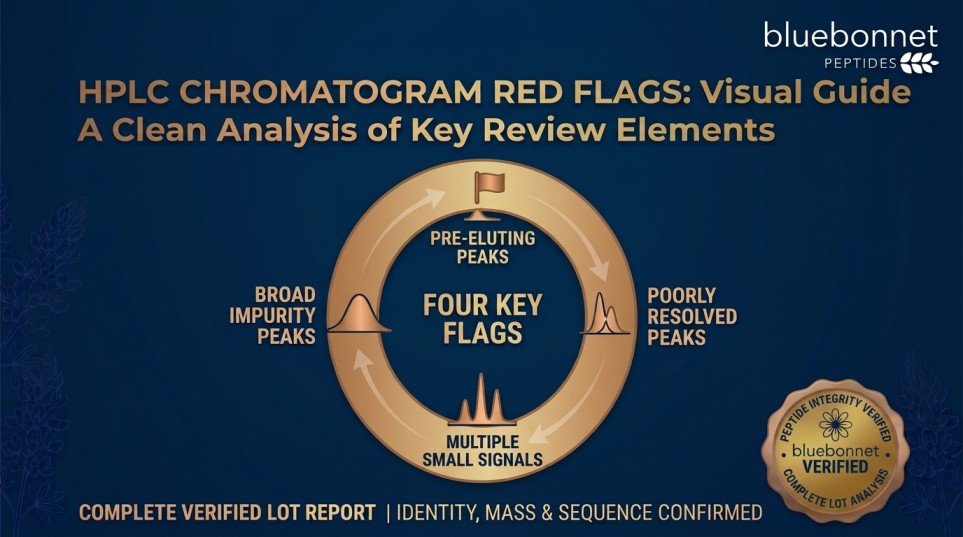
Impurity Peaks
Smaller peaks eluting before or after the main peak. These may represent synthesis-related species, degradation products, or other detectable components.
What researchers should look at:
- Whether one peak clearly dominates the chromatogram
- The number and relative size of secondary peaks
- Whether the main peak is sharp and well-defined or broad and poorly resolved
- Whether the baseline is stable
Related Reading:
How to read a Certificate of Analysis
Why HPLC Is Commonly Used to Assess Purity
HPLC is the standard analytical technique for peptide purity assessment because it separates closely related species efficiently and produces quantifiable, reproducible data.
Reverse-phase HPLC is particularly well suited to peptides because it separates based on hydrophobicity — a property that often differs measurably between a target peptide and its synthesis-related impurities.
Key advantages:
- Quantitative peak area integration
- Good resolution of structurally similar compounds
- Reproducible retention times under defined conditions
- A visual record that can be reviewed independently
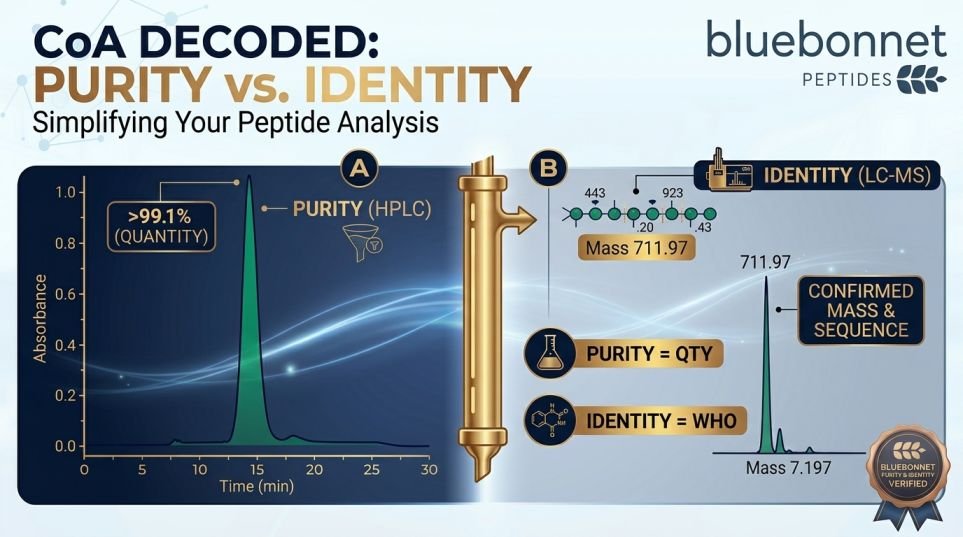
Purity Alone Is Not Identity
This is the most important distinction in peptide analytical documentation.
HPLC purity answers: How much of this sample is one dominant component?
It does not answer: Is that dominant component the peptide named on the label?
A sample can produce a clean chromatogram with a single sharp peak and still be a different peptide than intended. Purity assessment and identity confirmation are separate analytical questions requiring separate methods.
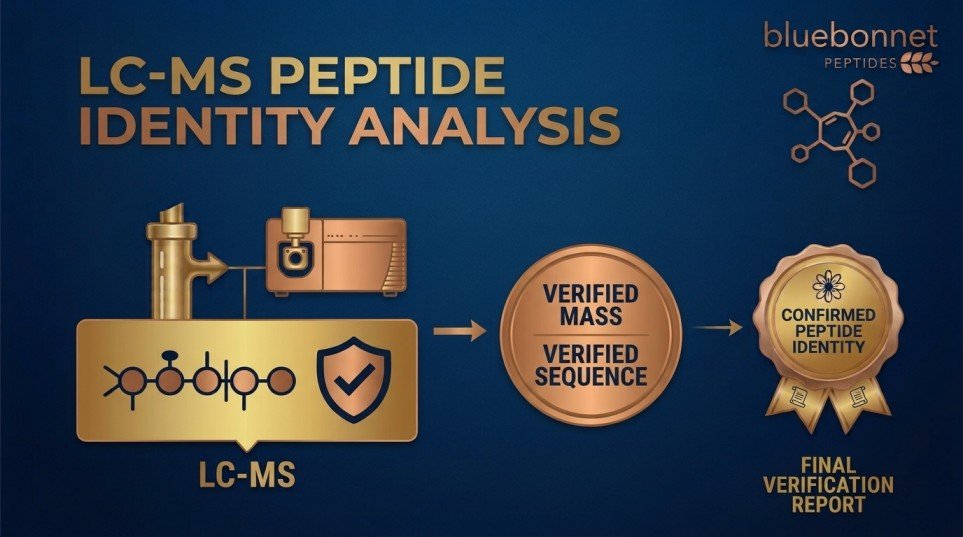
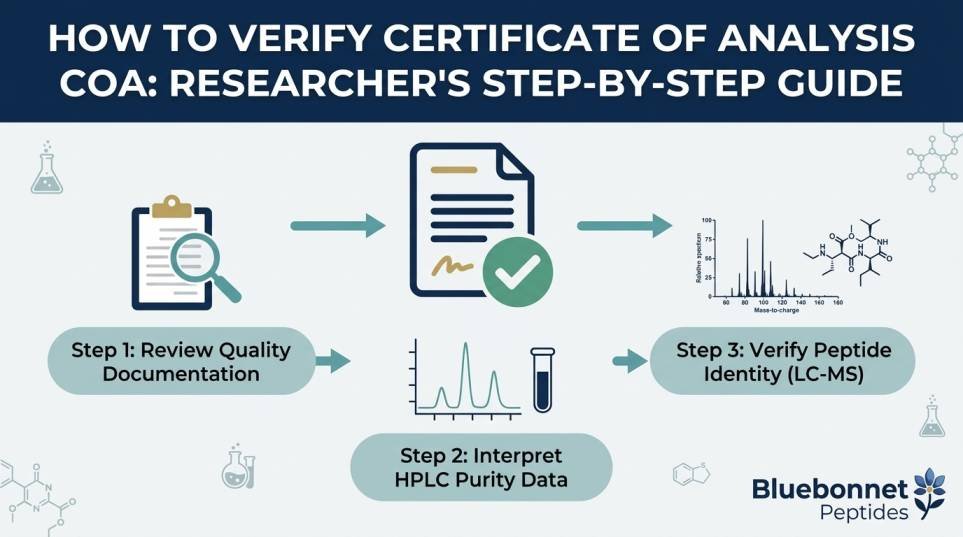
Identity is typically confirmed through mass spectrometry, which measures molecular weight and compares the observed value against the expected value for the target sequence.
Meaningful analytical documentation addresses both purity and identity.
How to Evaluate Purity Information on a COA
When reviewing peptide purity on a Certificate of Analysis, researchers should look for more than a single figure.
Check the following:
Lot or batch number. The purity result should correspond to the specific lot in your possession. A purity percentage that is not tied to a batch number cannot be matched to the material you received.
The chromatogram itself. A stated percentage without the underlying chromatogram cannot be independently evaluated.
Analytical method details. Column type, gradient, detection wavelength, and run time provide context for the result.
Analysis date. Purity is measured at a point in time. The testing date relative to the manufacturing date is relevant context.
Identity data. Purity should appear alongside molecular weight confirmation, not in isolation.
Testing laboratory. Whether testing was performed internally or by an independent laboratory affects how the data should be weighted.
Related Reading:
How to read a Certificate of Analysis
Why Purity Matters for Research Reproducibility
Research reproducibility depends on knowing what was actually used in an experiment.
When purity is documented, verified, and traceable to a specific lot, researchers can:
- Record precisely which material was used in a given experiment
- Compare results across experiments using different lots
- Investigate unexpected results by reviewing starting material quality
- Provide material specifications in methods documentation
- Distinguish material variability from experimental variability
When purity is undocumented or untraceable, unexplained variability becomes difficult to diagnose. Was the difference experimental, or did the material differ between runs? Without lot-specific analytical data, that question often cannot be answered.
Related Reading:
Understanding batch-to-batch consistency
Frequently Asked Questions
Q: What does 99% peptide purity mean?
A: It generally means that under the HPLC method used, the main peak accounted for approximately 99% of the total integrated peak area. It is a chromatographic measurement relative to detected components, not a statement that the sample is 99% of a specific identified compound.
Q: Does high purity confirm the peptide is the correct one?
A: No. Purity describes the proportion of one dominant component. Identity requires a separate method, typically mass spectrometry, which compares observed molecular weight against the expected value for the target sequence.
Q: Can two labs report different purity values for the same sample?
A: Yes. Purity is method-dependent. Differences in column chemistry, gradient, detection wavelength, or run time can produce different peak resolution and therefore different reported values.
Q: Why should I review the chromatogram instead of just the percentage?
A: The chromatogram shows peak shape, baseline behavior, the number of secondary peaks, and their distribution — information a single number cannot convey. Two samples reporting identical purity percentages can have noticeably different chromatographic profiles.
Q: What purity should research peptides have?
A: Requirements depend on the application and the laboratory’s internal standards. Many research workflows specify high-purity material verified by HPLC. The appropriate specification should be determined by the researcher based on the sensitivity of the intended analytical or experimental method.
Research Use Only
All information presented here is for educational purposes. Bluebonnet Peptides supplies research peptides for laboratory research use only. These materials are not for human consumption, veterinary use, or therapeutic application, and are not intended to diagnose, treat, cure, or prevent any disease.
 ≥99% Purity
 Third-Party Tested
 COA Available
 U.S.-Based
 Research Use Only