≥99% Purity
 Third-Party Tested
 COA Available
 U.S.-Based
 Research Use Only

Last updated: July 2026 | 9-minute read
Every research peptide supplier claims third-party testing. However, when you ask for the certificate of analysis, the responses vary wildly.
For instance, some suppliers link batch-specific COAs directly from product pages. Others, by contrast, send generic PDFs with no lot numbers. And in many cases, some provide nothing at all — just vague assurances that “testing was done.”
A certificate of analysis is the one document that separates verifiable quality from marketing claims. But knowing what to look for requires, therefore, understanding what the data actually means.
This guide explains what a COA is, how to read HPLC and mass spectrometry results, and how to spot the red flags that signal a fake or misleading document.
What Is a Certificate of Analysis?
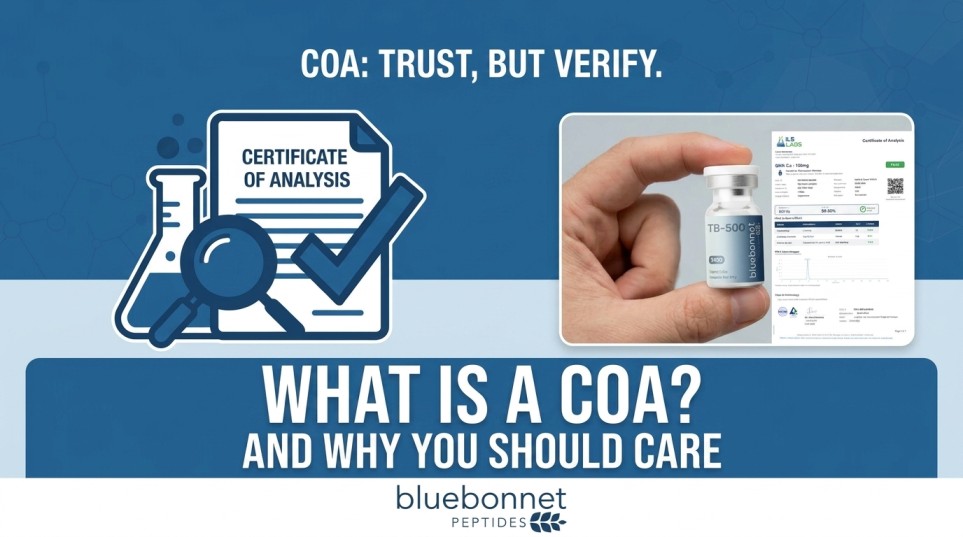
A certificate of analysis (COA) is a laboratory document that reports the results of quality testing performed on a specific batch of product.
For research peptides, a COA typically includes:
- Product name (e.g., BPC-157)
- Lot number (batch identifier)
- Test date
- Testing methods used (HPLC, mass spectrometry, contamination screening)
- Purity percentage (via HPLC)
- Molecular identity confirmation (via mass spec)
- Contamination results (fentanyl, heavy metals, endotoxins)
- Lab name and accreditation
- Pass/fail conclusion
Why a Certificate of Analysis Matters
In research, the quality of your compound directly impacts your results. Specifically, if the peptide you’re studying is:
- 85% pure instead of the claimed 99%
- Contaminated with heavy metals or bacterial endotoxins
- The wrong compound entirely (mislabeled)
- Degraded due to improper storage
…your research outcomes are compromised.
A certificate of analysis, therefore, provides verifiable data that removes guesswork entirely.
Real Certificate of Analysis vs. Fake COA: What to Look For
Not all COAs are legitimate. In fact, the differences between a real and a misleading certificate of analysis can significantly affect your research. Here’s how to tell them apart.
✅ Real Certificate of Analysis:
- Lab Name: Independent, accredited laboratory (verifiable online)
- Accreditation: A2LA, ISO 17025, or equivalent certification
- Lot Number: Matches the lot number on your vial label
- Test Date: Recent (within 3-6 months for current batches)
- Testing Method: HPLC for purity, mass spec for identity
- Purity: ≥99% for research-grade peptides
- Contamination: Fentanyl screening, heavy metals, endotoxins tested
- Chromatogram: HPLC graph showing peaks and purity
- Batch-Specific: One COA per batch, not recycled across batches
❌ Fake or Misleading COA:
- Manufacturer self-testing: Lab is owned by the company that made the product
- No lab name listed: Can’t verify independence or accreditation
- Generic COA: Same document used for multiple batches
- No lot number: Can’t match COA to your specific batch
- Outdated: COA is 1-2+ years old, doesn’t prove current quality
- No testing method listed: Can’t verify how purity was measured
- Purity below 95%: Not research-grade quality
- No chromatogram: Can’t visually verify HPLC results
- No contamination testing: Fentanyl, heavy metals, endotoxins not screened
How to Read a Certificate of Analysis HPLC Purity Test
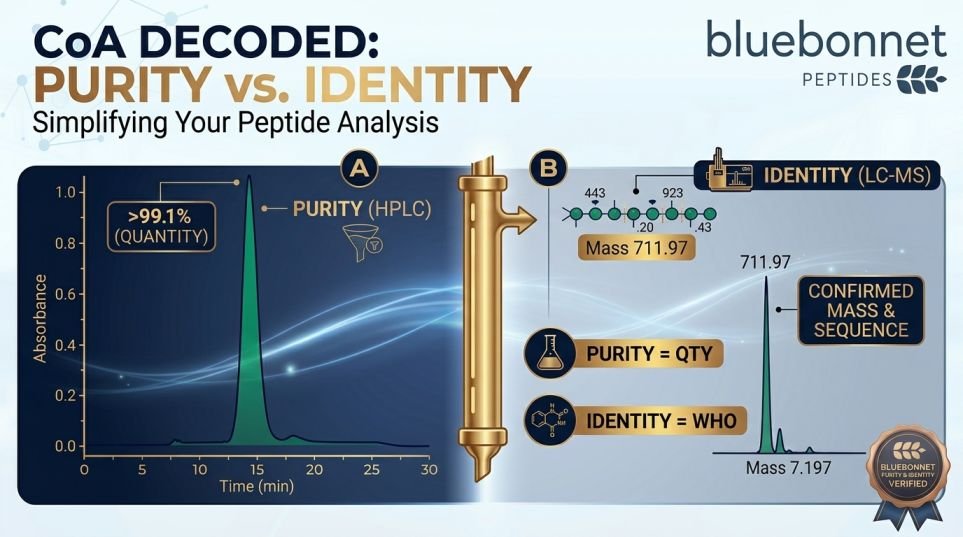
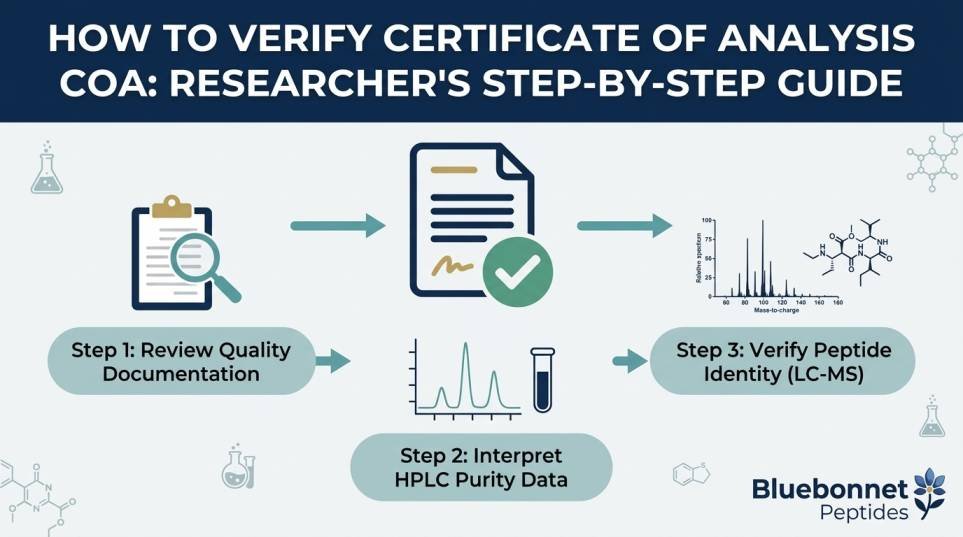
HPLC (High-Performance Liquid Chromatography) is the gold standard for measuring peptide purity.
What HPLC Measures
HPLC separates the components of a sample and measures the concentration of each. For peptides, specifically, this tells you:
- What percentage is the target peptide (e.g., BPC-157)
- What percentage is impurities (degradation products, synthesis byproducts)
Reading an HPLC Chromatogram on a Certificate of Analysis
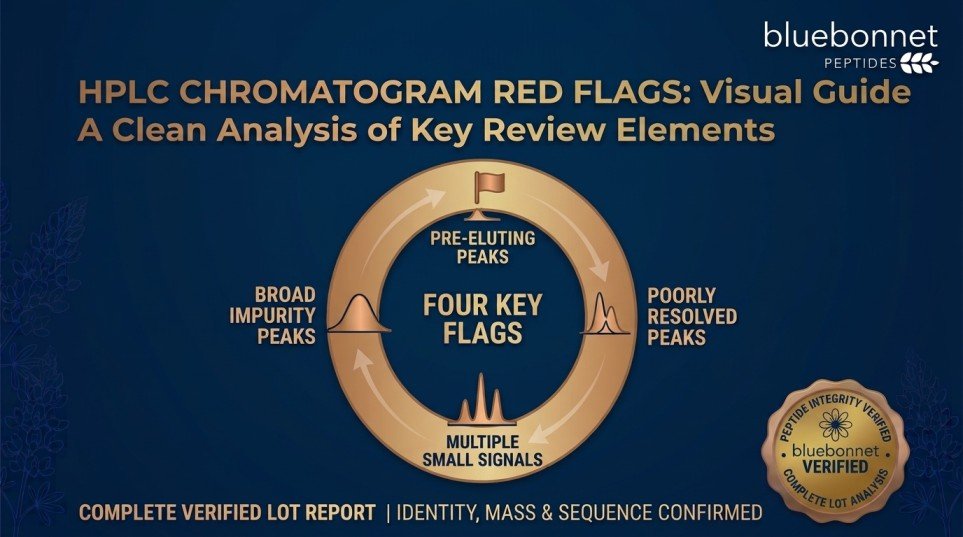
On a COA, you’ll see a graph called a chromatogram. What to look for:
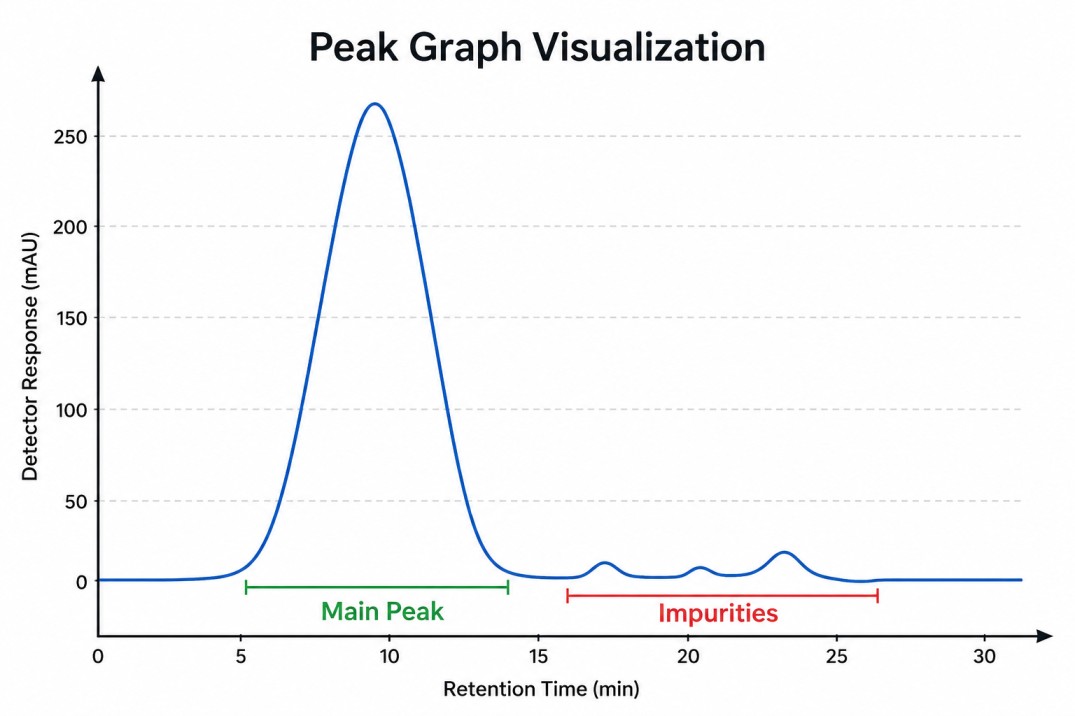
✅ One dominant, well-defined peak:
- This represents the target peptide (e.g., BPC-157)
- Should be tall, sharp, and clearly separated from other peaks
✅ Peak area ≥99%:
- The percentage under the main peak = purity
- Research-grade standard is ≥99%
✅ Minimal secondary peaks:
- Small peaks = impurities or degradation products
- Should be very small compared to the main peak
❌ Red flags:
- Multiple large peaks (high impurity levels)
- Main peak below 95% purity
- No chromatogram provided (can’t verify visually)
Purity Standards Explained
- ≥99% — Research-grade — Scientific research, reproducible studies
- 95-98% — Lower-grade — Preliminary studies (not ideal)
- Below 95% — Not research-grade — Too many impurities for reliable results
How to Read Mass Spectrometry on a Certificate of Analysis
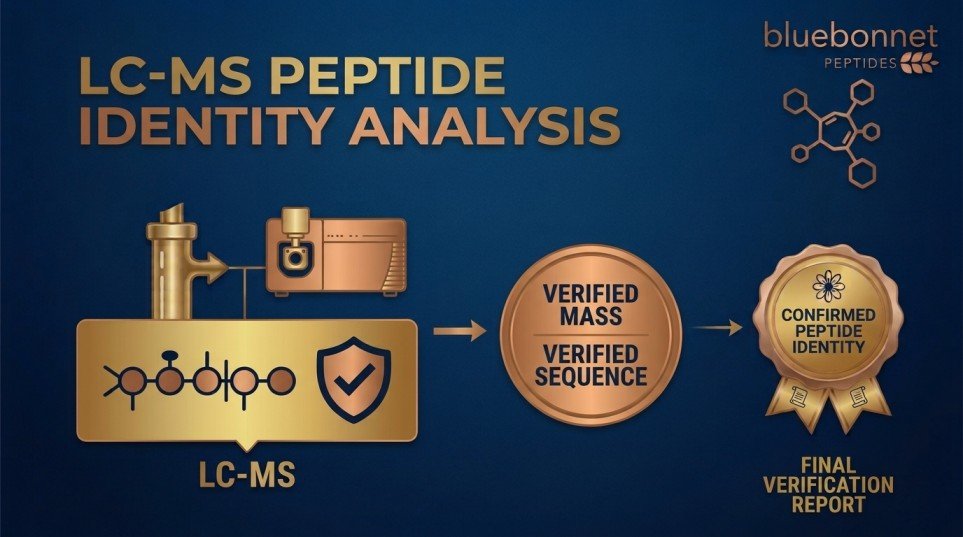
Mass spectrometry (mass spec) confirms the molecular identity of the peptide.
What Mass Spec Measures
While HPLC tells you how pure the sample is, mass spec tells you what it actually is. Mass spec measures the molecular weight of the sample and compares it to the expected value.
For BPC-157 specifically:
- Expected molecular weight: ~1,419 Da (Daltons)
- Observed weight on COA: Should match within ±1-2 Da
Why This Matters on a Certificate of Analysis
Two different peptides could have similar HPLC purity profiles. However, they have different molecular weights. As a result, mass spec confirms:
- ✅ You’re getting the correct peptide (BPC-157, not a different compound)
- ✅ The amino acid sequence matches expectations
- ✅ The product wasn’t mislabeled or substituted
What to look for on the COA:
- ✅ Mass spec results showing molecular weight — e.g., “Observed MW: 1,418.6 Da” — should match expected MW for the peptide
- ✅ Peptide mapping (advanced) — some labs provide amino acid sequence confirmation
❌ Red flags:
- No mass spec data provided
- Molecular weight doesn’t match expected value
- COA only lists HPLC without identity confirmation
Contamination Testing on a Certificate of Analysis: Fentanyl, Heavy Metals, Endotoxins
Purity testing tells you how much of the sample is the target peptide. Contamination testing, however, tells you what else might be in there.
1. Fentanyl Screening
Fentanyl is a synthetic opioid that has been detected in research chemicals sourced from unverified manufacturers. Fortunately, a fentanyl screen is simple and inexpensive, and its presence on the COA shows the supplier prioritizes safety.
What to look for:
- Fentanyl test result listed on COA
- Should read “Not Detected” or “Negative”
Red flag: No fentanyl screening listed — supplier hasn’t considered contamination risks.
2. Heavy Metals Testing
Heavy metals (lead, mercury, arsenic, cadmium) can be present in peptides produced in facilities with poor quality control. Moreover, their presence indicates poor manufacturing standards.
What to look for:
- Heavy metals panel results
- Levels should be below regulatory limits
- Often listed as “< LOQ” (below limit of quantification)
Red flag: No heavy metals testing — unknown contamination risk.
3. Bacterial Endotoxin Testing
Endotoxins are toxins released by bacteria during manufacturing. As a result, their presence can significantly affect cell culture and animal research outcomes.
What to look for:
- Endotoxin test results (measured in EU/mg = endotoxin units per milligram)
- Should be below < 10 EU/mg (typical regulatory limit)
Red flag: No endotoxin testing — potential bacterial contamination.
How to Verify Certificate of Analysis Lab Accreditation
Not all labs are created equal. In fact, some COAs list labs that don’t exist or carry expired accreditation. Therefore, here’s how to verify a lab is legitimate before you trust their documentation.
Step 1: Look Up the Lab Name
First, Google the lab name listed on the COA and visit their website. Then verify:
- ✅ Lab exists and is operational
- ✅ They offer peptide testing services
- ✅ Their accreditation is current
Red flags:
- Lab name isn’t searchable
- No website or online presence
- Lab name is generic (“Testing Lab USA”)
Step 2: Check Accreditation
Next, independent labs should carry accreditation from:
- A2LA (American Association for Laboratory Accreditation)
- ISO 17025 (International Organization for Standardization)
How to verify: visit the A2LA directory, search for the lab name, and confirm their accreditation status and scope.
Red flags:
- Lab isn’t listed in accreditation directories
- Accreditation is expired or inactive
- No accreditation info provided on COA
Step 3: Match Lot Numbers
Subsequently, the lot number on the COA must match the lot number on your vial. This matters because COAs can be recycled or falsified. Consequently, matching lot numbers prove the COA corresponds to your specific batch.
How to verify:
- Check vial label for lot/batch number
- Compare to lot number on COA
- If they don’t match, contact supplier immediately
Red flags:
- No lot number on vial
- No lot number on COA
- Lot numbers don’t match
Step 4: Contact the Lab If Necessary
Finally, if you have doubts about a COA’s authenticity, contact the testing lab directly. Legitimate labs will verify or deny COA authenticity and provide additional documentation if requested.
What to do:
- Find lab contact info (phone or email)
- Provide lot number and COA date
- Ask: “Can you confirm this document was issued by your facility?”
Red flags:
- Lab doesn’t respond
- Lab says they didn’t issue the COA
- Supplier discourages you from contacting the lab
Red Flags: When to Walk Away from a Certificate of Analysis
Here are the deal-breakers. If you encounter any of these, don’t purchase.
🚩 No COA Provided
If a supplier doesn’t offer a certificate of analysis, or only provides one “upon request” after purchase, walk away. In 2026, batch-specific COAs should be standard practice, not an afterthought.
🚩 Manufacturer Self-Testing Only
If the COA is issued by the same company that made the peptides (often overseas manufacturers), it’s not independent verification. Instead, it’s self-certification — grading their own homework.
🚩 Missing or Vague Testing Methods
If the COA doesn’t specify HPLC for purity, mass spec for identity, or any testing methods used, there’s no way to verify the data.
🚩 Purity Below 95%
Research-grade peptides should be ≥99% pure. Consequently, anything below 95% isn’t suitable for serious research.
🚩 No Lot Numbers or Mismatched Lot Numbers
If the COA doesn’t have a lot number, the lot number doesn’t match your vial, or multiple batches share the same COA, the document most likely doesn’t correspond to your batch.
🚩 Outdated COA
If the COA is 6+ months old, from a different production run, or generic and recycled, it doesn’t prove current batches meet the same standards.
How to Request a Certificate of Analysis from a Supplier
If a COA isn’t publicly available, here’s how to request it professionally.
Email Template:
Subject: COA Request for [Peptide Name] – Order #[Order Number]
Hi [Supplier Name],
I’m interested in purchasing [Peptide Name] from your company. Before placing an order, I’d like to review the Certificate of Analysis for the current batch.
Could you please provide:
- Batch-specific COA for the current lot
- Lab name and accreditation information
- HPLC purity results
- Mass spectrometry identity confirmation
- Contamination testing (fentanyl, heavy metals, endotoxins)
Thank you for your transparency.
Best regards,
[Your Name]
What to expect:
✅ Good suppliers will:
- Provide the COA within 24-48 hours
- Include all requested information
- Answer follow-up questions clearly
❌ Red flags:
- Supplier is evasive or slow to respond
- COA is vague or incomplete
- Supplier discourages questions about testing
Bluebonnet Peptides Certificate of Analysis Transparency
At Bluebonnet Peptides, COAs aren’t hidden behind “request” forms or provided only after purchase. Instead, every batch of BPC-157, TB-500, and our complete Recovery Research range goes through the same transparent process:
- Every batch is sent to an independent, accredited third-party lab
- HPLC confirms ≥99% purity
- Mass spectrometry confirms molecular identity
- Fentanyl screening confirms no contamination
- Batch-specific COA is published and remains publicly accessible
- COAs are linked directly from every product page
- Lab name, accreditation, and lot numbers are fully verifiable
We don’t ask you to trust us. We provide the data so you can verify independently.
Frequently Asked Questions About the Certificate of Analysis
A: They’re the same thing. “COA” and “CofA” both stand for Certificate of Analysis. Both terms are used interchangeably in the industry.
A: COAs should be batch-specific. Consequently, every new batch (lot number) should have its own COA. Suppliers should update COAs every time a new batch is produced — typically every 3-6 months for actively sold products.
A: Yes. Legitimate suppliers should be able to provide the original lab report directly from the testing facility. If they can’t, or if they discourage you from verifying, that’s a red flag.
A: This is a red flag. COAs should be transparent and verifiable. If a supplier won’t share testing data before purchase, they’re not prioritizing transparency.
A: No. A manufacturer COA means the company that made the product also tested it. This is a conflict of interest. As a result, independent third-party testing is the only way to verify quality objectively.
A: Real chromatograms show:
✅ Clear axis labels (time, intensity)
✅ Well-defined peaks
✅ Lab name and date
✅ Lot number matching your product
Fake chromatograms, by contrast:
❌ Generic, unlabeled graphs
❌ Stock images (reverse image search can detect this)
❌ No lab or date information
Final Thoughts on the Certificate of Analysis
A certificate of analysis is the difference between verifiable quality and blind trust. Specifically, HPLC confirms purity, mass spectrometry confirms identity, contamination screening confirms safety, and lab accreditation confirms independence.
Together, therefore, these elements provide the data you need to trust your research compound. In research, you can’t afford to wonder whether the peptide you’re studying matches its label. As a result, a legitimate COA removes that question entirely.
Same peptide name. Very different documentation. It’s worth knowing the difference.
Additionally, if you want to go deeper, the related reading below covers the key areas:
- Third-Party Peptide Testing Explained
- How to Choose a Research Peptide Supplier
- BPC-157 Research Guide: Quality Standards
- Research Use Only: What It Actually Means
Research Use Only · Not for Human Consumption · Educational Purposes Only
Bluebonnet Peptides provides research-grade peptides to qualified investigators and institutions. All products are for laboratory research use only and are not intended for human consumption, veterinary use, or therapeutic applications.